QSR Operational Governance vs. Forecourt Foodservice Differentiation: Technology Deployments and Menu Strategy
This analysis contrasts McDonald's tech-driven operating strategies and pricing governance with Bosselman Enterprises' regional forecourt expansion in Iowa, examining how corporate QSR tools and co-branded c-store foodservice models address evolving operational demands.
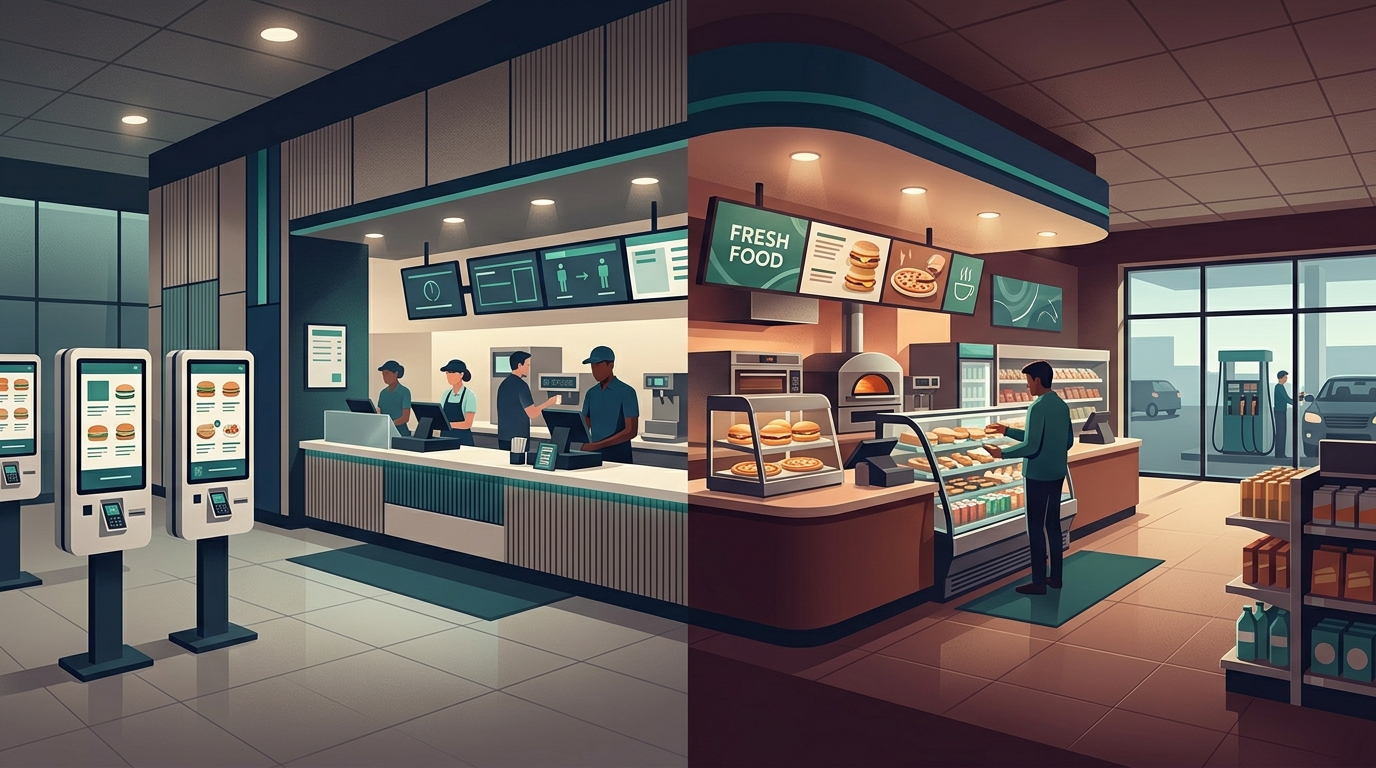
Editorial illustration
Operational Governance and Technology Deployment in QSR Networks
In October 2026, McDonald's addressed public reports concerning its menu pricing architecture, formally denying that it utilizes artificial intelligence to set menu prices or execute real-time dynamic pricing routines. The clarification followed media coverage suggesting that transaction analytics across 14,000 U.S. locations were being processed via AI algorithms to calculate dynamic customer price sensitivity. McDonald's stated that franchisees maintain final authority over menu costs, while the corporation supplies "tools, resources, research and recommendations to help them make informed decisions" based on operational expenses, local competition, and economic factors.
The operational autonomy of franchisees produces localized menu price variation across the system. For example, during the LTO promotion of the Big Arch Burger, item prices varied between $8 and $9 across different store locations. Corporate pricing recommendation tools operate without real-time price changes during peak hours. To protect brand value perception, McDonald's initiated a comprehensive franchisee pricing evaluation at the start of the year to verify consistent value delivery across its location network.
These pricing governance measures align with McDonald's broader technology and operational restructuring under its Next strategy, announced in September 2026. The strategy incorporates an $8.5 billion capital commitment through 2036 to support store modernization, operational improvements, and technology deployment. As part of this platform, McDonald's introduced ArchIQ, an AI-driven operating system designed to process drive-thru voice ordering, automate inventory tracking, and integrate computer vision tools to confirm order assembly accuracy. Digital menu boards are deployed across sites to display dynamic LTO content, daypart-specific menus, and real-time inventory adjustments when items sell out.
Daypart Menu Adaptation and Co-Branded Coffee Strategy in Forecourt C-Stores
In the convenience forecourt sector, regional operators are deploying targeted foodservice strategies to establish local market share. Bosselman Enterprises, ranked No. 142 on CSP's 2026 Top 202 list of U.S. c-store chains by store count, expanded its Pump & Pantry chain into the Des Moines, Iowa market following its acquisition of 21 Hy-Vee Fast & Fresh stores earlier in the year.
To differentiate itself from large regional competitors, Bosselman integrated specialized coffee assets acquired during the transaction, which included five Starbucks counters and seven Smokey Row specialty coffee shops. Under Director of Foodservice Alex Dunn, Pump & Pantry structured its menu around targeted dayparts rather than copying legacy offerings. The retailer paired morning beverage traffic with a dedicated breakfast burrito line and grab-and-go lunchtime wraps for later consumption.
Product development relies on guest feedback channels to isolate core menu items from short-term promotional trends. For instance, a maple-flavored, pancake-type griddle-stack sandwich transitioned into a permanent menu item after receiving positive customer feedback, whereas less popular flavor variations were retired quickly. Furthermore, operational standards at converted locations emphasize visible back-of-house hygiene, utilizing open-kitchen layouts where staff adhere to strict sanitation protocols, uniform policies, hair restraints, and glove usage.
Strategic Analysis: Formulating Hypotheses for Forecourt Operations
*Analyst Note:* The contrasting approaches of QSR corporate technology investments and regional c-store foodservice adaptation highlight two distinct avenues for driving customer retention and ticket growth. While national QSR chains invest heavily in back-of-house operating automation like ArchIQ to optimize drive-thru labor, forecourt operators often rely on differentiated daypart offerings and co-branded beverage anchors.
*Hypothesis 1:* Implementing visible open-kitchen layouts with mandatory employee sanitation standards in forecourt c-stores improves customer perceptions of food safety, resulting in higher repeat purchases of hot prepared menu items compared to standard closed kitchen models. *Proposed Test:* Conduct a 12-month comparative study measuring hot foodservice sales growth and repeat loyalty transactions across ten converted open-kitchen Pump & Pantry stores versus ten legacy closed-kitchen locations within similar demographic zones.
*Hypothesis 2:* Integrating recognized specialty coffee sub-brands (e.g., licensed coffee shops) within convenience stores generates higher morning daypart cross-selling of breakfast food items than standard unbranded self-serve coffee stations. *Proposed Test:* Analyze point-of-sale register data over 180 days across acquired sites featuring Starbucks/Smokey Row counters versus baseline Pump & Pantry locations, calculating the basket attach rate of morning food items per 100 coffee orders.