Forecourt Foodservice Models: Automated Kiosk Trials and Tiered Value Menus
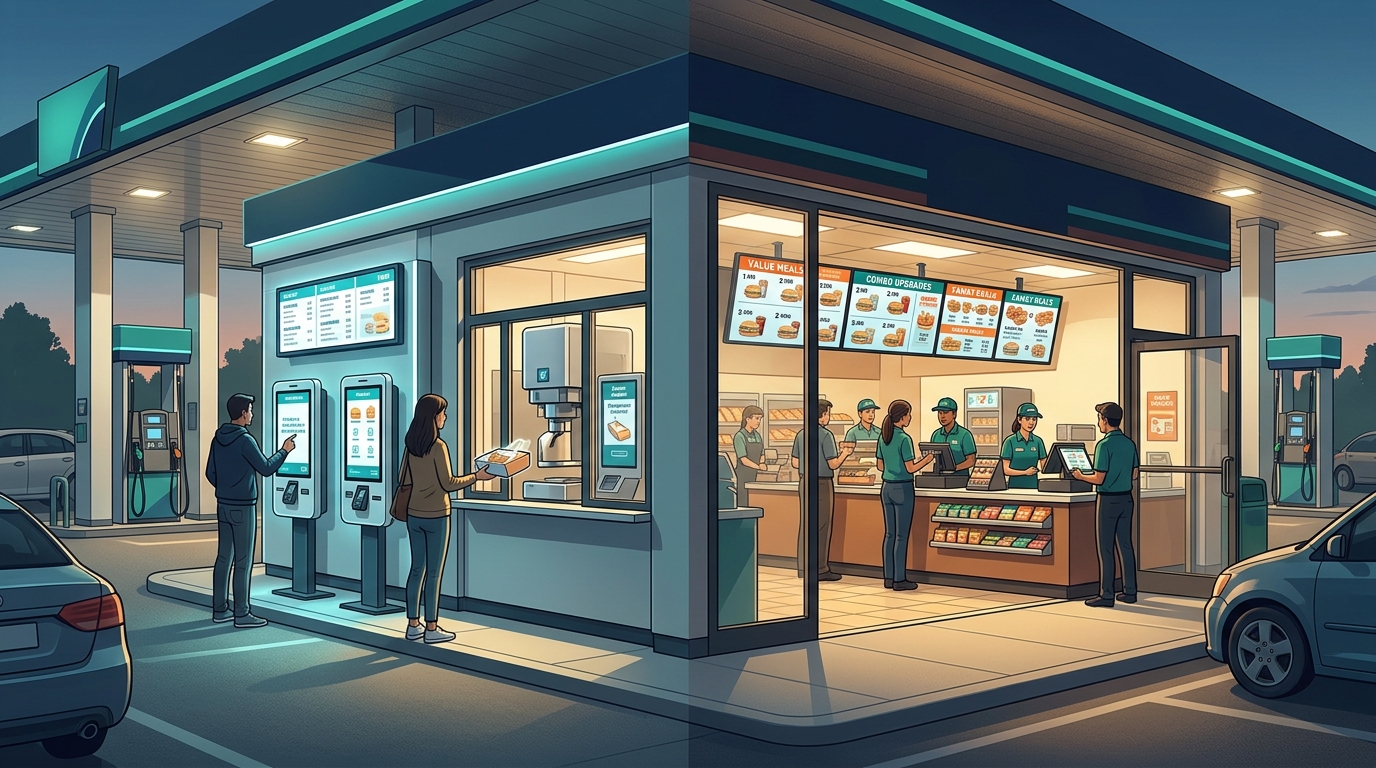
Forecourt operators are testing contrasting foodservice strategies to engage consumers while managing operational costs. While 7-Eleven is deploying price-tiered value menus across its co-branded QSR concepts, Murphy USA is piloting automated, modular kiosks dispensing White Castle menu items.
Editorial illustration
Forecourt Foodservice Expansion Strategies: Automated Platforms and Tiered Value Menus
Sourced Industry Developments
In late September 2026, 7-Eleven, Inc. introduced structured value menus across its Laredo Taco Company, Raise the Roost, and Speedy Café concepts (7-Eleven Value Deals). The Laredo Taco Company "Más Value Menu" establishes a $5 breakfast pairing consisting of two original breakfast tacos—chorizo and egg, potato and egg, or bean and cheese—and a small coffee. Its $7 lunch pairing bundles two lunch tacos with a large Big Gulp beverage, supplemented by side items like fresh-fried diced potatoes and quesadillas priced under $3. At Raise the Roost, the "Raise Your Cravings Menu" provides breakfast and lunch items priced at $4 and under, such as a chicken biscuit, sausage & cheese muffin, crispy wrap, and 4-piece nuggets. At Speedy Café, the "Speedy Deals Menu" lists crispy and grilled wraps for under $3, alongside breakfast items under $4 such as the bacon, egg and cheese croissant and sausage, egg and cheese biscuit. William Armstrong, senior vice president of restaurant operations and innovation at 7-Eleven, Inc., commented that these value menus "bring together hot, craveable favorites at great value, giving customers an easy answer for breakfast, lunch or dinner during busy schedules."
In August 2026, Murphy USA announced a pilot of an autonomous foodservice platform developed by Automated Retail Technologies across select large-format store locations (Murphy USA Automated Foodservice Trial). The modular, self-contained system automates food preparation, heating, and dispensing, allowing consumers to order through a touchscreen interface and receive heated items from burger chain White Castle in approximately two minutes. Scott Woodward, senior vice president and chief merchandising officer at Murphy USA, stated that the partnership allows the retailer to "introduce a new convenience offering informed by customer insights, while maintaining the operational discipline and focus on everyday value." This deployment aligns with earlier statements from CEO and President Mindy West on Murphy USA's April Q1 earnings call, where she noted that while the company evaluates store enhancements using new formats and services, foodservice is not projected to expand to every location in the near term. Murphy USA also previously announced a main banner store redesign featuring updated surface materials, modified forecourt lighting, enhanced signage, and a refreshed color scheme.
Analysis: Operational Hypotheses and Program Evaluation
*Analysis*
Convenience and fuel retailers are actively testing divergent operational models to solve the price-versus-labor equation in forecourt foodservice. While large-scale co-branded kitchens leverage manual labor to capture value-oriented foot traffic across key dayparts, automated self-contained kiosks offer a compact footprint alternative designed to bypass kitchen buildouts and dedicated culinary labor.
Hypothesis 1: Modular Automated Kiosks Eliminate On-Site Kitchen Overhead
*Proposed Test*: Store operators evaluating modular automated kiosks (such as the Automated Retail Technologies platform) should monitor footprint yield and labor hours over a six-month pilot across select large-format stores. The proposed test involves comparing net margins per square foot between automated QSR dispensing kiosks and traditional grab-and-go warming displays. Key performance indicators should isolate utility draw, product waste rates, maintenance downtime, and order fulfillment speed relative to fixed equipment costs.
Hypothesis 2: Daypart Value Tiering Increases Fountain and Hot Beverage Conversion
*Proposed Test*: To evaluate whether fixed-price meal deals (such as $5 breakfast or $7 lunch bundles) increase gross margin dollars despite reduced food item margins, operators should conduct a multi-store trial comparing bundled daypart pricing against standalone menu items. The trial should measure register scan data over 90 days to determine whether high-margin attachments—specifically fountain beverages and coffee—offset the price compression on core breakfast and lunch items.