Forecourt Foodservice Execution: Rutter's Pasta Expansion and McDonald's Technology Investment Strategy
Forecourt operators are leveraging both high-margin culinary customization and enterprise technology to boost store performance. Rutter's has expanded its hot food offerings across 94 locations with imported Italian pasta dishes, while McDonald's targets a 250 basis point efficiency boost through its $8.5 billion Next investment strategy and ArchIQ AI platform rollout.
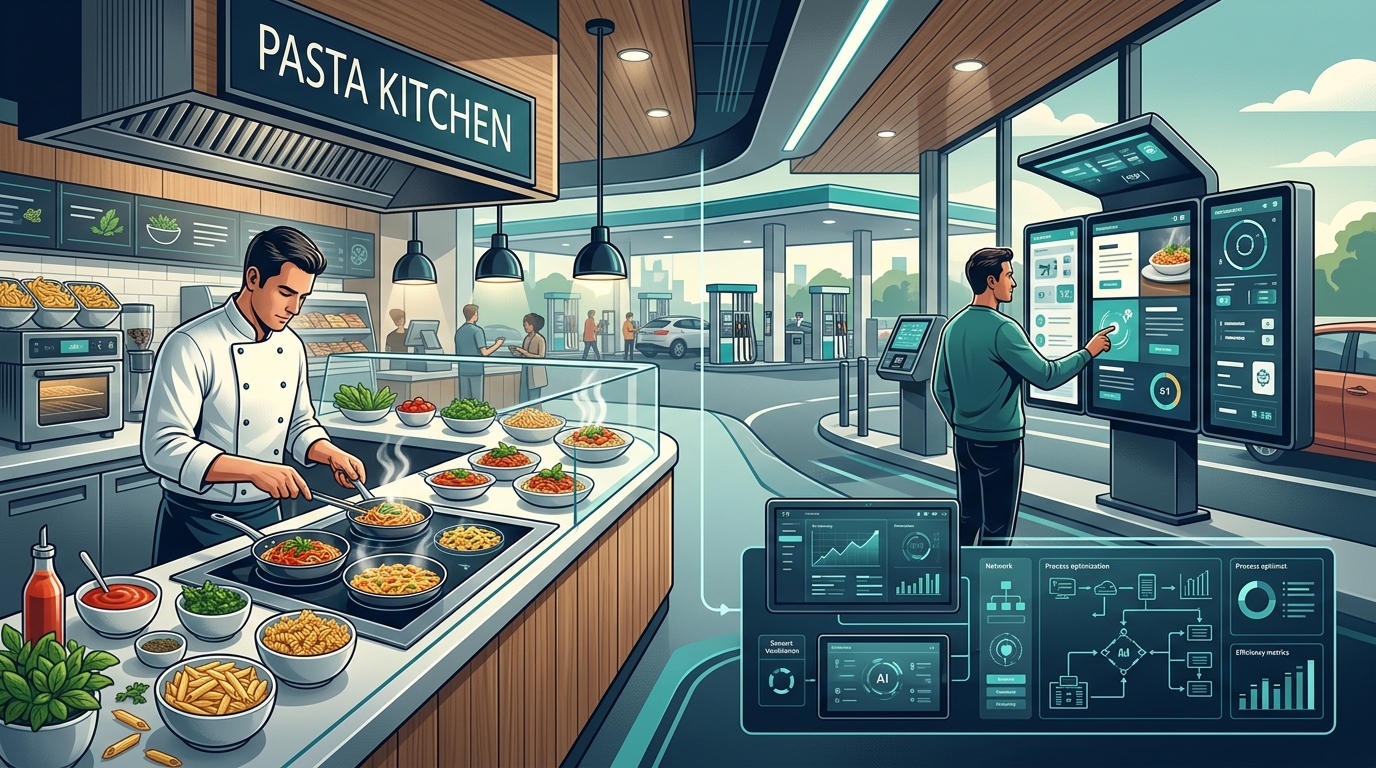
Editorial illustration
Forecourt convenience operators and QSR brand owners are actively evaluating menu diversification and technology infrastructure to capture higher-margin meal occasions. Recent market developments from regional c-store operator Rutter's and QSR enterprise McDonald's illustrate two distinct operational vectors: aggressive hot-food menu expansion and large-scale AI-driven operational automation.
Forecourt Hot-Food Expansion: Rutter's Italian Pasta Platform
Regional forecourt chain Rutter's, headquartered in York, Pennsylvania, announced a major expansion of its hot foodservice program with a customized pasta menu rollout (CSP Daily News). Operating 94 stores across Pennsylvania, Maryland, Virginia, and West Virginia, Rutter's is building beyond its foundational fettuccine Alfredo and spaghetti marinara options.
The expanded lineup incorporates specialized pairings, combining standard spaghetti and fettuccine with proteins including Italian sausage, meatballs, fried chicken, bacon, shrimp, and steak. Key new dishes include:
- Italian Sausage and Peppers Spaghetti
- Buffalo Fried Chicken Fettuccine Alfredo
- Surf and Turf Fettuccine Alfredo
- Powerhouse Fried Chicken and Mozzarella Sticks Spaghetti Marinara
- Cannoli Chips and Dip cup
According to Philip Santini, Rutter's senior director of food and beverage, the initiative relies on "pastas imported directly from Italy" to maintain product quality while providing customizable options through flexible topping and sauce combinations (CSP Daily News).
QSR Enterprise Scale: McDonald's Next Strategy and ArchIQ Deployment
Concurrently, fast-food giant McDonald's outlined its long-term corporate growth and technology roadmap during its investor day conference (Restaurant Dive). As part of its overarching "Next" strategy, the company committed $8.5 billion in partner support through 2036, which incorporates approximately $5 billion dedicated to rent relief and capital support through 2030.
McDonald's management targets a 250 basis points improvement in U.S. gross store-level productivity, projecting an average franchisee cash flow boost of approximately $100,000 per store (Restaurant Dive). Key technology initiatives supporting these targets include:
- ArchIQ AI Rollout: Deployment of the ArchIQ artificial intelligence platform designed to manage drive-thru processing, inventory accuracy, and order fulfillment precision.
- Loyalty Program Optimization: Structured effort to reactivate 150 million infrequent loyalty consumers through tiered rewards, brand partnerships, and personalized marketing.
- Media Network Expansion: Testing an in-house media network model targeting a $1 billion advertising revenue business over time.
- Menu Core Refinement: Menu development focused on larger beef burgers, expanded chicken platforms (including chicken bowls), and specialized beverage programs.
Operational Analysis: Hypotheses for Forecourt QSR Integration
*Note: The following analysis reflects independent operational evaluation and operational hypotheses based on reported developments.*
As forecourt operators balance labor constraints against demand for freshly prepared foodservice, the contrast between menu complexity and tech-assisted kitchen throughput becomes paramount.
Balancing Customization with Prep-Line Bottlenecks
Rutter's strategy leverages direct-imported dry pasta and customizable protein platforms to elevate evening daypart appeal. However, multi-protein pasta stations present operational labor risks if assembly routines are not carefully standardized.
- Hypothesis: Broadening customization across pasta dishes increases gross ticket margin without compromising drive-thru or store dwell time if prep lines utilize batch-cooked bases paired with rapid-induction finishing heaters.
- Proposed Operational Test: Compare peak-hour labor hours per order, waste percentages, and order assembly times across 15 high-volume stores over 60 days, testing pre-portioned protein trays against bulk ingredient pans.
AI-Driven Predictive Inventory in High-Skill Kitchens
Deploying tools similar to McDonald's ArchIQ platform within forecourt kitchens could significantly mitigate waste associated with expanded, perishable menus (e.g., seafood and fresh meats in Rutter's new lineup).
- Hypothesis: Automated AI inventory and predictive ordering systems reduce perishable kitchen waste by at least 15% in convenience stores offering customizable hot meal programs.
- Proposed Operational Test: Implement real-time POS-linked inventory prediction algorithms in 10 test locations for 90 days and measure shrinkage against historical baseline control sites.