How Ampol charges eight bays when grid power varies
At Wyong on Australia’s M1, Ampol can draw extra power when the grid has room. What happens to waiting times when that headroom disappears? The hosts also look at the kitchen bottleneck behind faster ordering.
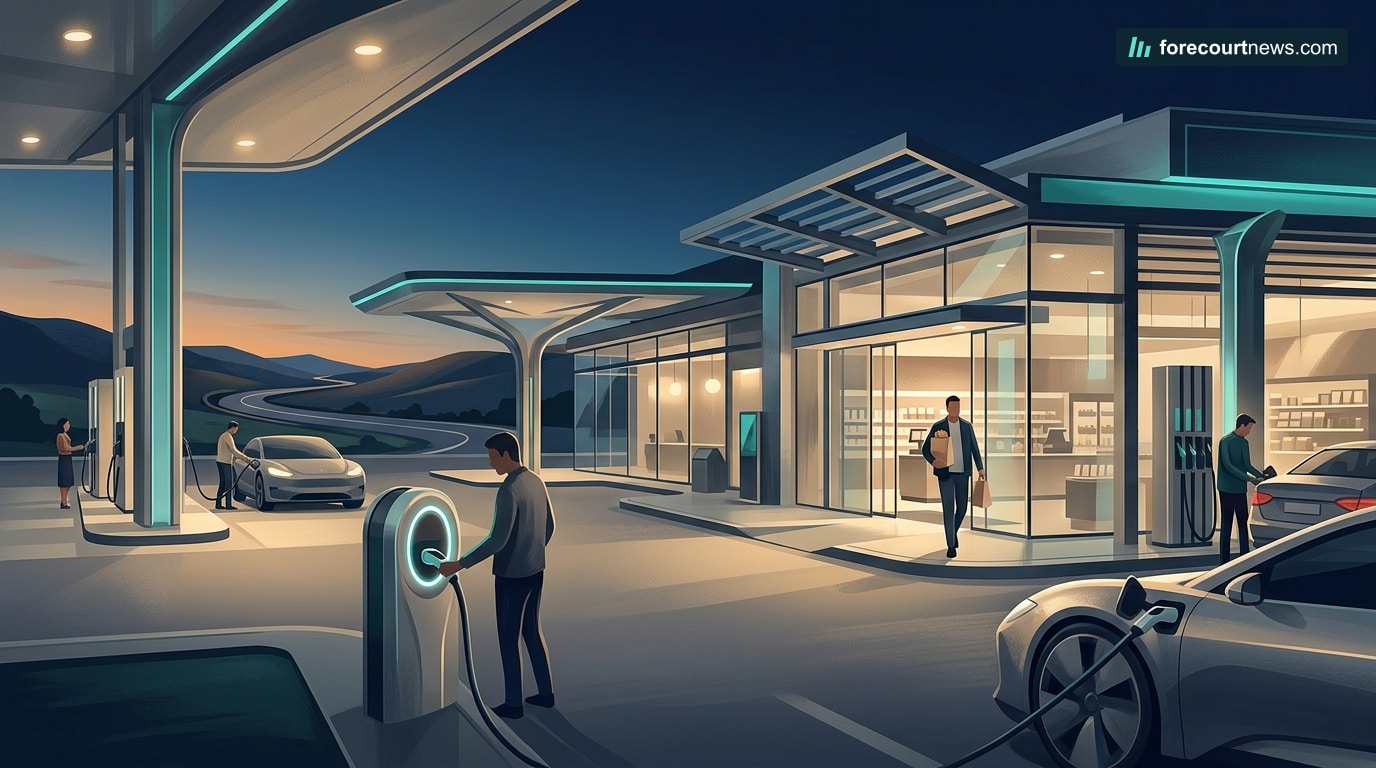
Editorial illustration
Fuel Retail
Post-Midterm Policy Priorities and Refining Dynamics: Energy Trade Pressures and European Methane Rules
Global Petroleum Supply Channel Pressures
Global petroleum flows remain exposed to heightened trade friction and regional security conflicts. Analysis shared by John Eichberger, executive director of the Transportation Energy Institute (TEI) during a post-midterm election webinar, indicated that approximately 68% of crude oil traded globally in 2025 moves through supply routes facing disruption from the war in Iran, the Russia-Ukraine war, or trade tensions between the United States and Canada (NACS). Eichberger observed that crude oil prices have experienced sharp single-day volatility this year, swinging up by as much as 18% in one day and down by as much as 16% in one day.
Middle distillate logistics face parallel strains. According to Eichberger, 58% of global diesel shipments in 2025 move through stressed supply corridors, compounded by damaged Middle Eastern refining assets and Ukrainian targeting of Russian refineries (NACS).
Domestically, the United States maintains a net-export balance for diesel, producing an average of roughly 5.8 million barrels per day through September 2026 against domestic consumption of approximately 3.8 million barrels per day (NACS). Eichberger noted that restricting diesel exports could rapidly saturate domestic storage capacity and compel refiners to curtail crude runs, directly impacting gasoline and other refined output.
Domestic Fleet Composition and Policy Landscape
While alternative powertrains expand, internal combustion engines (ICE) continue to comprise the bulk of light-duty sales in the United States. Conventional and hybrid ICE vehicles accounted for 94% of all vehicles sold through October 2026, with hybrid models specifically capturing more than 15% of sales (NACS). Greater fleet fuel economy represents a gradual shift in overall gasoline demand even as EV adoption trends show a bullish long-term trajectory despite pacing variations.
From a regulatory and legislative perspective, the balance of power following the midterm elections introduces specific governing parameters for forecourt operators. Matt Durand, deputy general counsel for NACS, reported that Democrats will hold majorities in both the House and the Senate in 2027 (NACS). However, the Senate majority remains below the 60-vote threshold needed to overcome filibusters or clear the two-thirds requirement to override presidential vetoes, requiring bipartisan coordination.
During the lame-duck session, federal appropriations, defense authorization, transit programs, and the farm bill present immediate legislative vehicles. Durand observed that year-round E15 fuel provisions remain linked to the farm bill deliberations, though policy negotiations are complicated by disagreements regarding small-refinery exemptions (NACS). Legislative passage of year-round E15 remains uncertain. Looking into 2027, the congressional agenda is expected to focus on EPA oversight, vehicle-emissions targets, corporate average fuel economy standards, and messaging bills covering tariffs, retail pricing, and energy taxes.
European Methane Import Mandates and Compliance Timelines
In Europe, downstream and midstream supply chains are tracking regulatory requirements under the EU Methane Regulation (EUMR). The Council of the European Union adopted a general approach proposing a targeted postponement of specific importer obligations to allow compliance tools to be finalized before enforcement begins (FuelsEurope).
Industry association FuelsEurope acknowledged the Council's targeted postponement approach on 06 November 2026, while cautioning that a deferral alone does not resolve core compliance gaps. FuelsEurope stated that a stepwise structure based on conditional postponements risks introducing uncertainty for operators and EU Member States (FuelsEurope). The association called for a dedicated impact assessment to examine compliance feasibility, EU industrial competitiveness, and supply diversification, advocating for a realistic and predictable timeframe during forthcoming interinstitutional negotiations.
Operational Analysis: Fuel Sourcing and Volatility Risk
Forecourt operators face operational exposures from both global supply disruptions and regulatory transition timelines. A primary operational hypothesis is that high single-day crude volatility increases wholesale rack price unpredictability, placing strain on working capital requirements for independent dealers.
*Proposed Working Capital Test:* Operators can evaluate this hypothesis by tracking 90-day rack spread variances against daily wholesale inventory purchases across high-volatility trading cycles. By testing tight delivery cycles (e.g., maintaining 24-to-48 hours of retail storage turnover) versus forward bulk ordering, fuel managers can empirically quantify whether short-cycle purchasing mitigates inventory devaluation risk during 10%+ daily crude shifts.
Regarding E15 infrastructure readiness, retail fuel distributors evaluating blender pumps or higher-ethanol dispensing must verify station underground storage tank (UST) and dispenser component compatibility before committing capital, given the ongoing uncertainty surrounding federal farm bill negotiations and small-refinery exemptions.
EV Charging
Dynamic Grid Connections in Highway Fast Charging: Operational Lessons from Ampol and Ausgrid
Dynamic Capacity Management on Constrained Highway Corridors
Highway service areas face structural electrical limitations when adding high-power DC fast-charging plazas. Traditional utility interconnections require fixed maximum capacity allocations that reflect peak coincident charging events, which frequently necessitates costly substation or line rebuilds and extended development timelines. At the Ampol Foodary M1 Wyong Northbound service station, located on Australia’s busiest inter-capital corridor, fuel retailer Ampol and electricity distributor Ausgrid have deployed an operational alternative: a dynamic network connection.
Under this deployment, each station location operates with 500 kVA of dedicated capacity while retaining software-governed access to draw up to an additional 750 kVA when local grid conditions permit. The underlying power electronics and management software, supplied by Kwetta, interface directly with Ausgrid’s distribution system to modulate charging output in near real time. When network headroom exists, the site scales beyond its baseline connection; during peak distribution grid stress, the station curbs power draws back toward its dedicated allocation. Furthermore, the twin Northbound and Southbound sites are engineered to share electrical capacity under defined grid outage conditions. While the Northbound site is operational, the Southbound installation is scheduled to open later in November 2026.
Layout and Bay Configuration for Towing and Commercial Vehicles
The physical design of highway charging hubs directly impacts traffic flow, turn turnaround, and dwell times. Standard charging stalls are configured as perpendicular pull-in spaces, which create access barriers for vehicles towing trailers or caravans and for medium-duty commercial vans. Drivers of these combinations are often forced to unhitch before charging or occupy multiple adjacent bays, obstructing forecourt circulation.
The Wyong Northbound hub addresses this operational friction by installing eight charging bays, which include two drive-through bays tailored specifically for longer vehicles, commercial fleets, and drivers towing caravans or trailers. The charging hardware delivers up to 200 kW per vehicle, with instantaneous power delivery dependent on vehicle battery architecture, aggregate station load, and dynamic network capacity. Kwetta’s charging infrastructure has also been deployed across 13 public forecourt locations within the Ampol-owned Z Energy network in New Zealand, reflecting a repeatable equipment footprint across regional markets.
Analysis: Operational Hypotheses for Dynamic Connections
Ausgrid described the dynamic connection as a faster and less capital-intensive deployment model compared to conventional network reinforcement. For forecourt operators evaluating similar technology, several commercial and operational factors must be tested rather than assumed:
- Throughput versus Throttling Risk: Dynamic capacity avoids fixed network upgrade costs, but charging speed is subject to local utility curtailment during peak summer or winter grid events. Operators should evaluate the hypothesis that dynamic throttling does not materially depress customer satisfaction or forecourt retail conversion. A proposed test involves tracking average session delivery rates (kW), total session duration (minutes), and auxiliary retail basket size across peak grid periods compared to unconstrained shoulder periods.
- Drive-Through Bay Utilization and Dwell Dynamics: While drive-through bays prevent unhitching bottlenecks, they consume greater physical forecourt area than standard pull-in parking stalls. Operators can test whether drive-through stalls improve space productivity by measuring bay turnover rate, dwell time per transaction, and the proportion of towing or commercial fleet drivers against non-towing passenger cars occupying those specific slots.
- Cross-Carriageway Capacity Sharing: The ability of paired highway sites to share power during localized outages introduces network resilience. Operators can benchmark system reliability by monitoring mean time between service disruptions and verifying whether capacity-sharing logic successfully sustains minimal continuous service at both carriageways without tripping station switchgear.
C-Store
Cross-Platform Loyalty Integration and Specialty Beverage Strategy in Convenience Retail
Convenience store operators are confronting aggressive competitive maneuvers from leading quick-service restaurant (QSR) chains across two traditionally reliable forecourt profit centers: customer loyalty ecosystems and high-margin dispensed beverages.
Cross-Platform Loyalty and Delivery Fulfillment
QSR networks are rapidly expanding digital reach by connecting proprietary loyalty engines with third-party delivery and mobility platforms. In November 2026, McDonald’s expanded its partnership with Uber, making Uber Eats the preferred integrated delivery fulfillment partner directly within the McDonald’s app. This integration allows consumers to place and monitor delivery orders inside the native restaurant application or directly via Uber Eats.
Crucially for convenience retail operators assessing digital retention tools, this agreement extends beyond off-premise logistics into loyalty currency exchange. Starting in November 2026, MyMcDonald’s Rewards members in designated trial markets can redeem accrued loyalty points on Uber ride offers through seasonal app activations. McDonald’s and Uber plan to expand functionality by enabling members to earn points on orders submitted through Uber Eats and redeem them for mobility services.
This cross-utility model reflects a broader strategic initiative called Make It Golden, designed to enhance McDonald’s app capabilities with tiered loyalty frameworks and integrated customer feedback. McDonald’s first partnered with Uber in the United States in 2017, and delivery is now active across 30 countries.
The QSR Push into Dispensed Specialty Beverages
Simultaneously, quick-service brands are targeting the specialty beverage category—historically a primary traffic driver and basket margin anchor for forecourt retailers. At the 2026 NACS Show in Las Vegas, McKinsey & Company partners Andrew Davis and John R. Moran highlighted that specialty beverages have emerged as an industry megatrend, citing statements from the McDonald’s CEO valuing the addressable space at $100 billion.
Consumer purchasing patterns, especially among younger cohorts, have shifted away from standard carbonated soft drinks (CSDs), hot coffee, and beer toward cold, caffeinated, sweet, and functional beverages. According to McKinsey’s analysis, Gen Z shoppers are 11% more likely than the average consumer to follow beverage trends and sample novel items. In response, QSR chains are redesigning menus to capture this volume:
- McDonald’s is introducing energy drinks such as Red Bull into dispensed drink offerings and integrating concepts tested at its experimental CosMc’s brand directly into the core footprint.
- Starbucks reports that a significant proportion of its volume has shifted from traditional coffee to matcha, chai, and refreshers.
- KFC has introduced its branded beverage platform called Kwench.
- Chick-fil-A launched Daybrite specialty beverages, while Taco Bell expanded its Live Mas Cafe platform.
- Focused drive-thru operators including Dutch Bros and 7 Brew continue expanding market presence.
Strategic Takeaways and Operational Hypotheses
For forecourt operators, defending dispensed beverage margins requires structured experimentation rather than defensive discounting. McKinsey practice leaders recommend that retailers maintain a deliberate pipeline of trial products, arguing that 10% to 30% of tested beverages should fail if an organization is sufficiently testing consumer boundaries. Operators should lean on supplier research and category management data rather than developing proprietary beverage formulations entirely in isolation.
*Hypothesis for Forecourt Operators:* Establishing localized loyalty point redemption partnerships with third-party delivery or micro-mobility providers may increase monthly active app usage and repeat visits among non-fuel shoppers. A measurable test would track 90-day retention and app-driven basket sizes across a control group versus a pilot cohort offered cross-platform mobility perks.
QSR & Foodservice
Benchmarking Destination Foodvenience and Digital Personalization: Global Forecourt Foodservice Lessons
Destination-Led Foodservice: The Forecourt Shift
Forecourt retail has traditionally operated on a convenience-first model anchored by vehicle refueling. However, global fuel retailers are increasingly testing formats that position proprietary food and beverage programs as primary destination drivers rather than secondary roadside amenities.
In Argentina, energy company YPF operates more than 1,200 convenience retail and foodservice locations under its FULL brand across a wider network of over 1,600 service stations, which collectively serve more than 1.5 million daily visitors, according to NACS. The group's flagship concept, YPF FULL Black Nordelta located in Greater Buenos Aires, was recognized on November 12, 2026, as the winner of the 2026 Best Foodvenience Store in the World competition at The Retail Marketeers’ Convenience Leaders Convention in Hamburg, Germany. The competition was co-hosted by Insight Research and NACS, with Deliverect acting as sponsor and The Moseley Group as knowledge partner; prior winners include Rutters in 2025 and Applegreen in 2024.
According to YPF, the Nordelta store reorganized its checkout and service flow into a single connected journey encompassing discovery, recommendation, preparation, and choices between table service or takeaway. Its culinary program features chef-led meals, specialty coffee, freshly prepared dishes, and a signature burger platform developed with Chef Mauro Colagreco. The format is designed around distinct dayparts: morning and lunch drive peak traffic with specialty coffee, bakery, salads, and fast meals, while afternoon and evening transitions accommodate remote working, informal meetings, and casual dining.
Operational Analysis: Destination Foodvenience
For forecourt operators, transforming convenience retail into a food destination requires separating physical site potential from legacy fuel habits. When a site offers sit-down seating, chef collaborations, and table service alongside fast grab-and-go options, it competes directly with commercial fast-casuals.
*Hypothesis to test:* Introducing multi-tier service flows (table service alongside rapid takeaway) in residential or mixed-use commuter forecourts may increase non-fuel footfall during mid-day and afternoon dayparts. Operators should measure this by tracking non-fuel basket size, dwell times, and kitchen throughput across distinct shifts before committing capital to full dining-room retrofits.
---
Digital Personalization and Drive-Thru AI Workflows
As forecourt foodservice programs scale, they face similar throughput and customization bottlenecks to those managed by multinational quick-service restaurant (QSR) operators. Advanced digital ordering channels, tiered loyalty structures, and automated drive-thru touchpoints are increasingly deployed to sustain order volume.
In its Q4 2026 earnings report, Starbucks reported that global comparable store sales rose 7.2% year over year, with U.S. comparable store sales increasing 7.7% on the back of higher transaction volumes and larger average tickets, according to Restaurant Dive. By the end of Q4 2026, the company had completed more than 1,700 store uplifts under its "Back to Starbucks" program to create warmer physical environments, while its 90-day active Starbucks Rewards base expanded to 36 million members.
CEO Brian Niccol outlined roadmap priorities for 2027 targeting digital customer interaction, drive-thru automation, and direct delivery integration:
- App Updates and Delivery Integration: In Q2 2027, Starbucks plans to directly integrate delivery options within its proprietary mobile application, enabling loyalty members to earn and redeem reward points directly on delivery orders.
- Algorithmic Recommendations: The digital ordering interface will integrate AI-driven search, discovery, and personalized menu recommendations.
- Drive-Thru AI Trials: Testing involves artificial intelligence tools designed to assist baristas with order accuracy and efficiency, alongside vehicle arrival recognition that displays personalized digital menus and streamlined payment flows.
- Loyalty Progression: Following the implementation of loyalty tiers in January, customer progression from Green to Gold and Reserve status has been driven primarily by transaction frequency.
Operational Analysis: Digital Personalization in High-Throughput Formats
While automated drive-thru interfaces and app recommendations are frequently promoted as immediate throughput boosters, operational complexity can escalate if kitchen production lines are not synchronized with order influx.
*Hypothesis to test:* Deploying customer recognition and dynamic digital boards at the drive-thru order point will decrease order placement duration without negatively impacting kitchen fulfillment speed. Operators can test this by running pilot drive-thru lanes with automated menu prompts on specific shifts, comparing total service time (order point to collection window) against standard manual speaker-box ordering.
---
Strategic Takeaways for Forecourt Operators
- Design for Evolving Dayparts: Expanding beyond fuel-centric retail relies on menu architecture that addresses distinct routines, moving from morning specialty coffee and bakery to afternoon casual dining.
- Synchronize Tech with Kitchen Velocity: Digital ordering, loyalty tiers, and delivery integrations expand sales channels, but require kitchen routing that prevents mobile and delivery tickets from disrupting on-site counter and drive-thru fulfillment.
Host
Welcome to this week's executive briefing. Today, we analyze operational shifts across fuel retail, EV charging, convenience retail, and forecourt foodservice. We will explore refining exposures, dynamic grid interconnections, cross-platform loyalty and specialty beverages, and destination dining, concluding with four operational review questions.
Co-Host
In fuel retail, global supply channels face acute exposure. Analysis shared by John Eichberger of the Transportation Energy Institute indicates that roughly 68 percent of crude traded globally in 2025 moves through routes stressed by conflicts involving Iran, Russia and Ukraine, or US-Canada trade tensions. Single-day crude volatility has ranged from an 18 percent spike to a 16 percent drop. Furthermore, 58 percent of 2025 global diesel shipments move through disrupted corridors following refinery damage in the Middle East and Russia. Domestically, the US produced roughly 5.8 million barrels per day of diesel through September 2026 against 3.8 million consumed. Eichberger noted restricting exports could saturate domestic storage and force crude run curtailments, impacting gasoline supplies.
Host
On fleet demand and policy, conventional and hybrid vehicles represented 94 percent of light-duty sales in the United States through October 2026, with hybrids exceeding 15 percent. Looking to 2027, NACS Deputy General Counsel Matt Durand reported Democrats will hold majorities in both the House and Senate, but lack the 60-vote threshold to overcome Senate filibusters. Durand noted year-round E15 provisions remain tied to farm bill talks, where small-refinery exemptions leave passage uncertain. In Europe, the Council of the European Union proposed targeted postponements of certain importer mandates under the EU Methane Regulation. FuelsEurope acknowledged the postponement effort on November 6, but cautioned that conditional delays do not resolve compliance gaps and risk creating ongoing uncertainty.
Co-Host
Operationally, high crude volatility increases rack price unpredictability. Fuel managers can evaluate whether 24- to 48-hour inventory turnover mitigates inventory devaluation risk compared to forward bulk purchasing during double-digit price swings. For higher-ethanol blends like E15, operators must confirm underground storage tank and dispenser compatibility before committing capital, given unresolved legislative debates.
Host
Turning to EV charging, grid limitations on highway corridors remain a key hurdle. At the Ampol Foodary Wyong Northbound site on Australia's M1 corridor, Ampol and electricity distributor Ausgrid deployed a dynamic network connection. Instead of building costly fixed capacity for peak coincident charging, the site pairs a 500 kVA dedicated allocation with Kwetta power electronics and software that dynamically access up to an additional 750 kVA when local grid conditions permit.
Co-Host
Kwetta’s software modulates power in near real time, scaling up when network headroom exists and curtailing draws during peak grid stress. The hub offers up to 200 kW across eight bays, including two drive-through bays sized for commercial vans and vehicles towing trailers. Charging speed depends on vehicle battery architecture, aggregate station load, and dynamic capacity. The Southbound site is slated to open later in November 2026, with twin sites engineered to share capacity during grid outages. Kwetta has deployed similar hardware across 13 Z Energy forecourts in New Zealand.
Host
While Ausgrid presents dynamic connections as faster and less capital-intensive than traditional network reinforcement, operators must test key operational risks. Primarily, will dynamic throttling during peak summer or winter grid stress curb throughput, extend dwell times, or lower retail spend? Furthermore, operators should track bay turnover to verify whether space-intensive drive-through bays deliver higher productivity than standard pull-in parking stalls.
Co-Host
In convenience retail, quick-service restaurant chains are challenging core forecourt margins in loyalty and specialty beverages. In November 2026, McDonald’s expanded its Uber partnership, integrating Uber Eats fulfillment into the McDonald’s app. In trial markets, MyMcDonald’s Rewards members can redeem points for Uber ride offers, with plans to expand earning and redemption across both platforms. This cross-utility model shows QSRs expanding digital retention directly into urban mobility.
Host
Concurrently, QSRs are targeting dispensed specialty beverages, an addressable market the McDonald's CEO valued at 100 billion dollars. At the 2026 NACS Show, McKinsey partners noted Gen Z shoppers are 11 percent more likely than average consumers to sample novel beverages, driving growth in cold, caffeinated, and functional drinks. Chains are pivoting rapidly: McDonald’s is testing Red Bull drinks and CosMc’s concepts, Starbucks sees significant migration to matcha and refreshers, and KFC, Chick-fil-A, and Taco Bell have launched branded lines. McKinsey advises maintaining active beverage pipelines, suggesting that a 10 to 30 percent trial failure rate indicates healthy boundary-testing.
Co-Host
In forecourt foodservice, retailers are shifting from roadside fueling stops to food destinations. In Argentina, YPF operates over 1,200 FULL convenience and foodservice locations across 1,600 stations, serving over 1.5 million daily visitors. Its YPF FULL Black Nordelta store won the 2026 Best Foodvenience Store in the World award on November 12. The site features chef Mauro Colagreco burgers, specialty coffee, and daypart transitions shifting from morning bakery and grab-and-go into afternoon remote work and evening table service.
Host
Meanwhile, digital ordering and drive-thru automation are scaling. Starbucks reported Q4 2026 global comparable store sales up 7.2 percent and U.S. comps up 7.7 percent. CEO Brian Niccol outlined 2027 priorities including in-app delivery integration in Q2, AI-driven menu personalization, and drive-thru AI trials. These tests leverage AI order-assist tools for baristas and vehicle arrival recognition to display personalized digital menus and streamline payment.
Co-Host
For operators scaling digital foodservice, kitchen velocity must match front-end order volume. Automated drive-thru recognition and app channels can create kitchen bottlenecks if prep lines are not synchronized with order influx. Operators testing dynamic menu boards should measure total service time from order point to collection window against manual speaker-box ordering to ensure automation does not slow fulfillment.
Host
Across all four sectors, capital allocation requires separating proposed benefits from measured operational reality. As external volatility and cross-industry competition rise, site operators must validate their strategies with structured tests.
Co-Host
To guide your operational reviews, we leave you with four questions: First, in fuel purchasing, how does a 24- to 48-hour retail inventory turnover cycle compare against bulk forward buying in mitigating rack price volatility during sharp crude price swings? Second, on EV charging, does dynamic utility throttling during peak distribution stress materially depress customer satisfaction or retail conversion, and do drive-through bays justify their larger footprint with higher turnover? Third, in convenience retail, can cross-platform loyalty partnerships with delivery or mobility providers increase active non-fuel app engagement, and does your dispensed beverage pipeline tolerate a 10 to 30 percent failure rate? And fourth, in foodservice, are your kitchen prep lines sufficiently synchronized with digital and drive-thru ordering to prevent peak-hour fulfillment bottlenecks across shifting dayparts?