The Daily Forecourt Brief — 2026-10-05
An executive audio briefing across fuel retail, EV charging, convenience stores and foodservice.
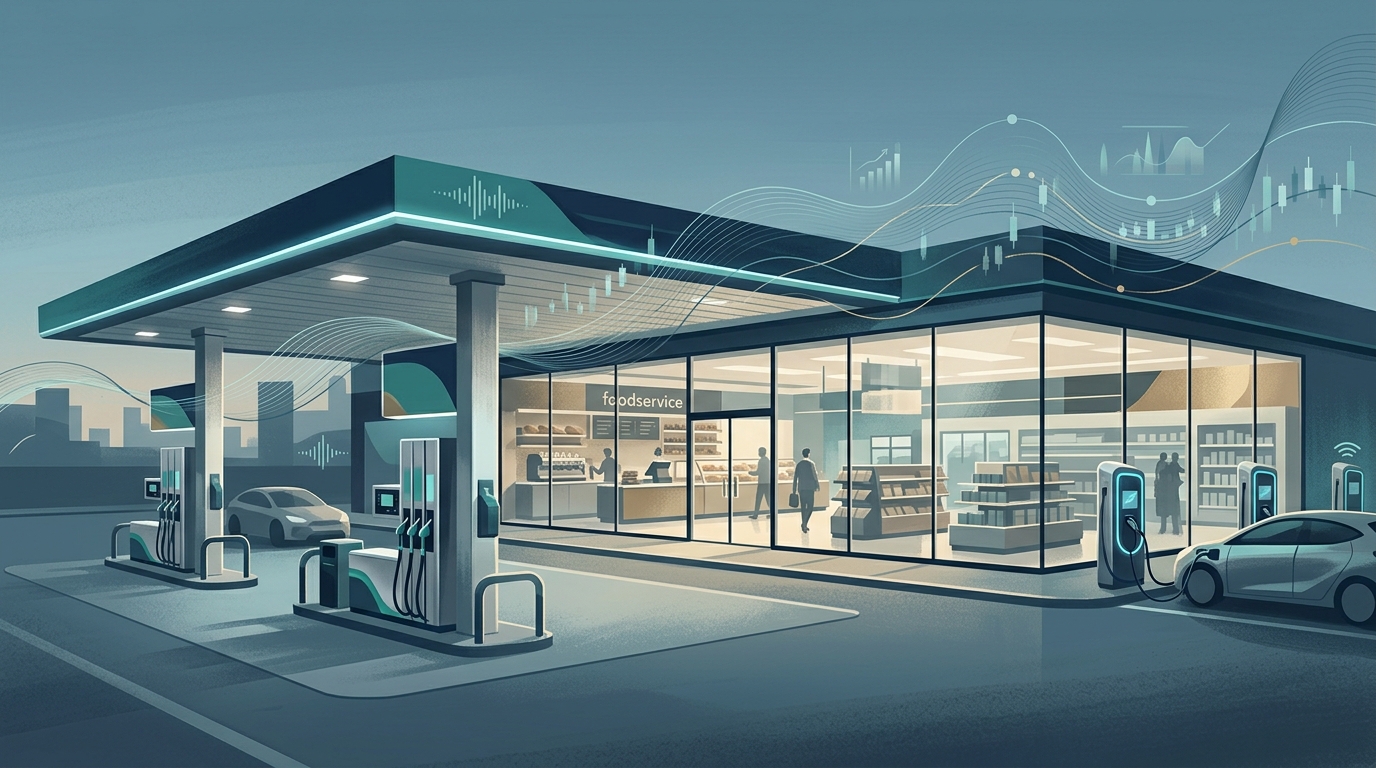
Editorial illustration
Fuel Retail
Refining Capacity Strategy and Freight Hydrogen Logistics: Downstream Operational Analysis
Refining Capacity Strategy and Freight Hydrogen Logistics: Downstream Operational Analysis
Policy Recognition and Refining Capacity Shifts in Europe
Macro energy policies are increasingly confronting the balance between traditional refining infrastructure and long-term decarbonization targets. According to FuelsEurope, G7 leaders recently issued a statement formally recognizing refining as a vital component for energy security, economic resilience, and market stability.
Industry data highlighted by the trade association shows that Europe has faced "35 refinery closures since 2009" alongside a 20% reduction in processing capacity during a period of rising geopolitical uncertainty. Addressing these supply chain dynamics, Liana Gouta, Director General of FuelsEurope, stated that "refining is a strategic industry" and essential to energy security. To safeguard long-term fuel availability and transition readiness, the association is calling on the European Commission to establish a permanent Strategic Dialogue with the refining and fuel manufacturing sector.
Operational Analysis
While high-level political statements underscore the essential role of existing refining assets, forecourt operators must navigate immediate regional supply vulnerabilities. The loss of regional refining capacity increases reliance on imported finished products, potentially amplifying wholesale price volatility and supply chain lead times.
- Hypothesis for Fuel Retailers: Establishing multi-supplier rack contracts and expanding on-site distillate storage capacity will lower supply disruption risks during geopolitical crises.
- Proposed Operational Test: Compare fuel delivery fulfillment rates and landed margin variances across sites utilizing single-supplier contracts versus dual-source racked procurement protocols over a six-month evaluation period.
Private-Public Partnerships Driving Heavy-Duty Hydrogen Infrastructure
In South America, zero-emission freight transport infrastructure is expanding through co-located logistics partnerships. MobilityPlaza reports that Walmart Chile and Copec have launched Chile's first hydrogen refueling station tailored specifically for heavy-duty trucks.
Located at Walmart Chile’s distribution center in Quilicura, the site powers a green hydrogen truck operated by Marval Clean Logistics for retail distribution. The installation was developed under the Hidrohaul technology program, supported by Chilean development agency Corfo, alongside partners including IEE and Mining3 Chile.
Key technical and environmental parameters of the deployment include:
- Equipment engineering capable of servicing heavy trucks with a "driving range of more than 600 km."
- Projected environmental benefits estimated to "prevent around 380 tonnes of CO₂ emissions annually" which partners equate to taking approximately 83 gasoline vehicles off the road for one year.
- Future roadmap goals targeting the deployment of up to 10 hydrogen trucks at Walmart Chile’s El Peñón distribution facility by 2028.
Operational Analysis
Integrating heavy-duty hydrogen dispensing directly into high-throughput distribution hubs bypasses the initial utilization risks typical of public highway stations. By embedding dispensing assets within captive fleet logistics centers handling hundreds of daily truck movements, project developers secure predictable demand baselines.
- Hypothesis for Commercial Fleet Operators: Co-locating alternative fuel dispensing at private logistics hubs yields lower operational costs per kilogram dispensed than uncommitted public corridor sites.
- Proposed Operational Test: Measure asset utilization rates, maintenance costs, and total cost of ownership (TCO) per kilometer for fleet vehicles serviced at dedicated hub stations versus public corridor retail facilities over 12 months.
Strategic Framework for Forecourt Operators
- Supply Resilience: Track regional refining capacity and evaluate terminal access contracts to mitigate potential finished-product import bottlenecks.
- Fleet Partnership Models: Align clean fuel investments (such as hydrogen or ultra-fast EV charging) with guaranteed daily commercial fleet cycles before committing capital.
- Phased Scaling: Implement pilot facilities at high-density logistics nodes prior to scaling infrastructure across broader forecourt networks.
EV Charging
Evaluating M&A Strategy in Australian Public EV Charging: Ampol’s A$225M Evie Acquisition
Evaluating M&A Strategy in Australian Public EV Charging: Ampol’s A$225M Evie Acquisition
Australian fuel retail major Ampol has entered into an agreement to acquire 100% of Fast Cities Australia Pty Ltd, the operating company behind Evie Networks, for A$225 million (approximately $145 million USD), according to reporting from MobilityPlaza. The transaction is subject to regulatory approval by the Australian Competition and Consumer Commission (ACCC) and is targeted for completion in the first half of 2027. Until regulatory approval is granted, Ampol and Evie Networks will continue to operate as separate business entities.
Transaction Terms and Infrastructure Totals
The acquisition structure involves adding substantial new additions to Ampol's infrastructure portfolio while expanding its nationwide footprint across Australia:
- Transaction Valuation: A$225 million (~$145 million USD) for 100% equity in Fast Cities Australia Pty Ltd.
- New Network Additions: Over 1,030 EV charging bays added via the Evie acquisition.
- Combined Network Totals: Approximately 1,425 charging bays across more than 400 nationwide sites when integrated with Ampol’s existing AmpCharge infrastructure.
- Regulatory Governance & Scope: Primary provision requires ACCC merger clearance for 100% acquisition; transaction completion is projected for H1 2027.
Market Adoption and Measured Performance
According to Ampol statements reported in October 2026, electric vehicles accounted for an average of more than 20% of new vehicle sales in Australia over the five-month period preceding the announcement.
Measured operational performance metrics reported by Ampol for its proprietary AmpCharge network during the first half of 2026 (H1 2026) compared to the prior year demonstrate significant utilization gains:
- Charging Session Growth: +116% increase in charging sessions.
- Energy Delivered Growth: +120% increase in total energy delivered.
Ampol Managing Director and CEO Matt Halliday stated that "disciplined investment at the right time" drives the company's EV charging strategy, emphasizing that the acquisition enables the group to expand its charging presence "at scale and at pace."
---
Analysis: Operational Implications and Investment Strategy
*Note: The following section reflects analytical interpretation by Forecourt News and is clearly distinguished from reported source facts.*
Scaling Infrastructure via M&A vs. Greenfield Development
For forecourt operators navigating transitioning transport markets, acquiring established charging networks provides immediate access to secured grid connection contracts, pre-selected sites, and active user bases. Developing charging hubs individually often incurs multi-year delays related to transformer procurement, local grid utility approvals, and civil works. Ampol’s acquisition of Evie Networks illustrates how fuel retailers can bypass site-by-site lead times to secure regional network density.
Disentangling Infrastructure Capacity from Utilisation Performance
Forecourt operators must carefully distinguish between total network capacity (such as combined bay counts) and measured throughput performance. While adding over 1,030 bays expands geographic reach, site-level profitability relies on session frequency and energy volume per bay. Ampol's reported H1 2026 performance (+116% sessions, +120% energy) provides evidence of growing demand, but integrating two distinct operational platforms introduces software, payment, and maintenance harmonization challenges.
Unmeasured Operational Hypotheses and Proposed Testing Protocols
It is frequently asserted in forecourt strategy discussions that integrating dedicated charging networks with convenience stores automatically increases shop spend and customer dwell time profitability. However, this cross-merchandising benefit remains an unmeasured hypothesis across merged sites.
- Hypothesis: Consolidating off-site or standalone charger locations into convenience forecourt loyalty networks raises average c-store basket size among EV drivers.
- Proposed Operational Test: Conduct a 90-day controlled trial across a representative sample of 30 newly integrated charging sites. Measure point-of-sale (POS) conversion rates and basket values of EV drivers using linked mobile payment applications against a control group of non-loyalty fast-charging visits. Compare net retail gross margin against site maintenance and software integration costs before making capital allocations for unified site re-branding.
C-Store
Regional Foodservice Scaling and Forecourt Retail Media Strategies in C-Store Operations
Regional Foodservice Scaling and Forecourt Retail Media Strategies
Regional convenience store operators are pursuing dual growth strategies: expanding proprietary foodservice concepts through strategic store acquisitions and commissary partnerships, while leveraging targeted forecourt retail media to convert pump traffic into in-store shoppers.
Indiana C-Store Consolidation: Family Express and Leo's Market & Eatery
Valparaiso, Indiana-based Family Express has reached an agreement to assume operations of Leo's Market & Eatery store locations, as announced in October 2026. Family Express is tied for 80th place on CSP's 2026 Top 202 U.S. convenience store ranking by store count and currently operates approximately 90 store locations across Indiana. Leo's Market & Eatery, headquartered in Greenfield, Indiana, maintains seven locations situated across suburban Indianapolis and Lafayette.
Under the transaction structure, Leo's will focus on expanding its food platform and central commissary operations, developing Leo's Eatery as a standalone concept. Since 2019, Leo's has developed over 20 kolache varieties alongside sandwiches, salads, and prepared foods. The agreement expands Leo's fresh food offerings to Family Express's existing footprint of around 90 stores.
This transaction complements Family Express's broader strategy in Indiana, where the retailer previously committed $100 million toward new store development across the state. Gus Olympidis, president and CEO of Family Express, noted that the partnership combines Leo's culinary platform with Family Express's operational infrastructure. Stephanie White Longworth, owner and president of Leo's Market & Eatery, stated that the arrangement allows Leo's to preserve its central commissary while expanding its food concepts. The transaction is scheduled to close later in fall 2026, subject to customary closing conditions, with store personnel remaining central to operational continuity.
Links:
Forecourt Retail Media Dynamics and Demographic Trends
Parallel to physical foodservice expansion, forecourt media platforms are targeting customer activation at the pump to influence store conversion. In an October 2026 interview with NACS Media, GSTV CEO Eric Kozik detailed industry trends based on GSTV Consumer Pulse research.
According to GSTV survey data, 80% of GSTV viewers planned or considered a fall road trip, and 73% of road trippers stop at gas stations and convenience stores for breaks or snacks. Furthermore, GSTV research indicates that 96% of viewers who saw a pump video advertisement went on to recognize, consider, research, or purchase the advertised brand.
GSTV's demographic findings highlight pronounced engagement among younger demographics. Survey results show that 76% of GSTV's Gen Z viewers visit a convenience store at least once per week. Additionally, Gen Z viewers are 17% more likely than average viewers to walk inside the store after fueling. Within the store, 97% of Gen Z viewers report enjoying store browsing, and they are 31% more likely than other age groups to discover new products. Kozik attributed this engagement to pump-side media effectiveness, stating that gas station video ranks first with Gen Z viewers across channels in GSTV research.
To maximize forecourt media value, GSTV is expanding managed service models, programmatic advertiser partnerships, and retailer data integrations that link pump impressions to register transaction data.
Links:
Analysis: Analytical Frameworks for Foodservice Expansion and Media Attribution
Distinguishing Sourced Facts from Analytical Frameworks
The acquisition details, store counts, commissary plans, and survey percentages reported above represent documented facts from source reporting. The following operational evaluations represent analytical frameworks and hypotheses formulated for store operators.
Hypothesis 1: Centralized Commissary Hub-and-Spoke Distribution
*Hypothesis:* Rollout of Leo's specialized kolaches and prepared fresh food across Family Express's 90-store network will increase average foodservice basket size without requiring on-site kitchen rebuilds. *Proposed Test:* Measure net foodservice gross margin and daily food discard rates across 15 pilot transition sites over a 90-day period versus a control group of non-converted stores. Track prep labor hours to verify whether commissary delivery maintains store-level operational efficiency.
Hypothesis 2: Forecourt Media Loyalty Data Unification
*Hypothesis:* Integrating forecourt digital video promotions with point-of-sale loyalty data will increase fuel-to-store conversion rates for targeted age groups like Gen Z. *Proposed Test:* Execute a 60-day A/B test across 20 forecourt sites. Group A pumps display dynamic promotions tied to time-of-day offers (such as morning coffee or afternoon snack bundles paired with loyalty QR codes), while Group B pumps show standard non-targeted video ads. Measure conversion via loyalty redemption rates and store foot-traffic sensors.
QSR & Foodservice
QSR Operational Governance vs. Forecourt Foodservice Differentiation: Technology Deployments and Menu Strategy
Operational Governance and Technology Deployment in QSR Networks
In October 2026, McDonald's addressed public reports concerning its menu pricing architecture, formally denying that it utilizes artificial intelligence to set menu prices or execute real-time dynamic pricing routines. The clarification followed media coverage suggesting that transaction analytics across 14,000 U.S. locations were being processed via AI algorithms to calculate dynamic customer price sensitivity. McDonald's stated that franchisees maintain final authority over menu costs, while the corporation supplies "tools, resources, research and recommendations to help them make informed decisions" based on operational expenses, local competition, and economic factors.
The operational autonomy of franchisees produces localized menu price variation across the system. For example, during the LTO promotion of the Big Arch Burger, item prices varied between $8 and $9 across different store locations. Corporate pricing recommendation tools operate without real-time price changes during peak hours. To protect brand value perception, McDonald's initiated a comprehensive franchisee pricing evaluation at the start of the year to verify consistent value delivery across its location network.
These pricing governance measures align with McDonald's broader technology and operational restructuring under its Next strategy, announced in September 2026. The strategy incorporates an $8.5 billion capital commitment through 2036 to support store modernization, operational improvements, and technology deployment. As part of this platform, McDonald's introduced ArchIQ, an AI-driven operating system designed to process drive-thru voice ordering, automate inventory tracking, and integrate computer vision tools to confirm order assembly accuracy. Digital menu boards are deployed across sites to display dynamic LTO content, daypart-specific menus, and real-time inventory adjustments when items sell out.
Daypart Menu Adaptation and Co-Branded Coffee Strategy in Forecourt C-Stores
In the convenience forecourt sector, regional operators are deploying targeted foodservice strategies to establish local market share. Bosselman Enterprises, ranked No. 142 on CSP's 2026 Top 202 list of U.S. c-store chains by store count, expanded its Pump & Pantry chain into the Des Moines, Iowa market following its acquisition of 21 Hy-Vee Fast & Fresh stores earlier in the year.
To differentiate itself from large regional competitors, Bosselman integrated specialized coffee assets acquired during the transaction, which included five Starbucks counters and seven Smokey Row specialty coffee shops. Under Director of Foodservice Alex Dunn, Pump & Pantry structured its menu around targeted dayparts rather than copying legacy offerings. The retailer paired morning beverage traffic with a dedicated breakfast burrito line and grab-and-go lunchtime wraps for later consumption.
Product development relies on guest feedback channels to isolate core menu items from short-term promotional trends. For instance, a maple-flavored, pancake-type griddle-stack sandwich transitioned into a permanent menu item after receiving positive customer feedback, whereas less popular flavor variations were retired quickly. Furthermore, operational standards at converted locations emphasize visible back-of-house hygiene, utilizing open-kitchen layouts where staff adhere to strict sanitation protocols, uniform policies, hair restraints, and glove usage.
Strategic Analysis: Formulating Hypotheses for Forecourt Operations
*Analyst Note:* The contrasting approaches of QSR corporate technology investments and regional c-store foodservice adaptation highlight two distinct avenues for driving customer retention and ticket growth. While national QSR chains invest heavily in back-of-house operating automation like ArchIQ to optimize drive-thru labor, forecourt operators often rely on differentiated daypart offerings and co-branded beverage anchors.
*Hypothesis 1:* Implementing visible open-kitchen layouts with mandatory employee sanitation standards in forecourt c-stores improves customer perceptions of food safety, resulting in higher repeat purchases of hot prepared menu items compared to standard closed kitchen models. *Proposed Test:* Conduct a 12-month comparative study measuring hot foodservice sales growth and repeat loyalty transactions across ten converted open-kitchen Pump & Pantry stores versus ten legacy closed-kitchen locations within similar demographic zones.
*Hypothesis 2:* Integrating recognized specialty coffee sub-brands (e.g., licensed coffee shops) within convenience stores generates higher morning daypart cross-selling of breakfast food items than standard unbranded self-serve coffee stations. *Proposed Test:* Analyze point-of-sale register data over 180 days across acquired sites featuring Starbucks/Smokey Row counters versus baseline Pump & Pantry locations, calculating the basket attach rate of morning food items per 100 coffee orders.
Host
Welcome to the daily executive briefing. Today, we examine refining strategy and freight hydrogen logistics in fuel retail, Australian EV charging M and A, regional c-store foodservice consolidation, and operational technology across quick-service and forecourt dining. We will conclude with core strategic questions for operators.
Co-Host
Starting in fuel retail policy, FuelsEurope highlighted G7 recognition of refining's vital role in energy security and market stability. According to industry data, Europe has faced thirty-five refinery closures since 2009 alongside a twenty percent reduction in processing capacity. In response, FuelsEurope Director General Liana Gouta called on the European Commission to establish a permanent Strategic Dialogue with the sector. Meanwhile in Chile, Walmart Chile and Copec launched the country's first heavy-duty truck hydrogen refueling station at Walmart's Quilicura distribution center. Operated by Marval Clean Logistics under Corfo's Hidrohaul program, the site supports heavy trucks with a driving range exceeding six hundred kilometers. Partners project the installation will prevent around three hundred eighty tonnes of CO2 emissions annually—equating this to taking approximately eighty-three gasoline vehicles off the road for a year—with roadmap goals targeting up to ten hydrogen trucks at the El Peñón distribution facility by 2028.
Host
In terms of operational analysis, losing regional refining capacity exposes fuel retailers to import supply volatility. Analysts hypothesize that multi-supplier rack contracts and expanded on-site distillate storage can mitigate disruption risks, a model that can be evaluated over six months by comparing fulfillment rates and landed margin variances. On the hydrogen side, co-locating dispensing directly within private high-throughput hubs bypasses public corridor utilization risks by securing predictable demand baselines. Operators can test asset utilization, maintenance costs, and total cost of ownership per kilometer against public stations over a twelve-month evaluation.
Co-Host
Turning to EV charging, Australian fuel retail major Ampol agreed to acquire Fast Cities Australia, operator of Evie Networks, for two hundred twenty-five million Australian dollars, or approximately one hundred forty-five million US dollars. The transaction requires Australian Competition and Consumer Commission clearance, with completion targeted for the first half of 2027. Separate business entities will remain until regulatory approval. The deal adds over one thousand thirty charging bays to Ampol’s portfolio, creating a combined footprint of roughly fourteen hundred twenty-five bays across more than four hundred sites. Ampol reported that electric vehicles averaged over twenty percent of new vehicle sales in Australia across a five-month period in 2026, while its proprietary AmpCharge network experienced first-half 2026 gains of one hundred sixteen percent in charging sessions and one hundred twenty percent in energy delivered.
Host
From an analytical perspective, operators must separate network capacity expansion from throughput performance. While acquiring established networks bypasses grid connection lead times, claims that integrating chargers automatically increases c-store basket spend remain unmeasured hypotheses. A recommended ninety-day operational test across thirty integrated sites involves tracking point-of-sale conversion and basket sizes among loyalty app users against non-loyalty fast-charging visits before allocating capital for unified site re-branding.
Co-Host
In C-Store reporting, Indiana-based Family Express agreed to assume operations of Leo’s Market & Eatery’s seven store locations across suburban Indianapolis and Lafayette. Scheduled to close in late fall 2026 subject to customary closing conditions, the deal allows Leo's to expand its central commissary and fresh food platform—including over twenty kolache varieties—across Family Express’s footprint of around ninety stores, while developing Leo's Eatery as a standalone concept. Family Express CEO Gus Olympidis highlighted the combination of Leo's culinary platform with Family Express's infrastructure, following a prior hundred-million-dollar commitment to Indiana store development.
Host
Concurrently, pump-side media is attempting to capture in-store conversion. Research data from GSTV CEO Eric Kozik indicates that seventy-three percent of road trippers stop at c-stores, and ninety-six percent of viewers who saw a pump video ad reported brand recognition, consideration, research, or purchase. Engagement is particularly pronounced among Gen Z, with seventy-six percent visiting weekly and being seventeen percent more likely than average to enter the store. Analysts suggest testing commissary rollouts across fifteen sites over ninety days to measure discard rates and labor efficiency, as well as running sixty-day forecourt video A and B tests linked to point-of-sale loyalty data to track actual conversion.
Co-Host
Moving to QSR governance, McDonald's officially denied public reports that it uses artificial intelligence for dynamic pricing or real-time menu adjustments across its fourteen thousand US locations. Corporate stated that franchisees maintain final authority over menu prices, with corporate providing advisory tools and research. Local prices vary, such as the Big Arch Burger promotional pricing ranging between eight and nine dollars. To support long-term operational updates, McDonald's detailed its Next strategy, involving an eight-and-a-half-billion-dollar capital commitment through 2036. This includes ArchIQ, an operating system for drive-thru voice ordering, inventory tracking, and computer vision order accuracy.
Host
In forecourt foodservice, Bosselman Enterprises expanded its Pump & Pantry chain into Des Moines after acquiring twenty-one Hy-Vee Fast & Fresh locations. Director of Foodservice Alex Dunn structured the menu around specific dayparts, utilizing five acquired Starbucks counters and seven Smokey Row specialty coffee shops to anchor morning traffic with breakfast burritos and grab-and-go lunch wraps. Items were curated via guest feedback, keeping popular options like a maple griddle-stack sandwich while retiring underperforming flavor variations.
Co-Host
Comparing these strategies reveals two operational frameworks: back-of-house automation versus daypart menu differentiation. For forecourt operators, open kitchens and recognized coffee sub-brands offer distinct testing opportunities. Analysts propose a twelve-month study comparing hot food repeat purchases across ten open-kitchen locations against ten legacy closed kitchens, alongside a hundred-eighty-day point-of-sale analysis measuring breakfast food attach rates per hundred coffee orders at branded counters versus standard self-serve stations.
Host
To wrap up today's edition, we leave operators with four core strategic questions to guide immediate decision-making: First, does your regional fuel procurement strategy incorporate multi-supplier rack access to insulate against refining capacity losses and import price spikes?
Co-Host
Second, are your EV charging capital allocations backed by measured basket conversion data rather than assuming foot traffic automatically increases store spend?
Host
Third, can your foodservice growth leverage central commissary distribution to expand fresh proprietary menus without requiring costly site-level kitchen overhauls?
Co-Host
And fourth, how are you structuring daypart beverage assets to maximize food cross-selling and boost customer retention across your forecourt footprint? Thank you for joining us on the daily executive briefing.