The Forecourt Brief — Special Edition — 2026-09-27
An executive audio briefing across fuel retail, EV charging, convenience stores and foodservice.
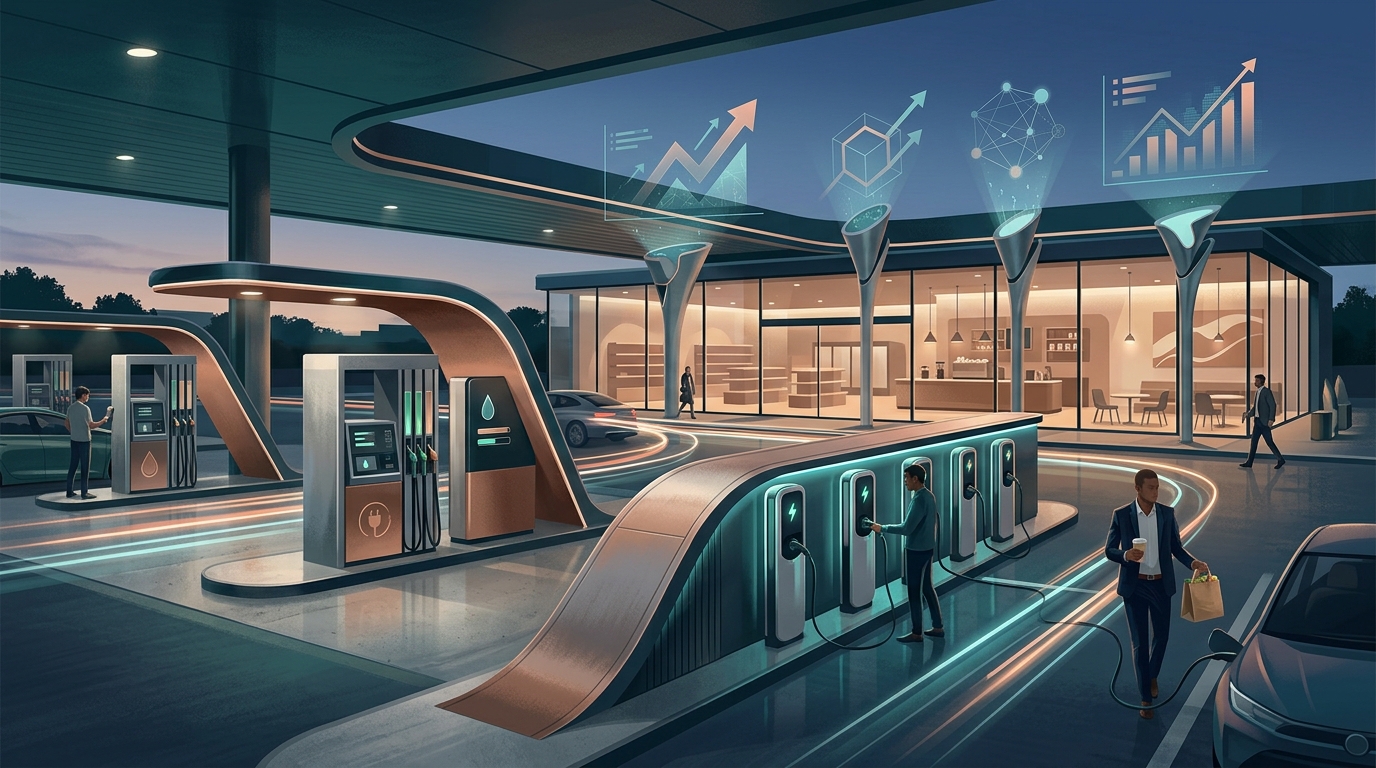
Editorial illustration
Fuel Retail
Capital Restructuring and Technology Integration: Strategic Real Estate Monetization and Regional Forecourt Automation
Real Estate Monetization: Refuel's Sale-Leaseback Model
Fuel retailers managing large retail footprints are increasingly re-evaluating capital allocation between real estate ownership and operational reinvestment. In September 2026, Refuel Operating Company announced the sale of the real estate for 41 of its convenience stores to real estate investment trust Getty Realty Corp. for $260.9 million (C-Store Dive).
The transaction represents Refuel's first sale-leaseback in its corporate history. Refuel operates approximately 250 convenience stores across five US states; the 41 locations involved in this deal represent roughly 16% of its c-store real estate portfolio. Geographically, the portfolio spans 17 sites in South Carolina, 12 in North Carolina, seven in Texas, and five in Mississippi. The property profile features large-format locations averaging nearly 2.5 acres per site, equipped with proprietary hot food offerings and branded QSR formats (C-Store Dive).
Under the terms of the sale-leaseback, Refuel retains continuous operation of all 41 sites under long-term leases. The operator simultaneously closed a new senior secured credit facility to refinance existing debt. Refuel co-CEOs Travis Smith and Jon Rier stated in the corporate announcement that the deal allows the company to "unlock significant value" while maintaining an attractive network and a strong balance sheet. Getty President and CEO Christopher Constant stated that Refuel's platform and assets "align well with Getty’s underwriting criteria". Prior to this agreement, Refuel was a tenant across six Getty-owned sites, five of which were new-to-industry developments. Following the acquisition, Refuel becomes Getty's third-largest tenant, generating nearly 8% of the REIT's annualized base rent (C-Store Dive).
Regional Technology Deployment: Latin American Forecourt Automation
While North American operators leverage real estate transactions to optimize balance sheets, equipment suppliers in emerging markets are focusing on integrated forecourt technology. At ExpoPostos & Conveniência 2026, held September 8–10 in São Paulo, Brazil, supplier Gilbarco Veeder-Root demonstrated point-of-sale, metering, and digital solutions (MobilityPlaza).
Ariel Dovek, Commercial Director for Latin America, stated that Brazil contains over 45,000 service stations, representing "almost half of Latin America, including Mexico", identifying Brazil as the primary commercial growth market in the region. Product displays at the exhibition focused on forecourt self-checkout, submersible pumps, and EV charging hardware. Gilbarco Veeder-Root introduced FlexPay 6 in Brazil and showcased expanded Red Jacket submersible turbine pumps, TLS wetstock monitoring systems, and digital management suites including Konect, MTA, and FuelONet Prime (MobilityPlaza).
Supplier executives articulated the evolution of forecourt technology beyond fuel dispensing. Marketing Leader Nadia Sarur addressed loyalty engagement and shifting convenience customer behaviors. Convenience Retail Business Leader Daniel Sartini stated that supplier solutions extend "beyond payment and the store", asserting that integrated systems bring greater efficiency to gas station operations (MobilityPlaza).
Strategic Analysis: Capital Allocation and Operational Integration
Real Estate Strategy Analysis
Sale-leaseback arrangements permit operators to monetize non-liquid property assets without sacrificing store locations or operational brand continuity. By shifting real estate into long-term lease obligations, retailers reduce property holding risks and secure capital for balance sheet debt refinancing or store upgrades.
*Hypothesis for Operators*: Converting owned real estate into lease agreements provides net financial flexibility that exceeds the long-term compounding cost of rent payments. *Proposed Test*: Retailers should conduct a financial modeling exercise over a 10-year period comparing a sale-leaseback scenario against traditional real estate ownership. The test must evaluate reduction in annual interest expense against compounding lease liabilities, accounting for site-level EBITDA margin, capital expenditure requirements for QSR and hot-food upkeep, and prevailing debt interest rates.
Technology Integration Analysis
Supplier assertions regarding integrated management platforms highlight the industry's shift toward unified store and pump environments. However, operational gains depend heavily on site layout, customer traffic density, and system interoperability.
*Hypothesis for Operators*: Implementing self-checkout terminals on forecourts reduces counter queue dwell time without increasing shrinkage or payment failure rates. *Proposed Test*: Retailers should run a 90-day controlled trial across 10 high-volume sites, comparing 5 locations equipped with self-checkout kiosks against 5 control sites utilizing conventional cashier checkouts. Operators should track average transaction duration, peak-period customer throughput, basket conversion rates, and audit logs for inventory variance.
EV Charging
Ultra-Fast EV Hub Design and Automated Amenities: Operational Analysis of Flagship Charging Infrastructure
Sourced Infrastructure Developments and Technical Specifications
In September 2026, energy operator EnBW inaugurated a fast-charging hub at its headquarters in Karlsruhe, Germany, situated at the intersection of Gerwigstraße and Ostring near the A5 and A8 motorways, as reported by MobilityPlaza. The location functions both as a public fast-charging destination for local drivers and highway motorists and as an operational test facility for technologies intended for subsequent network-wide rollout across Germany.
The facility's initial layout comprises 12 high-power charging points, with site infrastructure designed to accommodate a future expansion up to 20 charging stalls. Hardware supplied by XCharge delivers maximum power ratings of up to 480 kW per charger. According to technical specifications cited by the operator, compatible electric vehicles can add up to 640 kilometers of range in approximately 20 minutes. The installed charging hardware incorporates dynamic power-sharing capabilities, allowing two vehicles to charge simultaneously at a single station while dynamically adjusting energy distribution.
The site is constructed with a wooden canopy made from sustainably certified timber and runs entirely on renewable electricity. Construction partner Leonhard Weiss stated that utilizing electric and alternative-fuel-powered construction equipment alongside an on-site solar and battery storage system reduced construction-related carbon dioxide emissions by up to 50 tonnes compared with standard building methods. Customer amenities at the site include a dedicated waiting area with seating, automated restrooms, and vending machines providing drinks, snacks, and coffee, with plans to integrate an automated pizza vending machine. Network-wide, EnBW operates more than 9,000 charging points across Germany.
Strategic Analysis: Dwell-Time Monetization and Load Management
*Note: The following section represents analytical evaluation and hypothetical operational frameworks derived by Forecourt News, clearly distinguished from the factual reporting above.*
Forecourt operators expanding ultra-fast charging locations must carefully distinguish peak hardware power ratings from actual vehicle charge intake curves. While hardware rated at 480 kW establishes a high theoretical maximum, real-world charge transfer rates depend heavily on vehicle battery architecture, state of charge, and thermal conditioning. Separating maximum equipment ratings from measured site throughput is crucial when modeling site turnover and power supply agreements.
Hypothesis 1: Automated Foodservice as a Low-Labor Dwell Monetization Tool
Integrating automated vending systems (such as coffee and fresh pizza vending machines) alongside dedicated indoor or covered waiting areas may capture higher non-fuel gross margins from charging visitors without increasing store staffing levels.
*Proposed Testing Methodology:* Operators should implement a structured six-month pilot across paired sites—comparing locations with automated food vending against locations featuring only standard seating. Key performance metrics to monitor include non-fuel sales volume per charging session, average spend per dwell minute, machine maintenance costs, and customer transaction times.
Hypothesis 2: Dynamic Power Sharing for Grid Capacity Optimization
Deploying chargers capable of dynamic power sharing across dual outputs enables operators to maximize station utilization during high-density demand periods without exceeding grid connection caps.
*Proposed Testing Methodology:* Over a 90-day evaluation period, operators should collect high-frequency load-profile telemetry during peak traffic hours. The evaluation should measure average charge delivered per 15-minute interval, queue formation times, and user session duration under single-port versus dual-port shared power configurations to verify if power sharing maintains throughput while remaining within peak grid allowances.
Operational Takeaways for Forecourt Operators
When evaluating high-power EV charging hub deployments, forecourt managers should observe three core operational principles:
- Capacity Staging: Differentiate immediate physical stall deployments (e.g., 12 active points) from backend grid and site capacity (e.g., civil works pre-configured for 20 points) to optimize initial capital outlay while preserving future scalability.
- Network Scale vs. Site Metrics: Keep national network size metrics (such as operating over 9,000 charging points) separate from individual location performance indicators when assessing capital allocation.
- Amenities and Dwell Integration: Design site layouts where waiting areas and automated concessions directly serve driver dwell periods without adding physical labor complexity to standard c-store operations.
C-Store
North American Retail Operations: Store Network Restructuring and Cross-Pantry Foodservice Execution
Corporate Restructuring and Forecourt Foodservice Adaptation
Strategic realignment across North American retail networks highlights contrasting operational directions between dedicated QSR coffeehouses and convenience store foodservice operators in late 2026.
Corporate Network Restructuring and Footprint Adjustments
According to reporting by the NACS Report, Starbucks plans to close 250 North American locations. Chief Operating Officer Mike Grams communicated to staff that the stores selected for closure failed to meet acceptable financial metrics or maintain expected customer and employee standards. This store retrenchment marks the second major reduction under Chairman and CEO Brian Niccol, who assumed the leadership role in 2024. In September 2025, the corporation closed 627 locations across North America and Europe while eliminating 900 corporate positions. Subsequent overhead reductions in May 2026 removed an additional 300 corporate staff alongside office closures.
The latest restructuring initiative generates $300 million in financial charges. This total includes $200 million in direct cash outlays dedicated to lease exit fees and employee severance benefits, alongside $100 million in non-cash accounting charges associated with coffeehouse asset disposal and impairment. In tandem with store closures, Starbucks continues retrofitting existing locations, maintaining a target of updating 1,500 units by September 30, coinciding with the end of its fiscal year.
Limited-Time Offer Development in Convenience Retail
As reported by CSP Daily News, regional and national convenience store chains are refining their foodservice strategy through structured limited-time offers (LTOs):
- Johnny's Markets: Operating 66 locations under Marshall, Michigan-based Walters-Dimmick Petroleum Inc., the chain relies on historical sales records to build menu extensions. Food Service Director Alexis Wood noted that core sales performance drives LTO ideation, such as introducing hot honey breakfast sandwiches and pizza slices in 2025, alongside packaged holiday three-pack cookie grab bags.
- Rutter's: Operating 88 locations from York, Pennsylvania, Senior Director of Food Service and Bar Strategy Philip Santini explained that LTO design balances category analytics with ingredient cross-utilization across pantry items. Menu items undergo feasibility reviews and targeted store pilots before widespread rollout.
- Gate Petroleum: Based in Jacksonville, Florida, with 70 stores, Research and Development Chef Andy Spink highlighted the rollout of their Made-To-Order Fresh Kitchen program launched in 2025. Gate utilizes existing pantry inventory for LTOs such as Cuban sandwiches and Doritos walking tacos. Additionally, Gate completed a redesign of its pizza program in November 2025, converting from grab-and-go displays to a dual made-to-order and grab-and-go format.
- Casey's General Stores: Headquartered in Ankeny, Iowa, with 2,890 locations, Vice President of Proprietary Brands Eric Long reported using guest feedback surveys and culinary research to create specialty products. LTO offerings have included Chorizo Breakfast Pizza, summer 2025 BBQ Brisket Pizza, and Pickle Wrap Pizza.
- Pilot Co.: Operating 658 locations from Knoxville, Tennessee, President of Retail Sean Marrero cited guest survey data and vendor analytics in developing 2025 offerings including Buffalo Chicken pizza, Chicken Bacon Ranch pizza, and dual-flavor mac and cheese bowls.
Operational Analysis and Testing Frameworks
Analysis: The retrenchment of dedicated coffeehouse locations alongside the expansion of customizable forecourt foodservice indicates shifting customer traffic patterns. While specialty beverage chains exit underperforming real estate to consolidate capital around store updates, convenience retailers are expanding high-margin food offerings. However, introducing complex menu items without operational controls risks increasing kitchen friction and labor costs.
Hypothesis 1: Utilizing existing pantry ingredients for LTO menu items reduces kitchen prep complexity without depressing promotional sales volume. Proposed Test: Select 20 comparable forecourt sites divided into two equal groups over a 60-day period. Group A introduces an LTO using 100% stocked pantry inventory, while Group B introduces an LTO requiring two unique ingredients. Track order preparation duration, order assembly error rates, and product margin performance across both cohorts.
Hypothesis 2: Converting grab-and-go warmers into combined made-to-order and grab-and-go stations elevates custom item sales volume. Proposed Test: Implement dual-option service kiosks across 15 pilot forecourts for 90 days. Measure change in average check size, custom topping selection rate, and food waste percentages against a matched set of traditional grab-and-go sites.
QSR & Foodservice
QSR Daypart Maximalism and Hospitality Labor Reallocation: Forecourt Analysis
Sourced Operational Developments
On September 24, 2026, Restaurant Dive reported that KFC is launching an experimental restaurant format in McKinney, Texas, named "Open House." According to KFC U.S. President Catherine Tan-Gillespie, the commercial strategy behind this location is termed "AUV-maxxing," focusing on expanding sales volume across non-traditional dayparts, channels, and service touchpoints rather than prioritizing capital or operational restraint.
The format features a physical footprint of 3,400 square feet and accommodates 52 seated guests, contrasting with standard KFC stores that range between 1,700 and 3,000 square feet according to the chain's franchise disclosure document. Operating from 6 a.m. to midnight, the store introduces a dedicated breakfast menu—featuring items such as hashbrown sticks, mini cronuts, coffee, and iced lattes—alongside premium cold beverages derived from its international "Kwench" lineup (including boba refreshers and milkshakes).
Operationally, the brand is deploying ordering kiosks alongside artificial intelligence tools from Yum Brands' partnership with Nvidia. According to Tan-Gillespie, automation at the point of sale is intended to free up labor, which is then redeployed to front-of-house hospitality, delivery assembly, and table service while maintaining standard quick-service pricing.
Analysis: Evaluating High-Footprint QSR Models in Forecourt Settings
For forecourt and fuel retail operators, KFC's maximalist approach presents an interesting operational contrast to the lean, automated micro-kitchen models typically deployed in convenience environments. While traditional c-store operators prioritize minimal labor footprints and rapid transaction speeds, major QSR chains are testing whether expanded seating, broadened beverage tiers, and hospitality-focused labor can unlock higher average check sizes and capture off-peak site traffic.
However, applying a 3,400-square-foot, hospitality-heavy QSR model to a high-throughput forecourt or travel center introduces specific operational trade-offs:
- Space Allocation vs. Canopy Footprint: Expanding indoor dining to 52 guests requires substantial square footage that may compete with parking capacity, staging for EV charging, or high-volume c-store retail aisles.
- Labor Redeployment Dynamics: Reallocating staff from checkout counters to table service and order delivery assumes consistent customer dwell time across all dayparts (6 a.m. to midnight).
- Daypart Expansion Overhead: Introducing complex morning items and specialized cold drink lines (such as boba refreshers) increases equipment footprint, maintenance overhead, and back-of-house operational complexity.
Operational Hypotheses and Testing Protocols for Retailers
Because the financial impact of combining POS automation with table service and specialty cold beverages remains unmeasured in standard forecourt formats, operators should frame these strategies as hypotheses subject to controlled site testing.
- Hypothesis on Premium Beverage Conversion:
- *Hypothesis:* Introducing customizable, premium cold drink lines (such as iced lattes or boba refreshers) will increase afternoon (14:00–17:00) forecourt margin without degrading overall speed of service.
- *Proposed Test:* Deploy a specialized cold-beverage module at three high-volume forecourt sites for 90 days. Measure gross margin per labor hour and drive-thru/kiosk dwell times against baseline control sites offering standard fountain beverages.
- Hypothesis on Kiosk-Driven Labor Redeployment:
- *Hypothesis:* Reallocating register staff to guest hospitality and order-fulfillment runner roles will elevate customer satisfaction scores without increasing net shift hours.
- *Proposed Test:* Direct 100% of front-counter ordering through digital kiosks in select high-volume stores during peak morning shifts. Reassign cashiers to table delivery and dining room maintenance, tracking order fulfillment times and total labor costs against baseline historical periods.
Host
Welcome to today's daily briefing. We are diving into strategic developments across fuel retail, electric vehicle charging, convenience store operations, and quick-service restaurants. We begin in fuel retail, where capital restructuring and physical forecourt technology are taking center stage.
Co-Host
That's right. In September 2026, Refuel Operating Company announced its first-ever sale-leaseback transaction, selling the real estate of 41 convenience stores to Getty Realty Corp for 260.9 million dollars. Refuel operates roughly 250 sites across five states, meaning these 41 locations represent about 16 percent of its c-store real estate footprint. Geographically, the portfolio spans 17 sites in South Carolina, 12 in North Carolina, seven in Texas, and five in Mississippi, with locations averaging nearly 2.5 acres.
Host
Under the agreement, Refuel maintains continuous store operations under long-term leases while closing a new senior secured credit facility to refinance existing debt. Refuel co-CEOs Travis Smith and Jon Rier stated the deal unlocks significant value while preserving a strong balance sheet. Getty CEO Christopher Constant noted the assets align with Getty's underwriting criteria. Following the deal, Refuel becomes Getty's third-largest tenant, generating nearly 8 percent of the REIT's annualized base rent.
Co-Host
Meanwhile, equipment suppliers in Latin America are focusing on forecourt automation. At ExpoPostos and Conveniência 2026 in São Paulo, Gilbarco Veeder-Root demonstrated point-of-sale, metering, and digital management suites like Konect, MTA, and FuelONet Prime. Ariel Dovek, Commercial Director for Latin America, highlighted that Brazil contains over 45,000 service stations, representing almost half of Latin America including Mexico. Supplier executives Daniel Sartini and Nadia Sarur emphasized that integrated forecourt solutions extend beyond payment to drive operational efficiency.
Host
Analyzing these movements, industry analysts note that sale-leasebacks trade property holding risks for long-term rent liabilities. To evaluate this strategy, analysts propose a ten-year financial test comparing sale-leaseback net flexibility against compounding lease costs, accounting for site EBITDA margins and debt interest rates. On the technology front, analysts suggest testing forecourt self-checkout through a 90-day trial across ten high-volume sites to measure customer throughput against payment failure rates.
Co-Host
Turning to EV infrastructure, EnBW inaugurated a flagship fast-charging hub in September 2026 at its headquarters in Karlsruhe, Germany, near the A5 and A8 motorways. The site features an initial 12 high-power charging points with infrastructure designed to scale up to 20 stalls. Supplied by XCharge, the hardware offers maximum power ratings up to 480 kilowatts per charger.
Host
According to operator technical specifications, compatible electric vehicles can add up to 640 kilometers of range in approximately 20 minutes, using dynamic power-sharing across dual outputs. Construction partner Leonhard Weiss noted that using alternative-fuel equipment alongside on-site solar and battery storage reduced construction emissions by up to 50 tonnes of CO2. Site amenities include automated restrooms, seating, coffee and snack vending, with plans for an automated pizza vending machine.
Co-Host
Strategic analysis highlights that operators must separate theoretical maximum hardware ratings from actual vehicle charge intake curves. To test site monetization, analysts propose a six-month pilot measuring automated food vending sales per charging session. To evaluate grid optimization, analysts suggest a 90-day load-profile study testing dynamic power sharing during peak demand hours to verify if dual-port delivery maintains throughput within grid caps.
Host
Shifting to North American c-store and retail operations, footprint restructuring contrasts with expanding forecourt foodservice. According to the NACS Report, Starbucks plans to close 250 North American locations. Chief Operating Officer Mike Grams communicated to staff that selected stores failed to meet financial or operational standards. This follows major cutbacks under CEO Brian Niccol, including 627 store closures in late 2025.
Co-Host
This latest restructuring incurs 300 million dollars in financial charges, including 200 million dollars in direct cash for lease exits and severance, plus 100 million in non-cash accounting charges for asset impairment. Meanwhile, regional and national convenience chains are leaning heavily into limited-time offers. Operators like Johnny's Markets, Rutter's, Gate Petroleum, Casey's, and Pilot Company are building LTOs around customer feedback and ingredient cross-utilization.
Host
For example, Gate Petroleum introduced its Made-To-Order Fresh Kitchen using existing inventory for Cuban sandwiches and walking tacos, while converting its pizza program in late 2025 to a combined made-to-order and grab-and-go format. In analyzing these foodservice pushes, experts propose a 60-day trial comparing LTOs built entirely from stocked pantry items against LTOs requiring unique ingredients to measure prep friction and margins. Analysts also suggest testing combined service stations against standard grab-and-go setups to measure check sizes and waste.
Co-Host
Finally, in QSR and foodservice, Restaurant Dive reported on September 24, 2026, that KFC is testing an experimental restaurant in McKinney, Texas, named Open House. KFC U.S. President Catherine Tan-Gillespie described the strategy as AUV-maxxing, aimed at driving sales across non-traditional dayparts and service channels rather than focusing strictly on capital restraint.
Host
The format covers 3,400 square feet with seating for 52 guests, contrasting with standard KFC stores that range from 1,700 to 3,000 square feet. Operating from 6 a.m. to midnight, Open House introduces breakfast items, iced lattes, and specialty cold drinks from its international Kwench line. Point-of-sale ordering kiosks and Nvidia AI tools are deployed to free up labor, which is reassigned to table delivery and front-of-house hospitality while keeping standard QSR pricing.
Co-Host
Applying a 3,400-square-foot QSR footprint to high-throughput forecourts presents trade-offs regarding parking capacity, canopy space, and equipment complexity. To test these concepts, analysts suggest a 90-day pilot of dedicated cold-beverage modules to measure gross margin per labor hour, alongside controlled tests directing front-counter traffic to kiosks while reallocating staff to hospitality.
Host
To close today's episode, we leave forecourt and retail operators with three strategic questions to evaluate across their own networks.
Co-Host
First: When evaluating a sale-leaseback model, how does your long-term compounding lease liability compare against the immediate net financial flexibility gained for debt refinancing or capital upgrades?
Host
Second: When modeling turnover at fast-charging sites, are your dwell times and utility agreements calculated against actual vehicle charge intake curves or maximum equipment power ratings?
Co-Host
And third: Can your forecourt kitchens maximize limited-time offer volume by cross-utilizing existing pantry inventory before incurring the operational labor and equipment overhead of complex new menus?