The Daily Forecourt Brief — 2026-09-13
An executive audio briefing across fuel retail, EV charging, convenience stores and foodservice.
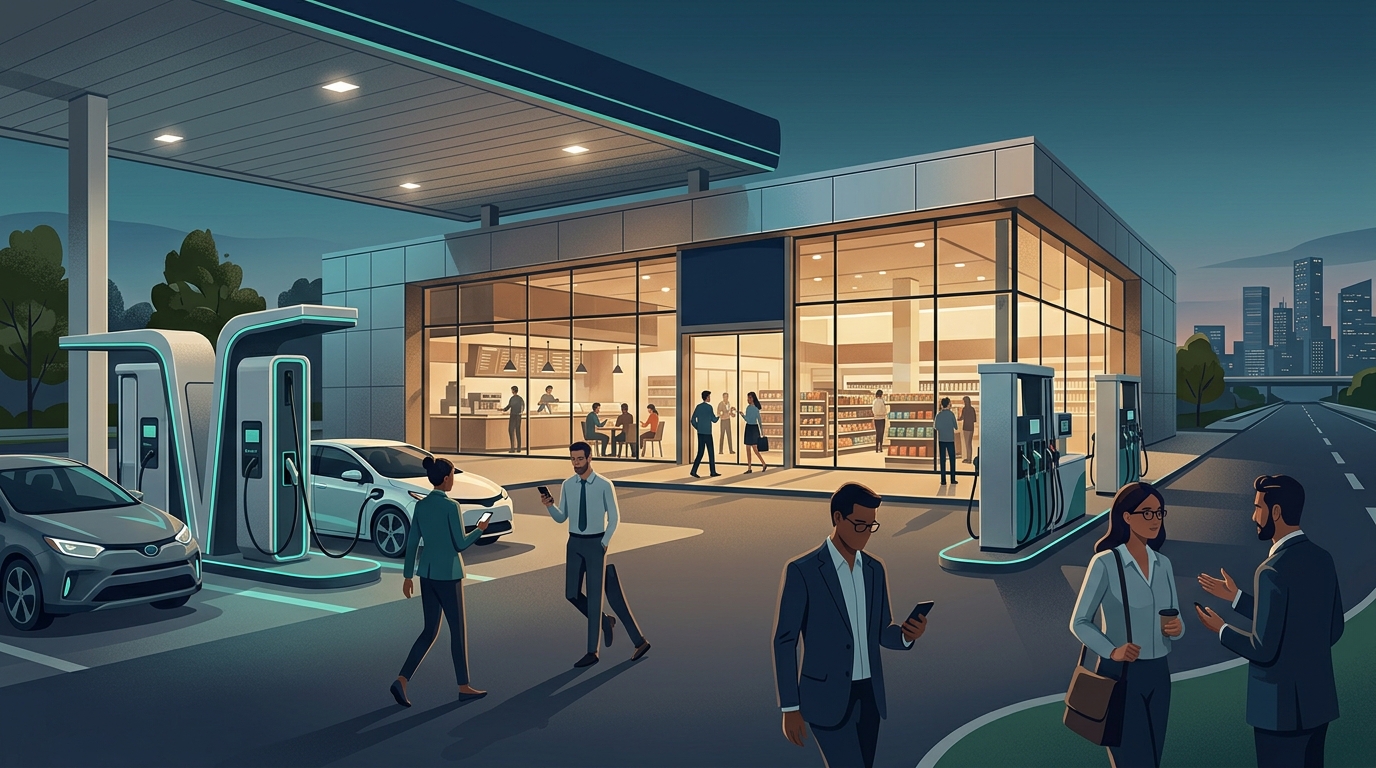
Editorial illustration
Fuel Retail
Forecourt Payment Models: Managing Drive-Off Loss vs. Convenience Retail Dwell Time
Forecourt Payment Models and Theft Prevention Strategies
Rising fuel prices and geopolitical instability have driven sharp increases in unpaid fuel incidents across major global markets. Retailers are consequently forced to evaluate the trade-off between switching to mandatory prepayment systems or investing in hardware-based surveillance and recognition tools.
Global Rise in Unpaid Fuel Incidents
According to reporting by MobilityPlaza, fuel theft incidents have escalated significantly following international conflicts:
- In the United Kingdom, recent data analysis indicated that drivers stole an estimated £194,000 worth of fuel daily in the months after the Iran war broke out. This represents a 20% increase in drive-off incidents and a 48% jump in total stolen value compared to the preceding period.
- In Australasia, the Australasian Convenience and Petroleum Marketers Association recorded a national increase in fuel theft of up to 30% over the same timeframe, costing the fuel retail sector an estimated AU$80 million ($57.2 million) annually.
- Operational responses have varied by region and operator. In 2024, rising theft pushed Petro-Canada to implement mandatory prepayment rules across most of its Ontario stations.
Additionally, data from payment platform Upside highlights how pump prices affect broader store traffic. In-store purchases dropped week-over-week starting in mid-March 2026 as fuel prices escalated, but rebounded after a June US-Iran ceasefire reduced pump prices by approximately 50 cents per gallon.
Strategic Perspectives on Transaction Flow
According to NACS, fueling transactions represent 28% of all transactions at the average convenience store. Maintaining post-payment options allows customers to enter the store to finalize payment, creating opportunities for additional retail purchasing.
Addressing this tension, Aart van Rooijen, CEO of security technology supplier BigBrother, stated that framing payment choices purely as operational decisions overlooks their strategic impact. Van Rooijen argued that when customers no longer enter the store, a site transitions from a retail destination to a commodity fuel point. He noted that license plate recognition, smart data, and real-time alert systems can help manage drive-offs as an operational issue without dismantling customer store flow.
Industry collaboration and dialogue around technology adoption remain active across international forums. As reported on forecourttech.com, Mark Wohltmann, Director of NACS Global, will return as moderator for the forecourttech’26 event. Stephen Bozdan, organiser of forecourttech and managing director of SAB Events, confirmed Wohltmann's role following his moderation of the previous year's event.
Analysis: Operational Hypotheses for Retail Operators
While prepayment software offers an immediate operational reduction in drive-offs without heavy upfront capital expenditure, its long-term impact on overall store basket value requires empirical verification for individual networks.
- Hypothesis 1: Implementing camera-based license plate recognition (LPR) tied to automated pump authorization reduces drive-offs while preserving in-store conversion rates.
- Proposed Test: Conduct a 90-day split-site pilot across 20 high-volume sites, comparing 10 control sites switching to mandatory pre-pay against 10 test sites equipped with real-time LPR alerts and post-payment authorization. Measure net margin by comparing avoided fuel loss against changes in convenience store basket revenue.
- Hypothesis 2: Dynamic payment switching based on time-of-day or customer risk profile mitigates loss during high-risk hours without suppressing peak daytime retail sales.
- Proposed Test: Implement mandatory prepayment exclusively between 22:00 and 06:00 across a 15-station regional trial for six weeks. Track drive-off loss reduction during overnight shifts versus overnight in-store sales volume relative to historical baselines.
EV Charging
Global Commercial EV Trends and Heavy-Duty Charging Outlook
Forecourt Analysis: Global Commercial EV Trends and Heavy-Duty Charging Outlook
Commercial vehicle electrification expanded significantly in 2025, presenting new strategic considerations for forecourt operators assessing dedicated heavy-duty vehicle (HDV) charging infrastructure. According to the IEA Global EV Outlook 2026 Report, global electric truck sales doubled in 2025 to exceed 400,000 units, capturing 9% of total truck sales worldwide.
Market Segmentation and Geographic Adoption
Growth in electric commercial fleets remains concentrated primarily in heavy freight trucks (HFT) and medium freight trucks (MFT). Globally, electric HFT sales reached 230,000 units in 2025, while MFT sales expanded 65% to 210,000. Battery electric powertrains accounted for 97% of all electric truck sales worldwide in 2025, driven by greater cost-competitiveness and a higher number of available models compared to plug-in hybrid alternatives.
Regional adoption rates vary markedly due to differing policy environments and economic support:
- China: Accounted for over 90% of global sales in 2025, exceeding 400,000 electric trucks. One in four trucks sold in China was electric. Adoption was driven by total cost of ownership (TCO) advantages, expanding battery-swapping operations—which represented 15% of Chinese electric truck sales—and government incentives. The renewed scrappage scheme provided up to USD 20,000 to replace older trucks, covering roughly 20-50% of the average electric truck price premium. Additionally, Stage 4 HDV fuel consumption standards took effect in July 2025, requiring a 12-16% fuel efficiency improvement over Stage 3.
- Europe: Electric truck sales grew 40% year-on-year to nearly 17,000 units, representing 3% of regional truck sales. Germany led regional volume with 4,400 sales, supported by EUR 1.6 billion in government funding for electric truck charging infrastructure. The United Kingdom led growth with a 55% increase to top 3,000 sales, while France reached 1,900 and Sweden reached 1,000. Regulatory drivers include EU HDV CO2 standards entering into force in 2025, targeting a 15% emissions reduction compared to 2019 levels. It should be noted that while the EU proposed extending road toll exemptions for battery electric and fuel cell trucks, a proposed extension remains distinct from an approved policy.
- North America: US electric truck sales rose 25% to 17,000 units, though over 95% were MFTs, including nearly 10,000 Rivian delivery vans. US policy momentum slowed, as California’s Advanced Clean Trucks regulation was revoked and the US Environmental Protection Agency repealed all GHG emission standards for medium- and heavy-duty vehicles. Canadian sales grew 35% to 2,700 units.
- Rest of the World: Outside major regions, electric truck sales fell 15% to 1,900 units, despite growth in India where registrations rose from 200 to 800 units.
Bus Electrification and Public Transport Infrastructure
Global electric bus sales grew 12% in 2025 to nearly 70,000 units, with battery electric models representing 98% of total volume. China accounted for roughly 60% of global sales, where electric vehicles made up over 60% of total bus sales and nearly 100% of urban bus sales. European sales rose 28% to over 12,000 units, with electric city bus shares exceeding 55%.
Conversely, US electric bus sales dropped 40% in 2025. Although the US Federal Transit Administration announced USD 2 billion in transit grants, none of the 165 funded projects included electric bus purchases or charging installations, favoring natural gas alternatives instead.
Supplier Range Claims and Operational Considerations
Manufacturer developments reflect advancing battery capabilities across heavy commercial segments:
- Volvo: Announced an electric HFT offering a 600 km driving range planned for Q2 2026, alongside an electric bus chassis unveiled in 2025 enabling up to 700 km range.
- Renault: Unveiled an electric truck model capable of a 600 km driving range.
- Sany: Offers an electric HFT model capable of exceeding 800 km on a single charge.
- Tesla: Claims it will begin deliveries of an 800 km-capable semi-trailer truck in 2026.
Average self-declared ranges currently stand at 270 km for MFTs, 310 km for HFTs, and 360 km for urban battery electric buses.
Forecourt Analyst Perspective: Operational Hypotheses
*Analysis*: While high-power megawatt charging and depot infrastructure are critical for long-haul commercial transport, integrating heavy-duty charging bays into traditional retail forecourts presents unproven commercial outcomes regarding throughput and land utilisation.
- Hypothesis A: Adding dedicated high-power heavy-vehicle charging lanes at highway forecourts will increase overall site revenue by capturing fleet dwell-time spend.
- *Proposed Test*: Operators should run a 12-month pilot program measuring revenue per square meter comparing dedicated truck charging bays against standard ultra-fast passenger EV bays on high-density freight corridors.
- Hypothesis B: Offering standardized truck battery-swapping services at strategic hub locations will improve charger utilization efficiency compared to cable-based fast charging.
- *Proposed Test*: Conduct a comparative operational trial at logistics-adjacent forecourts measuring vehicle turnaround times, grid peak-demand charges, and capital expenditure amortization over 24 months.
C-Store
Petrolimex and Ohmee Launch Pilot Convenience Stores at Hanoi Forecourts
Sourced Developments in Hanoi
In September 2026, fuel retailer Petrolimex partnered with Ohmee Vietnam to launch the first two Ohmee Express convenience stores located at Petrolimex service stations in Hanoi, as reported by MobilityPlaza. These initial locations function as pilot sites designed to evaluate product assortments, operational processes, and customer experience prior to any broader rollout decision.
The retail concept targets specific mobile consumer segments, including urban commuters, ride-hailing drivers, long-distance transport operators, and traveling families. Nguyen Thi Thu Ha, Chairwoman of Ohmee Vietnam, described the launch as a milestone in building a modern convenience ecosystem alongside Petrolimex.
This deployment represents the first international implementation of the Ohmee Express format, which was developed under the overseas expansion strategy of Chinese convenience store operator Meiyijia. Meiyijia was founded in 1997 and currently operates a network exceeding 40,000 stores across China. Vietnam served as Ohmee's initial international market starting in April 2026, with the brand expanding to 35 stores across Hanoi and several northern Vietnamese provinces by early September 2026.
Analysis & Operational Assessment
From an independent forecourt operational perspective, this partnership reflects broader regional efforts to monetize fueling station foot traffic through structured convenience retail. However, business operators evaluating this market entry must carefully separate factual pilot parameters from prospective growth expectations.
Pilot Scope vs. Approved Network Expansion
While Petrolimex holds an extensive fueling footprint throughout Vietnam, the binding scope of this initial agreement is strictly limited to two pilot locations in Hanoi. Operators analyzing this model should note that a strategic partnership or requested expansion does not equate to an approved or guaranteed network-wide store integration. Conducting a localized pilot allows companies to test operational workflows without exposing the broader retail estate to full capital commitment.
Targeting High-Frequency Road Users
The decision to target ride-hailing drivers, commuters, and logistics operators focuses on customer groups with high visit frequency. Proponents often suggest that co-locating retail offerings with fuel dispensers increases overall basket size and non-fuel gross margins. However, within this specific partnership, that operational outcome remains an unproven hypothesis rather than a measured performance baseline.
*Proposed Operational Test*: Forecourt operators considering similar c-store additions should establish a 90-day comparative trial. Managers should measure average basket size, non-fuel conversion rates among drivers, and average pump dwell time at pilot stores against a control group of standard fueling stations with similar traffic volume. This test verifies whether on-the-go food and beverage offerings drive incremental high-margin sales without causing pump congestion.
International Scale and Local Forecourt Adaptation
Ohmee benefits from the substantial backend resources of Meiyijia, which brings deep experience from managing over 40,000 domestic stores in China. However, international scaling requires adapting supply chains and product mixes to regional consumer tastes in Vietnam. Although Ohmee's expansion to 35 locations between April and September 2026 demonstrates swift site deployment, long-term operational performance will depend on achieving sustained profitability within fuel-anchored environments.
QSR & Foodservice
MFG Partners with Lavazza Professional for 600+ UK Forecourt Coffee Upgrades
Network Rollout and Scope
In a September 2026 announcement, Lavazza Professional partnered with Motor Fuel Group (MFG) to deploy over 600 Lavazza Coffee to Go machines across MFG’s network in the United Kingdom by spring 2027. Motor Fuel Group Rollout. This deployment represents a significant equipment addition across one of the UK's largest forecourt networks. Current figures indicate that MFG serves approximately 25 million cups of coffee annually across its combined service station and convenience store footprint.
The agreement expands the deployment of Lavazza On the Move, which is the supplier's automated coffee-to-go solution. Under this commercial arrangement, MFG is designated as the initial operator in the United Kingdom to install Lavazza Professional’s new Coffee Essence hardware platform.
Equipment Features and Beverage Customization
The Coffee Essence machine introduces expanded drink selection capabilities compared to standard automated forecourt dispensers. The equipment allows consumers to select from multiple coffee blends, including decaffeinated options. In addition, customers can customize their beverages using additions such as flavored syrups and extra espresso shots. Beyond traditional coffee, the dispenser menu incorporates alternative beverages including matcha to address shifting customer preferences.
Commenting on the commercial relationship, William Bannister, Chief Executive Officer of Motor Fuel Group, stated that the brand delivers "greater choice along with great value" for forecourt customers.
Operational Data and Analytics
According to supplier specifications reported in the agreement, the Coffee Essence platform incorporates built-in monitoring technology. This capability tracks individual user interactions and beverage consumption patterns. Lavazza Professional positions this feature as a tool to facilitate ongoing operational adjustments and refine customer experience through telemetry and usage insights.
Strategic Context for Forecourt Operators
Forecourt retailers managing high-volume coffee operations typically distinguish between existing baseline sales volume and incremental network upgrades. In this deployment, MFG’s network baseline of approximately 25 million annual coffee sales serves as the operational foundation into which the 600-plus new machines are being integrated.
For independent operators and forecourt managers evaluating hot beverage hardware across UK retail sites, the deployment highlights several clear operational considerations:
- Menu Diversity: Offering non-coffee alternatives such as matcha alongside traditional espresso options caters to broader demographics without increasing counter labor footprint.
- Customization Potential: Enabling customer-led customization through automated additions like extra shots and syrups allows operators to increase average transaction values through premium add-ons.
- Telemetry Integration: Deploying connected machines capable of logging consumption patterns provides store management with concrete data on peak traffic, flavor popularity, and ingredient depletion.
Analysis and Operator Hypotheses
Note: The following section represents independent analytical evaluation separate from sourced factual statements.
While hardware suppliers assert that telemetry and expanded customisation improve operational efficiency and customer experience, forecourt operators should view these claims as operational hypotheses requiring controlled empirical verification rather than guaranteed outcomes.
Hypothesis 1: Labor Reduction and Operational Efficiency
- Supplier Claim Context: Automated telemetry and user monitoring improve operational workflows.
- Proposed Test: Operators should measure labor hours spent on machine maintenance, cleaning, and refilling over a 90-day baseline before implementation versus a 90-day period post-installation. An operator can evaluate whether automated error alerts and consumption tracking lead to measurable reductions in staff intervention time or out-of-stock incidents.
Hypothesis 2: Profit Margin and Transaction Value Improvement
- Supplier Claim Context: Offering expanded syrup options, extra espresso shots, and specialty drinks like matcha enhances value and choice.
- Proposed Test: Retailers should compare basket size, gross margin per unit, and total hot beverage gross profit between sites with standard coffee machines and sites equipped with customizable automated units. A 180-day A/B test across comparable traffic locations will clarify whether premium add-on sales offset higher initial equipment and ingredient costs.
Hypothesis 3: Customer Satisfaction and Retention
- Supplier Claim Context: Interactive customization and broader menu offerings elevate customer satisfaction.
- Proposed Test: Perform quarterly customer intercept surveys and track repeat loyalty app transactions at newly upgraded sites versus control locations to establish whether menu breadth directly correlates with higher repeat visit frequency.
By systematically distinguishing supplier statements and equipment specifications from verified on-site performance metrics, forecourt operators can effectively evaluate automated coffee platform upgrades within their own retail networks.
Host
Welcome to today's forecourt executive briefing. Today, we examine four key shifts across the fuel and convenience landscape: managing fuel drive-offs versus c-store foot traffic, global commercial EV adoption and heavy-duty charging realities, international c-store pilots in Southeast Asia, and automated premium beverage rollouts in forecourt foodservice. Let's start with fuel retail, where rising pump prices and geopolitical tensions have amplified the friction between loss prevention and store dwell time.
Co-Host
Reporting shows a sharp global increase in drive-offs following international conflicts. In the United Kingdom, data indicates drivers stole an estimated 194,000 pounds worth of fuel daily in the months after the Iran war broke out—a 20 percent spike in drive-off incidents and a 48 percent jump in total stolen value. In Australasia, fuel theft rose up to 30 percent, costing the sector an estimated 80 million Australian dollars annually. In response, Petro-Canada made prepayment mandatory across most Ontario stations in 2024. But payment platform data from Upside highlights the broader risk: as fuel prices escalated, c-store purchases dropped week-over-week starting in mid-March 2026, before rebounding after a June US-Iran ceasefire lowered pump prices by about 50 cents per gallon.
Host
That store traffic dynamic is critical because NACS reports that fueling transactions account for 28 percent of all c-store visits. Maintaining post-payment options gives customers a reason to walk inside and spend on non-fuel items. BigBrother CEO Aart van Rooijen points out that framing payment choices purely as operational quick fixes overlooks their strategic impact. He argues that mandatory prepayment turns a site into a commodity fuel point, whereas technologies like license plate recognition, smart data, and real-time alerts can address drive-offs as an operational issue without cutting off customer store flow.
Co-Host
From an analytical standpoint, operators need to test these operational hypotheses. One proposed test is a 90-day split-site trial across 20 high-volume sites—comparing 10 control sites using mandatory prepay against 10 test sites using automated real-time license plate recognition alerts and post-payment authorization. The goal is to measure whether avoided fuel loss outweighs lost c-store basket margin. Another option is dynamic switching, such as testing mandatory prepay strictly between 22:00 and 06:00 across a 15-station regional trial to protect overnight margins while keeping peak daytime retail open.
Host
Moving to commercial EV trends, the IEA Global EV Outlook 2026 shows global electric truck sales doubled in 2025 to over 400,000 units, capturing 9 percent of total truck sales worldwide. Battery electric powertrains represented 97 percent of that volume. However, market growth remains heavily concentrated. China accounted for over 90 percent of global sales with more than 400,000 electric trucks sold, where one in four trucks sold was electric. Adoption there was supported by total cost of ownership advantages, battery-swapping representing 15 percent of sales, scrappage incentives up to 20,000 US dollars, and Stage 4 HDV fuel standards taking effect in July 2025.
Co-Host
In contrast, Western markets show mixed momentum and shifting policy drivers. Europe saw electric truck sales grow 40 percent to nearly 17,000 units, led by Germany with 4,400 sales—backed by 1.6 billion euros in charging funding—and the UK with 55 percent growth to over 3,000 sales. EU heavy-duty CO2 standards took effect in 2025 targeting a 15 percent emissions cut, though operators should note that proposed EU road toll extensions for zero-emission trucks remain a proposal, not an approved policy. Meanwhile, US electric truck sales rose 25 percent to 17,000 units, but over 95 percent were medium freight trucks like Rivian delivery vans. US policy support slowed as California's Advanced Clean Trucks regulation was revoked and federal EPA GHG standards were repealed.
Host
We see a similar contrast in public transport. Global electric bus sales rose 12 percent to nearly 70,000 units, but US electric bus sales dropped 40 percent in 2025. Even though the US Federal Transit Administration announced 2 billion US dollars in transit grants across 165 projects, none included electric bus purchases or charging installations, favoring natural gas instead. On the hardware front, manufacturers are highlighting expanded range claims: Volvo and Renault have announced 600 kilometer range electric trucks, Sany offers models exceeding 800 kilometers, and Tesla claims 2026 deliveries for an 800 kilometer Semi. However, current self-declared average ranges are more modest: 270 kilometers for medium freight, 310 kilometers for heavy freight, and 360 kilometers for urban buses.
Co-Host
For forecourt operators, integrating heavy-duty charging into retail sites involves unproven commercial outcomes regarding throughput and land utilization. Analytical hypotheses suggest operators run controlled trials before heavy capital deployment. For instance, a 12-month pilot on high-density freight corridors could measure revenue per square meter comparing dedicated heavy-vehicle charging lanes against standard passenger EV fast chargers. Alternatively, a 24-month trial at logistics-adjacent sites could evaluate whether standardized truck battery-swapping improves vehicle turnaround times and reduces peak-demand charges compared to cable fast charging.
Host
Next, looking at convenience retail expansion, fuel retailer Petrolimex partnered with Ohmee Vietnam in September 2026 to launch two pilot Ohmee Express c-stores at service stations in Hanoi. Ohmee represents the international expansion format of Chinese operator Meiyijia, which operates over 40,000 domestic stores in China. Since entering Vietnam in April 2026, Ohmee grew to 35 regional locations by September, making these Hanoi forecourt stores its first international station co-locations.
Co-Host
It is important to emphasize scope here: this agreement is strictly a two-site pilot in Hanoi to evaluate product assortment and operational workflows, not a confirmed or approved network-wide rollout across Petrolimex's broader estate. While proponents suggest co-locating c-stores targeting ride-hailing drivers and commuters will lift non-fuel gross margins, that remains an unproven hypothesis for this specific market. An operational test would require a 90-day comparative trial measuring average basket size, non-fuel conversion rates, and pump dwell time at pilot sites against similar control stations to verify whether added retail revenue offsets potential pump congestion.
Host
Finally, in forecourt QSR and foodservice, Motor Fuel Group announced a partnership with Lavazza Professional in September 2026 to deploy over 600 Lavazza Coffee to Go machines across its UK network by spring 2027. MFG currently serves approximately 25 million cups of coffee annually across its service station and c-store footprint, providing a massive existing baseline for this upgrade.
Co-Host
MFG will be the first UK operator to install Lavazza's new Coffee Essence platform. The hardware offers expanded beverage customization, including multiple coffee blends, decaf, extra espresso shots, flavored syrups, and non-coffee options like matcha. The machines also feature telemetry technology designed to monitor user interactions and track beverage consumption patterns.
Host
Analytically, supplier claims that telemetry and customization drive higher operational efficiency and customer retention should be treated as operational hypotheses. Operators evaluating similar hot beverage platforms can test these claims through structured metrics. For example, testing labor efficiency by tracking staff maintenance hours over a 90-day pre- and post-installation period to see if automated telemetry alerts reduce intervention time. Or running a 180-day A/B trial across comparable sites to determine if premium syrup and shot add-ons actually generate higher total gross profit after accounting for equipment and ingredient costs.
Co-Host
To wrap up today's briefing, we leave forecourt operators with three core strategic questions: First, does your forecourt payment strategy evaluate the net margin impact of lost c-store foot traffic against avoided drive-off fuel theft? Second, when analyzing heavy commercial EV opportunities, are you evaluating verified regional fleet baselines and land-yield requirements rather than reliance on OEM range claims? And third, when testing new c-store formats or automated coffee platforms, do you have controlled pilot metrics in place to separate initial equipment capability from sustained gross margin growth?
Host
Thank you for tuning into today's executive briefing. We'll see you tomorrow.