The Daily Forecourt Brief — 2026-09-11
An executive audio briefing across fuel retail, EV charging, convenience stores and foodservice.
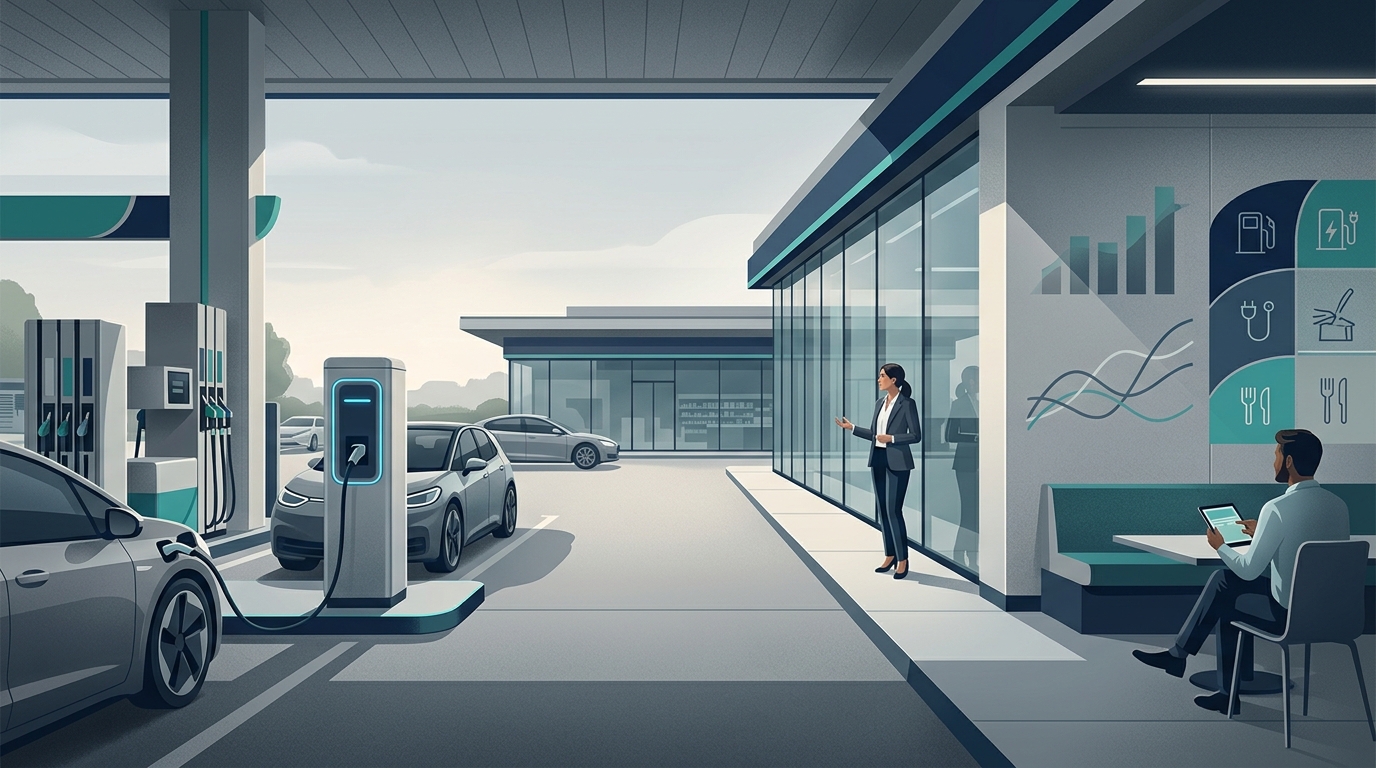
Editorial illustration
Fuel Retail
Market Dynamics in Fuel Retail: Midwest Dealer Acquisitions and European Scale Advantages
Midwest Wholesale Deal Dynamics and European Market Disparities
World Fuel Expands Midwest Distribution Network
In North America, Miami-based supplier World Fuel has completed an acquisition of roughly 33 branded dealer contracts from CF Altitude, as reported by C-Store Dive. These dealer locations are situated across the greater St. Louis metropolitan area spanning Illinois and Missouri. The acquisition strengthens the supplier's footprint in Midwestern wholesale fuel distribution. According to World Fuel spokesperson statements, the organization aims to facilitate a "seamless transition" for station operators while maintaining support tailored to local market conditions.
World Fuel presently provides fuel delivery, major brand portfolios, and related services to over 3,000 independent convenience retailers and truck stop operators across the United States. Bob Kenyon, World Fuel's senior vice president of retail, wholesale, and supply chain, stated that the transaction with CF Altitude "strengthens its distribution network in the Midwest."
The seller entity, CF Altitude, has historical ties to retail operator Alta Convenience. In January 2021, Pester Marketing Company (operating as Alta Convenience) was acquired by a joint venture involving Fortress Investment Group and a subsidiary of Phillips 66. Subsequent SEC documentation from May 2026 noted an association between CF Altitude and Phillips 66. Alta Convenience currently lists more than 100 retail sites across Colorado, Wyoming, and New Mexico, indicating that the newly transferred Midwestern dealer contracts do not involve Alta's core operating store footprint.
Structural Scale and Ecosystem Dynamics in Poland
In European forecourt retail, market dynamics in Poland demonstrate significant structural consolidation among leading entities, detailed in an interview published by forecourttech.com. According to Leszek Jurczak, Member of the NACS Global Industry Engagement Council, market leaders in Poland hold a substantial scale margin over competitors. In the traditional fuel retail sector, state-backed operator ORLEN maintains around 1,900 stations within Poland, whereas the second-largest international competitor, BP, operates approximately 600 sites.
This concentration is even more pronounced in the convenience retail segment. Żabka operates approximately 13,000 stores across Poland, contrasting with Carrefour Express, which operates around 550 locations. Jurczak highlighted "...the extraordinary scale advantage enjoyed by the market leaders." Żabka’s digital penetration is reflected in its Żappka mobile app, which maintains over 10 million registered users out of a national population of approximately 35 million people.
The Polish market context is further characterized by macro-economic growth, with national GDP expanding at around 3.5%. As retail formats evolve, convenience stores are targeting younger consumer demographics, often referred to as the "non-cooking generation," by expanding ready-to-eat foodservice offerings alongside digital customer engagement platforms.
Analysis
Strategic Implications for Wholesale and Dealer Relationships
Wholesale transfers such as World Fuel’s contract acquisition highlight a broader trend toward consolidation among fuel distributors. By acquiring existing dealer contracts rather than developing greenfield sites, distributors secure volume throughput across established regional nodes like the St. Louis metropolitan area. Independent dealers entering new supply agreements must evaluate long-term brand support, contract flexibility, and fuel pricing competitiveness against capital commitment requirements.
Operational Ecosystem Hypotheses for Retail Technology
Industry observers frequently suggest that integrating automated self-service, advanced ordering kiosks, or digital loyalty ecosystems directly leads to labor cost reductions and enhanced operating margins. However, these operational outcomes cannot be generalized without site-specific empirical verification.
- Hypothesis 1 (Labor Cost Reduction via Autonomous Checkout): Deploying unattended retail terminals or self-checkout hardware in high-frequency convenience locations reduces store labor hours required per transaction without decreasing throughput speed.
- *Proposed Empirical Test:* Conduct a 12-month controlled A/B trial comparing labor hours per 1,000 transactions across 20 high-volume sites equipped with automated self-checkout against 20 baseline control sites utilizing standard cashier counter arrangements.
- Hypothesis 2 (Foodservice Integration and Visit Frequency): Implementing expanded fresh food-to-go modules in forecourt stores raises non-fuel transaction frequency among younger consumer segments.
- *Proposed Empirical Test:* Monitor basket analysis and loyalty card scan rates across a representative sample of converted forecourt stores over a six-month post-implementation period to evaluate changes in repeat visit rates and non-fuel basket size.
Operators evaluating operational adjustments or platform acquisitions should treat projected technological efficiencies as hypotheses requiring rigorously measured field trials prior to full-network deployment.
EV Charging
Forecourt EV Infrastructure Upgrades: Analyzing Network Reliability and Capital Allocation Strategies
Modernizing Forecourt Charging Infrastructure: Shell Recharge Germany Strategy
Sourced Operational Updates
Shell Recharge announced that it has modernized 150 fast-charging points across more than 40 locations nationwide in Germany MobilityPlaza. According to Shell Recharge, these infrastructure upgrades were completed by the end of August 2026. The program replaced older charging hardware with new equipment designed to improve technical stability and lower operational issues. Furthermore, Shell Recharge reported that it plans to modernize at least 50 additional charging points in Germany before the end of 2026.
Shell states that at selected participating locations, the modernization program will increase available charging power to improve performance for EV drivers. In addition to hardware swaps, Shell attributes its broader charging service offer to features including multiple payment options, digital services, and continuous site monitoring. Shell currently operates a total network of more than 2,400 fast-charging points across Germany through company-owned forecourts and external partnerships.
Florian Glattes, Head of Shell Mobility Germany, Austria and Switzerland, framed the initiative by stating: "The next phase of e-mobility will not be determined solely by the number of charging points" MobilityPlaza.
The International Energy Agency (IEA) outlines global EV trends in its Global EV Outlook 2026 report IEA, covering charger deployment across light-duty and heavy-duty vehicles alongside battery manufacturing developments.
Operational Context: Upgrades vs Network Totals
For forecourt operators reviewing network metrics, it is vital to distinguish between existing network scale, net additions, and hardware upgrades. Shell’s total existing footprint of over 2,400 fast-charging points in Germany represents its overall operational baseline. The 150 modernized fast-charging points across 40 locations—and the additional 50 points targeted before the end of 2026—do not represent net new additions to the network footprint. Instead, these represent legacy equipment replacements aimed at sustaining operational stability. Operators tracking EV site economics should keep hardware replacement cycles separate from site expansion capacity.
Additionally, while Shell notes that maximum available charging power will increase at selected upgraded locations, maximum rated power figures describe peak hardware capability rather than measured, real-world power delivery or continuous session throughput.
Analysis: Testing the Reliability Hypothesis
Hardware stability is widely discussed as a driver of customer retention, but unmeasured operational benefits should be treated as hypotheses rather than established conclusions.
Hypothesis 1: Proactively replacing legacy fast-charging hardware with upgraded units improves uptime and reduces site maintenance visits. Proposed Test: Site operators should measure mean time between failures (MTBF) and average daily offline hours across upgraded sites for 12 months, comparing these metrics against a control group of unmodernized legacy chargers at similar location types.
Hypothesis 2: Increasing peak charging power and implementing continuous digital monitoring increases dwell time spent in adjacent convenience retail stores. Proposed Test: Implement point-of-sale tracking to monitor average basket size and total inside-store sales generated by EV drivers before and after hardware replacement, controlling for seasonal traffic variations.
Strategic Takeaways for Forecourt Managers
When planning EV charging asset lifecycle strategies, forecourt managers should incorporate structured maintenance and hardware replacement timelines:
- Audit Existing Assets: Identify aging charger hardware reaching end-of-life or experiencing elevated fault rates.
- Separate Expansion from Sustaining Capital: Allocate capital budgets clearly between greenfield location builds and sustaining hardware refreshes.
- Establish Verification Protocols: Test whether modernized chargers deliver measurable reductions in downtime before scaling hardware replacement across all regional forecourt locations.
C-Store
Forecourt & C-Store News: Supplier Mergers and Flagship Urban Network Expansion
Forecourt and C-Store Market Update: Consolidation in Merchandise and Urban Format Expansion
Market developments across the convenience and forecourt sectors show strategic supplier consolidation alongside physical store network expansions in urban centers. In supply chain operations, supplier acquisitions are expanding cross-channel retail reach across health and personal care categories. Concurrently, European convenience retailers continue expanding physical footprints by introducing multi-level flagship locations that blend traditional convenience retail with experiential foodservice and technology features.
Supplier Consolidation: Lil’ Drug Store Products Acquires Navajo Portfolio
In North American general merchandise distribution, Iowa-based supplier Lil’ Drug Store Products (LDSP) completed an acquisition of the health, beauty, and wellness division of consumer products company Navajo Inc. The transaction, announced in September 2026, officially took effect on Sept. 4. The acquisition includes Navajo’s trial and travel business, allowing LDSP to expand its portfolio in health and personal care items.
According to company data, LDSP's health and beauty items reach more than 100,000 convenience stores and gas stations across the United States, while its total footprint encompasses more than 180,000 retail locations across convenience, travel, hospitality, and alternative retail channels. Following the divestment, Navajo will continue to own and operate its eyewear, mobile electronics, and general merchandise divisions.
Supplier statements frame the acquisition as a channel expansion strategy. Chris DeWolf, president and chief executive officer of LDSP, stated that the transaction provides brand partners with a "more comprehensive retail solution" by combining LDSP’s established leadership in convenience and travel channels with Navajo’s presence in grocery and drug retail.
For further background, details are available in the full report from C-Store Dive.
Network Footprint Expansion: Żabka Opens 13,000th Store in Warsaw
In European retail expansion, Polish convenience operator Żabka celebrated a network total milestone by opening its 13,000th store on Marszałkowska Street in central Warsaw. Situated inside the Wars Sawa Junior Department Store complex, the location is operated by franchisee Piotr Jaworski.
The store spans more than 170m² across two levels. The ground level houses standard convenience merchandise, an expanded hot foodservice menu—including wraps, pizza, casseroles, nuggets, and a customized burger—alongside self-service beverage and meal heating stations, power bank rentals, and self-service printing. The upper level includes a café space overlooking the city center, seating, pastries, phone charging equipment, and a dedicated virtual entertainment gaming zone.
On the technology front, the store features what the company describes as Europe's first transparent outdoor LED display, designed to present three-dimensional visual displays while permitting natural light to enter the retail space. Chief Executive Officer of Żabka Polska, Adam Manikowski, attributed the milestone to operational strategy, noting that the network scale offers "proof of the effectiveness of our business model" in combining retail, foodservice, and digital services.
For additional information on this location, review the report published by MobilityPlaza.
Analysis: Operational Hypotheses and Performance Evaluation
The structural developments highlighted across these two announcements highlight distinct operational strategies for convenience operators: supplier consolidation for multi-channel product availability and flagship format diversification for high-density urban foot traffic.
Hypothesis 1: Multi-Channel Supplier Scale and Inventory Stability
- *Hypothesis*: Consolidating health, travel, and personal care distribution under a single primary supplier across convenience, grocery, and drug channels reduces wholesale out-of-stock rates for high-velocity travel-size SKUs.
- *Proposed Test*: Operators should compare 90-day product fill rates, lead times, and distributor unit costs before and after supplier consolidation across sample store clusters to measure fulfillment reliability.
Hypothesis 2: Multi-Level Experiential Services and Urban Dwell Time
- *Hypothesis*: Allocating upper-level square footage to dedicated seating, phone charging, and interactive gaming zones increases average customer dwell time and secondary foodservice attachments without bottlenecking ground-floor point-of-sale throughput.
- *Proposed Test*: Operators can measure hourly POS transaction velocity on the ground floor while tracking average dwell time and cafe/dessert basket values on upper levels during peak urban traffic hours over a 60-day trial period.
QSR & Foodservice
Fall Menu Strategies in Convenience Forecourts: Seasonal Flavors and Value Bundles
Fall Menu Strategy in Convenience and Mobile Forecourt Dining
Sourced Industry Developments
Seasonal menu rotations remain a primary tool for driving customer visits across convenience store forecourts and QSR beverage operators during autumn transition periods. On September 11, 2026, NACS reported that convenience retailer Wawa introduced seasonal coffee options alongside value bundling. Wawa re-introduced pumpkin, churro, and s'mores coffee varieties together with the limited-time Pancake Sizzli sandwich, composed of sausage, egg, and cheese. Additional Sizzli items include bacon, egg, and cheese bagels as well as sausage, egg, and cheese croissants.
To capture morning traffic, Wawa structured a temporary promotion running from September 8 to October 25. The $5 Sizzli Meal bundles a Wawa Sizzli breakfast sandwich, a side hash brown, and any size hot or iced coffee. For the first time, customers can substitute any size fountain beverage into the meal deal. Furthermore, Wawa set a promotional price baseline for all iced espresso and matcha drinks starting at $3 through November 29, featuring options such as the pumpkin brûlée iced latte, pumpkin iced matcha, and s'mores iced latte. Doug Martin, chief marketing and brand officer at Wawa, stated that the company seeks to combine preferred seasonal flavors with daily value to ease morning routines for returning school and work commuters.
In the mobile QSR segment, QSR Magazine reported on September 11, 2026, that Travelin' Tom's Coffee launched a limited-time fall menu across participating trucks nationwide. The seasonal promotion runs from September through October, subject to supply availability. The lineup introduces two main beverages: Pumpkin Pie, combining spiced pumpkin, vanilla, and cinnamon, and Spiced Apple Chai-der, fusing spiced chai with apple cider. Travelin' Tom's allows patrons to customize both options into hot, iced, or frozen formats. Founder and CEO Tony Lamb highlighted Pumpkin Pie as a customer favorite, targeting event sites, workplaces, and local schools.
Data cited by NACS from Placer.ai illustrates the broader market impact of seasonal launches. When Starbucks launched its autumn menu on August 25—featuring its Pumpkin Spice Latte alongside banana and pecan offerings—the chain logged its highest Tuesday foot traffic for 2026. Daily visits rose 25.7% above the company's 2026 year-to-date average and 35.1% above an average Tuesday. Launch day traffic also exceeded the 2025 autumn launch by 6.7%.
Operational Conditions and Promotional Scope
For operators analyzing these releases, specific execution guidelines define each program:
- Wawa $5 Sizzli Meal: Eligible from September 8 to October 25 at participating Wawa locations. Includes one Sizzli sandwich, one hash brown, and one hot coffee, iced coffee, or fountain drink of any size.
- Wawa Iced Beverage Offer: Applies to all iced espresso and matcha beverages starting at $3, valid through November 29.
- Travelin' Tom's Fall Lineup: Valid from September through October at participating mobile units, while supplies last. Covers hot, iced, and frozen formats for requested events, schools, and workplaces.
Analysis: Strategic Hypotheses for Forecourt Operators
*Note: The following analytical commentary represents independent market hypotheses and proposed testing frameworks rather than verified outcomes.*
Seasonal beverage additions and value-focused breakfast bundling are widely adopted to increase morning transaction volumes, but their economic impact depends heavily on site traffic patterns and operational margin profiles.
Hypothesis 1: Fountain Beverage Inclusion Expands Breakfast Appeal
*Hypothesis*: Allowing fountain drinks within a $5 breakfast bundle attracts non-coffee drinkers without degrading overall bundle profitability. *Proposed Test*: Compare unit sales and gross margin percentages at sites offering fountain drink substitutions versus control locations offering coffee-only breakfast combos over a six-week trial. Measure whether incremental overall transaction count offsets lower unit margins on fountain syrup versus brewed coffee.
Hypothesis 2: Temperature Customization Prevents Weather-Driven Sales Dips
*Hypothesis*: Offering seasonal flavor profiles (such as pumpkin or chai cider) in iced and frozen variants preserves seasonal beverage volume during unseasonably warm early-autumn days. *Proposed Test*: Track daily sales volume ratio of hot versus cold seasonal drinks correlated against local daily temperature metrics across mobile or forecourt locations. Measure whether cold seasonal menu availability stabilizes total daily beverage revenue when temperatures exceed regional seasonal averages.
Hypothesis 3: Discounted Entry-Level Pricing for Specialty Tea and Espresso Drives Cross-Category Conversion
*Hypothesis*: Setting a $3 promotional entry price on specialty iced matcha and espresso encourages core drip-coffee consumers to trade up to higher-margin specialty categories post-promotion. *Proposed Test*: Analyze loyalty program tracking data before, during, and 30 days after a $3 pricing campaign to calculate the repeat purchase rate of specialty drinks at full price among previously drip-coffee-exclusive customers.
Host
Welcome to today's executive briefing. We are covering major strategic movements across fuel retail, EV charging infrastructure, convenience merchandise distribution, and seasonal QSR menu strategies. Across all four sectors, we are tracking a clear pattern: physical network expansion, strategic supply chain consolidation, and aggressive seasonal promotions. But as always, we will separate reported operational facts from unmeasured hypotheses and vendor claims. Let's start with regional wholesale moves in the U.S. Midwest fuel market.
Co-Host
That's right. Miami-based supplier World Fuel has completed the acquisition of approximately 33 branded dealer contracts from CF Altitude. These dealer locations sit across the greater St. Louis metropolitan area in Illinois and Missouri, expanding World Fuel's Midwest wholesale distribution footprint. World Fuel currently supplies fuel delivery and brand services to over 3,000 independent convenience retailers and truck stop operators nationwide. It is also helpful to clarify the seller background: CF Altitude has historical ties to Alta Convenience, which was acquired in 2021 by a joint venture involving Fortress Investment Group and a Phillips 66 subsidiary. Alta's core operating footprint of over 100 stores across Colorado, Wyoming, and New Mexico is not part of this transaction.
Host
This wholesale acquisition highlights regional consolidation in North America, which stands in contrast to the structural scale margins seen in European forecourts like Poland. In Poland, state-backed operator ORLEN maintains around 1,900 traditional stations compared to BP's approximately 600 sites. In convenience, Żabka operates roughly 13,000 locations compared to Carrefour Express's 550, supported by a digital loyalty app with over 10 million registered users in a nation of 35 million people. Now, while industry observers often claim that deploying automated self-checkout or digital ecosystems directly reduces labor costs and boosts operating margins, those outcomes are hypotheses that require site-specific empirical verification, such as controlled A/B trials, rather than assumed facts.
Co-Host
Moving to forecourt EV infrastructure, Shell Recharge announced that it modernized 150 fast-charging points across more than 40 locations in Germany by the end of August 2026, with plans to modernize at least 50 additional points before the end of the year. For operators reviewing network statistics, it is vital to distinguish between total footprint, net additions, and hardware upgrades. These 150 modernized chargers do not represent net additions to Shell's total German network of over 2,400 fast-charging points. Instead, they represent legacy hardware replacements intended to improve technical stability.
Host
In addition, while Shell notes that maximum available charging power will increase at selected upgraded locations, maximum rated power describes peak hardware capability rather than measured real-world session throughput. Whether replacing legacy fast chargers actually reduces maintenance downtime or increases store dwell time remains an unverified hypothesis. Forecourt managers should separate sustaining hardware refresh budgets from greenfield expansion budgets and measure mean time between failures against unmodernized legacy control units over a 12-month period before drawing firm conclusions.
Co-Host
In convenience merchandise, Iowa-based supplier Lil' Drug Store Products acquired the health, beauty, and wellness division of consumer products company Navajo Inc, effective September 4, 2026. This acquisition adds Navajo's trial and travel business to Lil' Drug Store Products' portfolio, which currently reaches over 100,000 convenience stores and gas stations, and more than 180,000 total retail locations. Navajo will retain its eyewear, mobile electronics, and general merchandise divisions. From an operational standpoint, consolidating health and personal care categories under a single primary supplier across channels may improve inventory stability, but operators should track product fill rates over a 90-day window to confirm fulfillment reliability.
Host
On the physical store network side, Żabka celebrated a milestone by opening its 13,000th store on Marszałkowska Street in central Warsaw. The flagship store spans over 170 square meters across two levels. The ground level houses standard convenience items and an expanded hot foodservice menu, while the upper level includes a café space, seating, phone charging stations, and a virtual gaming zone. The store also features a transparent outdoor LED display. While the multi-level design aims to capture high-density urban foot traffic, whether upper-floor experiential amenities increase overall dwell time and secondary foodservice sales without bottlenecking ground-floor checkout velocity is an operational hypothesis requiring direct POS basket tracking.
Co-Host
Turning to QSR and foodservice, autumn menu rotations are underway across convenience forecourts and mobile operators. Wawa reintroduced seasonal pumpkin, churro, and s'mores coffees alongside its Pancake Sizzli sandwich. To target morning commuters, Wawa structured a temporary $5 Sizzli Meal promotion running from September 8 to October 25, which includes a Sizzli sandwich, a hash brown, and—for the first time—a choice of hot coffee, iced coffee, or any size fountain beverage. Wawa also established a promotional price baseline starting at $3 for iced espresso and matcha drinks through November 29.
Host
In the mobile QSR segment, Travelin' Tom's Coffee launched a limited-time fall menu across participating trucks nationwide, running from September through October, subject to supply availability. Their seasonal lineup introduces Pumpkin Pie and Spiced Apple Chai-der, customizable in hot, iced, or frozen formats. Broader market data cited from Placer.ai underscores the traffic impact of seasonal launches: when Starbucks launched its fall menu on August 25, 2026, it recorded its highest Tuesday foot traffic of the year, up 25.7% over its 2026 year-to-date daily average and 6.7% above its 2025 launch day.
Co-Host
However, convenience and forecourt operators evaluating these menu strategies should treat the financial benefits as hypotheses to be tested. For example, allowing fountain drinks within a $5 breakfast bundle is intended to attract non-coffee drinkers, but operators need to track unit sales and gross margin percentages to confirm that incremental transaction volume offsets lower unit margins on fountain syrup versus brewed coffee. Similarly, offering iced and frozen options for seasonal spiced drinks may protect sales during warm early-autumn days, but that requires correlating local daily temperatures with sales ratios across locations.
Host
That brings us to our final synthesis. Across wholesale fuel consolidation, EV hardware maintenance, supplier portfolio acquisitions, and seasonal menu bundling, retail leaders must maintain a clear distinction between strategy deployment and measured operational performance. Rather than assuming technological or promotional efficiency, executive teams should establish rigorous field verification protocols. To close today's briefing, let's review the core operational questions that site managers and executives should be asking right now.
Co-Host
First, on EV asset lifecycle and capital allocation: Are you clearly separating sustaining capital budgets—such as charger hardware replacements—from greenfield expansion capital, and are you measuring mean time between failures to verify uptime improvements before scaling swaps across your network? Second, regarding merchandise supply chains: Following distribution consolidation in health and travel categories, are you actively tracking 90-day product fill rates and lead times to confirm fulfillment reliability?
Host
Third, on foodservice bundling and pricing: When introducing value meal deals or entry-level promotional pricing on specialty beverages, are you tracking gross margin percentages and post-promotion repeat purchase rates to verify that customers actually trade up to higher-margin categories? And fourth, on retail technology and store formats: Before investing in multi-level flagship features or automated checkout systems, are you conducting controlled field trials to evaluate their real impact on labor hours, store throughput, and customer dwell time?
Co-Host
Asking those structured operational questions ensures that capital and resources are deployed effectively across every forecourt and retail node. That wraps up today's executive briefing. Thanks for joining us, and we will see you tomorrow.