The Daily Forecourt Brief — 2026-09-16
An executive audio briefing across fuel retail, EV charging, convenience stores and foodservice.
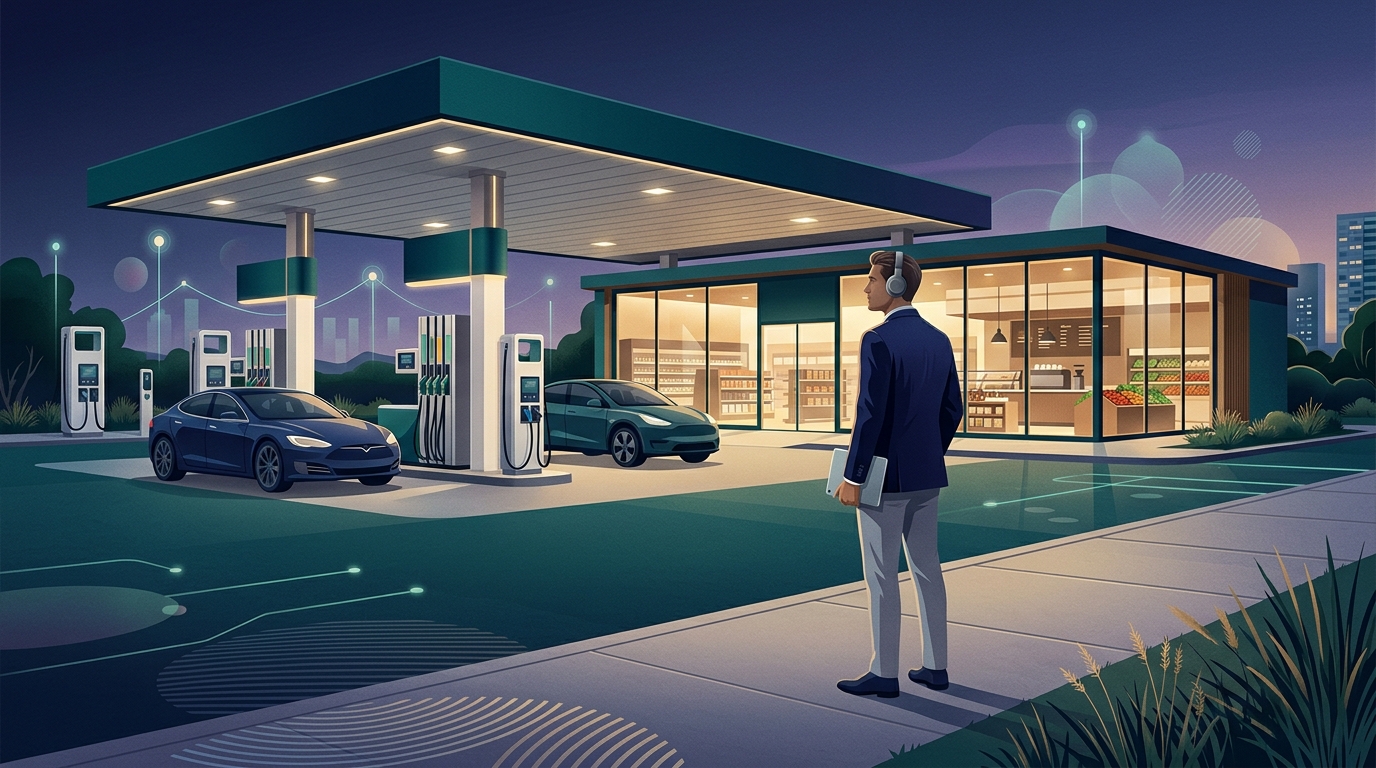
Editorial illustration
Fuel Retail
Forecourt Strategy Update: Loyalty Analytics and Expanded Destination Formats
Fuel Retail Transformation: Loyalty Analytics and Destination Formats
Fuel retailers globally are adjusting forecourt strategies to adapt to shifting consumer behaviors, pursuing digital engagement infrastructure on one end and large-format destination sites on the other. Recent developments from United Refining in North America and ADNOC Distribution in the Middle East illustrate these contrasting approaches, as detailed in reports from C-Store Dive and MobilityPlaza.
United Refining Partners with PAR Technology for Kwik Fill Loyalty
In September 2026, convenience retailer and oil supplier United Refining announced a partnership with retail technology vendor PAR Technology to build a customer engagement platform from scratch for its Kwik Fill convenience stores. United Refining operates a store network of more than 300 locations across New York, Pennsylvania, and Ohio, with approximately 250 operating under the Kwik Fill banner.
The technology stack incorporates the PAR Retail platform to manage loyalty, mobile applications, enterprise intelligence, and tobacco loyalty capability. Additionally, Kwik Fill will utilize PAR Intelligence to process customer insights and support operational decision-making across guest engagement, marketing, merchandising, and operations. The announcement did not specify an operational rollout schedule or confirm whether deployment will encompass the full network or a subset of stores.
Corporate and supplier representatives characterized the deployment as a foundational step for guest insight:
- Roy Williams, senior vice president of marketing at United Refining, stated that the company sees "tremendous opportunity to leverage the platform as we continue enhancing the experiences we deliver to our guests."
- Jake Kiser, general manager of PAR Retail, stated that Kwik Fill is making a "meaningful investment in understanding their customers at a level they haven’t been able to before."
ADNOC Distribution Expands Destination-Driven "The Hub" Sites
In the Middle East, ADNOC Distribution is accelerating its high-dwell destination strategy. Following the launch of its initial site in Shawamekh in November 2025, ADNOC Distribution established six Hub sites by the end of 2025 and planned six additional locations during 2026. Current active sites across Abu Dhabi include Shawamekh, Saadiyat Island, Riyadh City, and Khalifa City.
The Hub format features a retail footprint three times larger than a standard ADNOC service station and operates around a five-pillar concept: Fuel (including fast-EV charging), Food, Flex, Fix, and Future Ready. Key specs, metrics, and targets include:
- Network Targets and Financial Projection: ADNOC Distribution targets 30 Hub locations by 2030, which are expected to contribute approximately $30 million in annual EBITDA. This initiative supports a network-wide objective to double non-fuel retail transactions by 2030 compared to a 2023 baseline.
- Measured Sales Performance: The first six operational Hub sites achieved fuel volume growth significantly above the company's broader network average.
- EV Charging Infrastructure: The E11 EV Mega Hub along the Abu Dhabi–Dubai corridor features 60 high-speed charging points capable of charging standard electric vehicles from 0% to 80% in approximately 20 minutes. A twin site across the highway is slated to add 40 fast chargers.
- Foodservice and Supply Sourcing: A strategic agreement with Americana Restaurants aims to deploy up to 200 quick-service restaurants across 12 global brands throughout ADNOC's broader network. Furthermore, over 30% of products sold within the Oasis by ADNOC convenience concept are sourced locally.
Analysis & Hypotheses for Forecourt Operators
To evaluate these investments objectively, forecourt operators must isolate vendor assertions from verified operational results.
- Hypothesis 1 (Enterprise Loyalty Analytics): Deploying unified customer engagement software increases repeat store visit frequency and total basket margins across regional forecourt chains.
- *Proposed Test*: Track 90-day pre- and post-implementation basket composition and transaction frequency between a test cohort of digitized Kwik Fill stores and an unintegrated control group, deducting platform licensing fees from net margin gains.
- Hypothesis 2 (Destination Footprint Expansion): Tripling site retail square footage and introducing extended dwell amenities (e.g., work pods, expanded F&B) generates net non-fuel profit growth that offsets higher capital expenditure.
- *Proposed Test*: Compare 12-month non-fuel EBITDA per square meter between standard forecourts and large-format Hub sites across comparable traffic corridors.
EV Charging
Commercial EV Infrastructure Expansion and Global Battery Market Dynamics
Commercial EV Infrastructure and Global Battery Market Dynamics
Forecourt and logistics site operators are evaluating heavy-duty charging infrastructure alongside shifting battery supply dynamics. The deployment of commercial EV infrastructure offers insights for fleet managers and site developers balancing capital investment with operational requirements.
Logistics Fleet Electrification: The Lidl Netherlands Case
In the Netherlands, Lidl Netherlands has inaugurated its sixth fast-charging hub, completing the charging infrastructure needed to support its goal of supplying all stores in the country with fully electric trucks by 2027 MobilityPlaza Article. The new charging facility is located at Lidl's distribution center in Waddinxveen and serves stores across South Holland and parts of Utrecht. The hub's operations utilize 100% renewable electricity, including solar power generated directly at the distribution center.
To maximize operational throughput and offset infrastructure costs, the retailer is opening the hub to external commercial fleets. Local transport companies, businesses and logistics operators will be able to access the charging infrastructure through reserved time slots and preferential charging rates. Attributing supplier statements, Ruud Metten, Head of Transport at Lidl Netherlands, stated: "With the rollout of this project, we are demonstrating that a long-term vision pays off," noting that large-scale electric freight transition is achievable.
Global EV Battery Deployment and Market Trends
According to the International Energy Agency's reporting in the IEA Report, global EV battery deployment expanded significantly in recent years. In 2025, EV battery deployment reached 1.2 TWh, an increase of almost 30% compared to 2024. While Light‑duty vehicles remained the dominant segment, representing more than 85% of the 2025 EV battery deployment, commercial heavy-duty vehicles showed notable gains. Specifically, electric trucks accounted for about 8% of global EV battery deployment in 2025, up from less than 5% in 2024.
Key quantitative facts on global battery economics include:
- Average battery prices declined by 8% in 2025 across all applications.
- In 2025, LFP battery packs were more than 40% cheaper on average than lithium nickel manganese cobalt oxide (NMC) alternatives per kWh.
- In 2025, LFP batteries accounted for over 55% of EV batteries deployed globally, up from nearly 50% in 2024.
- In 2025, battery pack prices in China were 30% lower than in North America, and 35% lower than in Europe.
- Global nameplate manufacturing capacity for lithium‑ion batteries reached more than 4 TWh by the end of 2025.
- Among major suppliers, CATL maintained strong profitability, recording operating margins of 10‑15% each year between 2020 and 2024, and 18% in 2025.
Analysis: Operational Implications for Forecourt and Depot Charging Operators
Fact vs. Analysis Distinction
The facts established by market reporting demonstrate rapid growth in heavy-duty battery demand alongside shifting regional pack price differentials. My independent analysis examines how these trends shape depot charging strategy and forecourt monetization.
Depot Hub Utilization and Shared Access
Opening private depot charging hubs to external fleets, as seen at Waddinxveen, represents a growing asset-sharing model. While this strategy aims to generate secondary revenue and optimize asset use, claims that shared charging automatically increases site margins remain unproven.
*Hypothesis for Business Operators:* Monetizing off-peak charging capacity via reserved slots for third-party logistics operators increases net asset utilization without interfering with primary fleet delivery schedules. *Proposed Operational Test:* Implement a 90-day trial offering dedicated off-peak evening time slots to three external logistics partners. Measure net revenue per kWh against operational downtime, maintenance wear, and dispatch conflict incidents.
Chemistry Selection and Hardware Performance
The hardware cost advantage of LFP packs over NMC alternatives reduces battery pack capital expenses for commercial vehicles. However, forecourt and logistics operators must distinguish between nameplate charger power ratings and measured vehicle charging performance. High-capacity depot chargers rated for maximum DC throughput may experience reduced charging speeds depending on vehicle battery thermal conditions and state-of-charge curves.
*Hypothesis for Depot Planning:* Installing dual-standard ultra-fast DC chargers equipped with intelligent dynamic power sharing improves overall station throughput during peak depot dwell windows compared to fixed-power output chargers. *Proposed Operational Test:* Compare total daily energy delivered and vehicle turnaround times between fixed 150 kW outputs and dynamically managed 300 kW shared-power cabinets across a six-week monitoring period.
C-Store
C-Store Fleet Loyalty Strategies and Network Growth: September 2026 Industry Review
Fleet Promotions and Loyalty Initiatives for September 2026
During National Truck Driver Appreciation Week (September 13–19, 2026), major convenience store operators and travel centers announced targeted marketing promotions and reward initiatives to engage commercial transport fleets. According to NACS, participating brands established specific qualification criteria, timing windows, and participating-location rules.
At Dolly’s Tennessean Travel Stop in Cornersville, Tennessee, complimentary items available during the event include self-serve Cup of Ambition coffee at the retail store, two-scoop hand-dipped ice cream at the coffee shop, a BBQ grab-and-go meal with Lay’s Classic chips and a fountain drink, and direct line-skip access to reserved seating in the dining host area.
RaceTrac extended its driver promotions across all 30 days of September, specifically catering to registered RaceTrac Rewards users who select "semi-truck" under their professional app profile. Valid across RaceTrac Travel Center and Extended Diesel Offer sites, qualified guests receive one weekly free pizza slice, one weekly fountain drink, one weekly 16 oz energy drink (Reign, Bang, Nos, or Full Throttle), and double loyalty points on fuel purchases throughout the month.
Pilot returned its annual Road Warrior contest, offering a grand prize consisting of a Kenworth W990 truck customized by the Diesel Brothers alongside a $50,000 cash prize. In addition, Pilot travel centers are distributing three free drinks and a snack weekly during September via in-app deals.
Rutter's restricted its promotion to CDL-licensed drivers presenting a valid Commercial Driver's License at checkout across all store locations. Qualifying drivers receive one free hot coffee, fountain drink, or slushie of any size per day during the seven-day celebration.
Love’s Travel Stops structured its September app-exclusive promotions around double in-store points, triple points on beverage refills, and rotating weekly food deals including BOGO breakfast sandwiches (Sept 7–13), a free egg cup with a 3-count Drummies order (Sept 14–20), BOGO tacos (Sept 21–27), and a buy-two-get-one-free deal on Old Wisconsin 3 oz Meat Snacks (Sept 13–19).
Regional Chain Expansion Strategies: TXB Case Study
While travel centers leverage promotions to secure driver loyalty, regional convenience store chains are restructuring leadership to execute multi-year physical store growth. As reported by C-Store Dive, Texas Born (TXB) recently hired Nate Brazier—former President and CEO of Idaho-based Stinker Stores—as President to support operational execution alongside CEO Kevin Smartt.
TXB currently operates 54 store locations and aims to double its store network to over 100 locations within the next five years. To accomplish this objective, TXB plans to build four to six organic stores annually while aiming for a total of seven to ten annual location additions through a combination of new construction and strategic M&A deals. CEO Kevin Smartt noted that geographic expansion outside Texas remains a lower priority for the immediate future.
Analysis and Operational Hypotheses
Analysis *Note: The following section represents analytical synthesis and framed hypotheses by an independent analyst, clearly distinguished from primary factual source disclosures.*
Operators evaluating driver appreciation campaigns must distinguish between short-term promotion costs and long-term customer lifetime value. Seasonal giveaway campaigns require precise POS verification (such as CDL scans or app persona settings) to restrict redemption exclusively to target fleet personnel, preventing margin leakage from non-qualifying foot traffic.
Similarly, regional scaling strategies like TXB’s require rigorous site-level evaluation. Growing from 54 to 100+ stores creates supply chain and field leadership complexities that cannot be solved solely through real estate acquisitions.
*Hypothesis 1: Targeted Loyalty Personas and POS Verification* It is hypothesized that restricting promotional redemptions to app profiles verified as semi-truck operators (such as RaceTrac's model) increases long-term app registration and repeat diesel visits compared to unverified cashier-checkout giveaways. *Proposed Test:* Compare 90-day post-promotion fuel frequency and app retention rates among registered professional profiles versus unverified promotional redemption baseline cohorts across participating locations.
*Hypothesis 2: Modular Foodservice Scaling in Regional M&A Acquisitions* It is hypothesized that integrating standardized proprietary food service modules into newly acquired M&A locations within 120 days of closing raises inside sales per square foot faster than maintaining legacy store layouts. *Proposed Test:* Track month-over-month inside same-store sales and gross margin percentage on newly converted M&A sites over a 12-month post-integration period against non-converted control sites.
QSR & Foodservice
Forecourt Foodservice Innovations: Media Partnerships and Fresh Food Formats
Overview of Recent Forecourt Foodservice Initiatives
Forecourt and convenience store operators continue to test new concepts to boost brand visibility and capture market share in the quick-service restaurant (QSR) space. Two distinct strategies recently launched in September 2026 highlight how convenience brands leverage digital media partnerships and physical store format pilots to elevate their foodservice offerings.
In the United States, Altoona, Pennsylvania-based operator Sheetz launched a digital content marketing initiative on YouTube in collaboration with media studio First We Feast, as reported by CSP Daily News. Meanwhile, European operator Valora partnered with German energy firm team energie to pilot a fresh food convenience store concept at service stations in northern Germany, according to MobilityPlaza.
Media Partnerships and Brand Promotions: Sheetz "Fuel Stop Feast"
On September 4, 2026, Sheetz debuted a three-episode YouTube miniseries titled "Fuel Stop Feast" produced alongside First We Feast. Host Adam Richman guides the series, where Chefs Christian Alquiza and Ian Fujimoto compete to construct custom culinary items using Sheetz products.
The programming schedule consists of three specific episodes:
- September 4, 2026: A breakfast battle between Chefs Alquiza and Fujimoto.
- September 11, 2026: A contest focused on sandwich creations.
- September 18, 2026: A late-night snack competition.
According to Sheetz, the host challenged the participating chefs "to cook up over-the-top menu creations that feature Altoona, Pennsylvania-based Sheetz’s signature Made-to-Order (MTO) food" while incorporating convenience items as menu hacks.
Format Expansion in Europe: Valora and team energie Pilot
In Germany, Swiss retail company Valora and German energy provider team energie announced a joint pilot project on September 15, 2026. The initiative introduces Valora's "avec" store format to selected forecourt locations.
Key details of the pilot include:
- Scope: The initial phase encompasses eight team service stations across northern Germany.
- Format Focus: The avec model centers on a "foodvenience" concept, combining traditional convenience store merchandise with fresh food and prepared options tailored for on-the-go consumers.
- Evaluation: The participating companies plan to evaluate customer adoption and operational performance across the initial test sites before considering broader rollout decisions.
Philipp Angehrn, Managing Director Germany at Valora, commented on the initiative, stating, "The combination of attractive, high-frequency locations and a high-quality foodvenience offering opens up exciting opportunities for the future of the service station."
Analysis
Evaluating Digital Miniseries Content as a Customer Acquisition Tool
*Hypothesis:* Partnering with established media properties like First We Feast to produce themed video content will increase young demographic awareness and foot traffic for Made-to-Order food lines compared to standard promotional channels.
*Proposed Test:* Retailers can deploy unique promotional codes or menu items featured strictly in video episodes within their mobile loyalty app. By tracking activation rates, customer acquisition costs, and subsequent forecourt visits from users who redeem the episode-specific offers versus a control group exposed only to standard digital banners, operators can quantitatively evaluate marketing return on investment.
Testing "Foodvenience" Store Formats on Forecourt Networks
*Hypothesis:* Integrating specialized fresh food formats like avec into traditional forecourts will raise average transaction value and attract non-fuel customers during off-peak hours.
*Proposed Test:* Compare store traffic, category sales mix, waste percentage, and gross margins between the eight pilot sites and eight baseline forecourts with standard shop offerings over a 12-month period. Measuring basket composition and customer dwell times will clarify whether high-margin fresh food sales offset increased operational overhead.
Host
Welcome to today's executive briefing. Today we are tracking key operational developments across fuel retail, commercial EV charging infrastructure, fleet loyalty programs, and QSR forecourt integrations. In fuel retail, operators are pursuing two distinct paths: deploying digital analytics infrastructure on one end and building high-dwell destination sites on the other.
Co-Host
That's right. In North America, United Refining partnered with PAR Technology in September 2026 to build a customer engagement platform from scratch for its Kwik Fill convenience stores, which comprise roughly 250 of its 300-plus locations across New York, Pennsylvania, and Ohio. The platform manages loyalty, mobile applications, enterprise intelligence, and tobacco loyalty. Meanwhile, in Abu Dhabi, ADNOC Distribution is scaling its destination format called "The Hub," which features a retail footprint three times larger than a standard station.
Host
It's critical to note the distinctions between confirmed facts and future projections here. For Kwik Fill, the announcement did not specify an operational rollout schedule or confirm whether deployment encompasses the full network or a subset of stores. For ADNOC, the initial six Hub sites established by late 2025 demonstrated measured fuel volume growth significantly above the company's network average. However, their broader target of reaching 30 Hub locations by 2030 and generating approximately $30 million in annual EBITDA remains a financial projection supporting a non-fuel transaction doubling goal.
Co-Host
Moving to EV charging and heavy-duty logistics, Lidl Netherlands has completed its sixth fast-charging hub at its Waddinxveen distribution center. Powered by 100% renewable electricity—including solar generated directly on-site—the hub serves stores across South Holland and parts of Utrecht. It completes the charging infrastructure needed for Lidl's goal of supplying all Dutch stores with fully electric trucks by 2027. Notably, Lidl is opening the Waddinxveen hub to external commercial fleets via reserved time slots and preferential rates.
Host
That commercial fleet growth aligns with global data from the International Energy Agency's 2026 report. Global EV battery deployment reached 1.2 TWh in 2025, up nearly 30% from 2024. Electric trucks expanded their share of battery deployment to roughly 8% in 2025, up from under 5% in 2024. Average battery prices fell 8% in 2025, with LFP battery packs averaging over 40% cheaper per kilowatt-hour than NMC alternatives. LFP represented over 55% of global EV deployments in 2025.
Co-Host
From an analytical perspective, operators must differentiate supply trends from operational reality. While China's battery pack prices were 30% lower than North America's and 35% lower than Europe's in 2025, depot operators deploying fast chargers face performance nuances. High-capacity DC hardware can experience thermal throttling and state-of-charge slowing, meaning nameplate charger output doesn't always reflect vehicle charging speeds. Operators are testing whether dynamic power-sharing cabinets outperform fixed 150-kilowatt outputs during peak fleet dwell windows.
Host
Turning to convenience stores, September 2026 brought a surge of driver appreciation promotions around National Truck Driver Appreciation Week, held September 13th through 19th. Verification mechanisms varied significantly across chains. For instance, RaceTrac required app users to register a "semi-truck" profile to unlock September-long deals like weekly free pizza slices, energy drinks, and double fuel points. Conversely, Rutter's required drivers to present a valid Commercial Driver's License at checkout to claim daily free beverages.
Co-Host
Other chains deployed distinct offers: Dolly’s Tennessean Travel Stop provided complimentary coffee, ice cream, BBQ meals, and reserved dining line skips, while Love’s offered app-exclusive double points and rotating weekly food deals. Pilot ran its Road Warrior contest alongside weekly app deals. On the growth front, Texas Born hired former Stinker Stores CEO Nate Brazier as President to help double its 54-store footprint to over 100 locations within five years, targeting four to six organic builds and seven to ten total additions annually.
Host
In QSR and foodservice, operators are experimenting with novel engagement formats. Sheetz launched a three-episode YouTube miniseries on September 4, 2026, titled "Fuel Stop Feast," produced with media studio First We Feast. Hosted by Adam Richman, the series features chefs competing to create dish variations using Sheetz Made-to-Order items and convenience products, spanning breakfast, sandwich, and late-night snack themes.
Co-Host
In Europe, Swiss retailer Valora partnered with German energy firm team energie on September 15, 2026, to pilot its "avec" "foodvenience" format across eight service stations in northern Germany. The pilot combines traditional convenience goods with fresh, prepared options. Valora and team energie plan to evaluate customer adoption and operational performance across these initial test sites before making any decisions regarding broader network expansion.
Host
Analytically, both approaches require disciplined metrics. Media partnerships like Sheetz’s can be evaluated by embedding exclusive loyalty app promo codes into video episodes to track actual store conversion against control groups exposed to standard banners. For format tests like Valora’s, operators must track whether higher fresh food gross margins offset elevated waste percentages and labor overhead across pilot stores relative to standard baseline forecourts over a 12-month period.
Co-Host
To conclude today's analysis, we present key strategic questions for forecourt and commercial fleet operators. First, in fuel retail analytics, does deploying unified customer engagement software deliver verifiable net margin gains after deducting software platform licensing fees? Second, does tripling site retail square footage for expanded amenities generate sufficient non-fuel EBITDA per square meter to offset higher initial capital expenditure?
Host
Third, in commercial charging, does monetizing off-peak depot capacity via reserved third-party slots generate net asset utilization improvements without causing dispatch conflicts for primary fleets? Fourth, in fleet loyalty, do POS-verified persona profiles reduce margin leakage compared to open cashier giveaways? And finally, does integrating specialized fresh food formats into legacy forecourts sustainably increase average basket size and off-peak customer foot traffic?
Co-Host
That wraps up today's executive briefing. Thank you for listening, and we will see you tomorrow.