The Daily Forecourt Brief — 2026-09-30
An executive audio briefing across fuel retail, EV charging, convenience stores and foodservice.
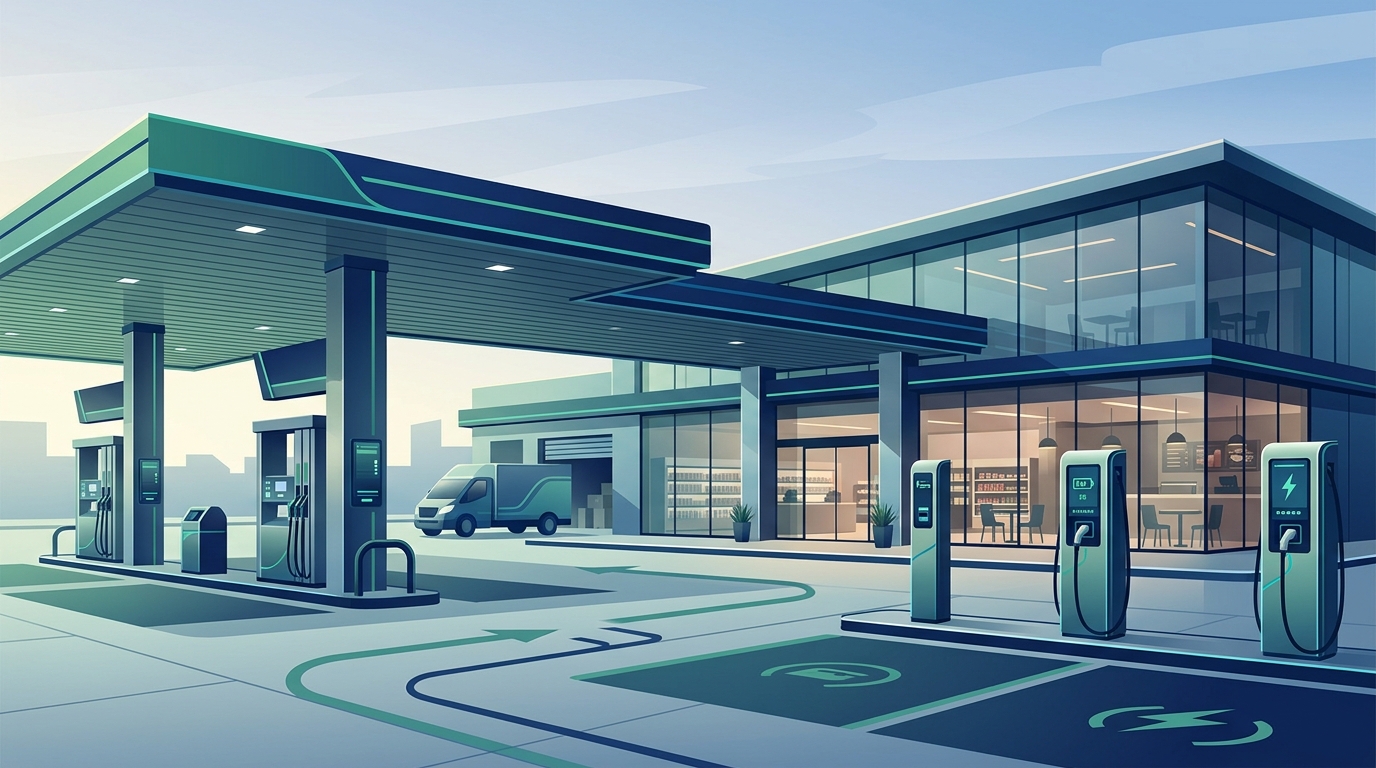
Editorial illustration
Fuel Retail
Forecourt Transaction Dynamics, Foodservice Reallocation, and Regional Technology Exports
Operational Shifts in In-Store Sales and Traffic Volumes
Data from NACS indicates evolving operational dynamics within convenience store retail. In 2025, foodservice represented 28.5% of in-store sales across convenience stores, expanding from 11.9% recorded in 2005. Concurrently, overall foot traffic showed contraction: the average convenience store registered 45,160 transactions per month in 2025, representing a 2.7% decrease compared to 2024 metrics.
This divergence between expanding foodservice sales shares and declining overall transaction volumes highlights a core operational challenge for fuel and convenience operators. While individual ticket values may benefit from prepared food programs, monthly store visits are declining across average sites. Specific regional chains continue to adjust footprint strategies within this market environment. For example, RoadDog recently opened a barbecue Quick Service Restaurant (QSR) inside one of its Ohio locations. In contrast, smaller regional networks—including Earnheart Oil, Fleming Brothers Oil, PowerTrac, FastLane, Big Boss Stores, and Monfort Companies—have exited the retail landscape amid broader consolidation.
Despite ongoing market consolidation, independent operators retain significant network scale. NACS figures demonstrate that 63% of c-stores remain operated by firms managing 10 or fewer locations. Regional operators like TXB, a 54-store chain, maintain positive growth outlooks despite competitive pressures from larger national networks.
Operators can review detailed North American industry data via C-Store Dive.
South American Forecourt Infrastructure and Retail Adaptation
Forecourt operations in South America present distinct regulatory and operational parameters, particularly in Brazil. The Brazilian fuel retail network encompasses more than 45,000 active service stations and approximately 8,500 convenience stores. The market features high ethanol blending mandates and offers pure E100 fuel as a standalone option for flex-fuel vehicle fleets.
Industry infrastructure developments were featured at ExpoPostos & Conveniência 2026, held from September 8 to 10 at São Paulo Expo. Organized by ABIEPS and Fecombustíveis alongside GL Events, the event attracted over 30,000 attendees and featured more than 250 exhibitors.
Supplier developments reflect both local adaptation and international expansion:
- Excel: Founded in 1990, the company introduced an early digital tyre calibrator and currently exports fuel management and fleet control hardware to over 30 countries. Excel President & CEO Cristian Bazaga, who also serves as President of ABIEPS, stated that operating across diverse regional demands within Brazil requires treating hardware deployment as a service model centered on quality and support.
- Grupo Dislub Equador: Marketing Manager David Freidzon outlined the group's franchise strategy with its Convém retail concept. Designed alongside architectural studio Balko, the flagship Convém location in Manaus earned the NACS Convenience Retailer of the Year Award for Latin America at the NACS Show 2024.
- GL Events Exhibitions: Managing Director Tatiana Zaccaro highlighted that trade exhibition focus areas are increasingly shifting toward artificial intelligence, payments, new energy vectors, and expanded foodservice concepts.
Forecourt security and tax governance remain critical operational considerations. Fecombustíveis President James Thorp Neto stated that over 1,000 service stations out of Brazil's total network were identified as having links to organized criminal groups. Furthermore, Thorp Neto emphasized that frequent shifts in tax regulations create operational friction and narrow net retail operating margins.
Further details on Latin American forecourt solutions are reported by MobilityPlaza.
Analysis: Hypothesizing Foodservice and Tech Upgrades
Foodservice Margin Performance Test Hypothesis
*Hypothesis*: Operators adding dedicated internal QSR formats (such as barbecue or hot food stations) can offset lower monthly foot traffic by increasing gross margin contribution per transaction, without expanding overall labor hours per shift. *Proposed Test Methodology*: Measure baseline labor hours, transaction count, and gross margin per customer across five control sites and five converted QSR test sites over a six-month period. Track net store profitability after accounting for waste, specialized kitchen equipment maintenance, and prep time.
Automated Forecourt Services and International Tech Export Hypothesis
*Hypothesis*: Exporting standardized digital fleet management and tyre maintenance devices built for complex multi-fuel environments simplifies forecourt maintenance procedures and reduces fuel loss reconciliation discrepancies in secondary markets. *Proposed Test Methodology*: Deploy digital fuel monitoring and calibrator systems across 20 international trial stations for 90 days. Compare error logs, reconciliation times, and maintenance downtime against existing legacy equipment baselines.
EV Charging
Electric Fleet Infrastructure Service Agreements: Operational Analysis of Depot Charging Contracts
Heavy-Duty Electric Logistics and Service Frameworks
According to reports published on MobilityPlaza, Norwegian grocery wholesaler ASKO and hardware supplier ABB E-Mobility have executed a dedicated service agreement covering operational support, monitoring, and maintenance for electric heavy-duty transport infrastructure across Norway. The logistics operator maintains an overall distribution fleet of approximately 700 trucks that serve more than 1,800 grocery store locations throughout the country.
The operational relationship between the hardware supplier and the wholesaler commenced in 2019. Over the course of this multi-year collaboration, installed charging infrastructure has delivered over 20 GWh of cumulative energy, with 5.5 GWh supplied within the past 12 months alone. The charging footprint comprises more than 60 high-power charging points distributed across seven cities in Norway. Recent deployments include the installation of ABB E-Mobility's A400 unit at an ASKO logistics site, featuring a maximum power output rating of up to 400 kW.
In corporate statements, Lars Erik Olsen, Technical Manager at ASKO, emphasized that long-term maintenance agreements aim to establish predictable service routines and stable charging operations. Separately, Bruno Bourguet, President EMEA at ABB E-Mobility, observed that scaling heavy commercial EV fleets necessitates ongoing maintenance and software monitoring in addition to physical charging hardware.
Analytical Evaluation of Dedicated Fleet Operations
*Analysis Notice: The following section represents independent analytical evaluation based on industry operational models and must be distinguished from the sourced facts reported above.*
From a commercial forecourt and logistics perspective, separating maximum equipment power ratings from long-term operational performance is essential when structuring high-power charging sites. While an individual charger may boast a maximum rating of 400 kW, daily throughput depends heavily on vehicle battery acceptance curves, ambient thermal management, grid connection limits, and site-level load balancing.
For site host operators and depot managers, service agreements that bundle proactive hardware monitoring with SLA-backed maintenance help prevent unexpected asset downtime. In commercial logistics environments—where vehicle dwell time directly intersects with delivery schedules—unplanned charger outages carry severe operational penalties compared to passenger car locations.
Furthermore, analyzing historical energy delivery trends provides valuable insight into utilization rates. ASKO’s reported cumulative figure of 20 GWh since 2019 alongside 5.5 GWh in the preceding 12 months demonstrates accelerating energy consumption as additional heavy-duty vehicles enter service. This indicates that network additions and higher-capacity dispensers alter the operational profile of fleet charging hubs over time, requiring periodic reviews of grid supply contracts and preventive maintenance cycles.
Operational Hypotheses and Testing Methodologies
*Analysis Notice: Unmeasured operational benefits described below are framed as hypotheses subject to empirical testing rather than established facts.*
Operators frequently assert that establishing comprehensive third-party service agreements reduces overall labor allocation for internal fleet maintenance teams and increases site profitability. However, these outcomes cannot be assumed without systematic evaluation.
Hypothesis 1: Multi-Year Fleet Service Contracts Reduce Operational Expenses
- *Proposed Test:* Implement a 12-month comparative tracking study across two distinct fleet logistics depots with similar vehicle counts. Hub A operates under a full-scope third-party maintenance agreement with automated uptime monitoring, while Hub B relies on standard ad-hoc repair requests. Measure labor hours expended by internal staff, total direct maintenance costs, charger availability metrics (uptime percentage), and delivery disruption incidents to determine net financial impact.
Hypothesis 2: High-Power Depot Charging Integrates Safely with Local Retail Forecourts
- *Proposed Test:* Conduct a 90-day pilot program co-locating 400 kW rated heavy-vehicle charging hardware adjacent to a retail c-store forecourt. Monitor peak electrical demand charges, transformer thermal profiles, and forecourt vehicle queue management. Evaluate whether load-shaving algorithms prevent demand fee spikes without extending fleet charge dwell times beyond scheduled departure windows.
By isolating verified operational metrics from strategic hypotheses, commercial operators can better evaluate capital expenditure and maintenance contracts for heavy-duty EV charging networks.
C-Store
Capital Investment Strategies and Shopper Value Priorities in Forecourt Foodservice
Evaluating Modern Foodservice Capital Expenditure
Recent corporate disclosures from major quick-service restaurant (QSR) operators outline the scale of financial capital required to modernize food execution and drive-thru technology. According to reporting from Restaurant Dive, McDonald’s Chief Financial Officer Ian Borden detailed that the chain plans to provide $8.5 billion in partner support through 2036 under its Next initiative. Of that capital, approximately $5 billion will be deployed by 2030 to "accelerate deployment of ArchIQ technology bundles, as well as kitchen and operations enablers."
For traditional U.S. drive-thru locations, the overall per-store expense for technology deployment and remodels under this program is estimated at $800,000. This outlay is incremental to standard franchisee-funded lobby remodels, which cost between $400,000 and $450,000 at representative U.S. locations. The company projects that these operational investments will deliver 250 basis points (2.5%) in restaurant-level P&L efficiency, yielding approximately $100,000 in gross annual cash flow per site. Borden noted that U.S. units currently generate an average annual unit volume (AUV) exceeding $4 million, with operating cash flow of about $500,000. The franchisee payback period for the Next investments is estimated at four years, while the chain projects a five- to six-year payback timeline.
Consumer Demand Patterns in Convenience Foodservice
While national QSR chains execute large-scale kitchen automation and facility retrofits, convenience retail operators face evolving shopper expectations regarding product pricing and quality. Data published by CSP Daily News detailing an Acosta Group study of 775 U.S. convenience-store shoppers conducted between August 26 and August 31, 2026, indicates that more than half of shoppers purchase food or beverages from convenience stores at least once a week.
The research underscores that perceived value and food quality remain critical drivers for increasing transaction frequency. Specifically, 53% of surveyed shoppers stated that better value for their money would make them more likely to purchase food and beverages from convenience stores. Additionally, 47% cited higher-quality food, and 35% indicated a desire for more freshly prepared meals and snacks. When evaluating product pairings, a sandwich combined with a beverage emerged as the most appealing combination, selected by 62% of respondents. Furthermore, nearly three-quarters of respondents noted that healthier or better-for-you items are at least somewhat important when shopping at convenience stores.
Convenience retailers are responding to these shopper preferences by structuring dedicated meal bundles. For example, 7-Eleven introduced value menus across its Laredo Taco Company, Speedy Café, and Raise the Roost Chicken banners, while Circle K offers bundled meal deals priced at $3, $4, and $6. Acosta Group’s Kathy Risch highlighted that while c-stores excel at solving immediate customer needs, "convenience alone isn't enough to win every occasion" when competing directly against fast-food and grocery alternatives.
Analytical Perspective: Strategic Hypotheses for Forecourt Operators
*Note: The following section represents independent analytical interpretation and operational hypotheses derived from comparing QSR capital deployment with c-store consumer research.*
The contrast between heavy QSR capital deployment and convenience retail shopper sentiment points to operational choices for forecourt network managers seeking to grow foodservice gross margin. While QSR chains invest heavily in tech-enabled kitchen throughput, forecourt operators may capture market share by optimizing core meal bundles without immediately executing multi-hundred-thousand-dollar kitchen overhauls.
Hypothesis 1: Bundling Impact on Basket Size *Hypothesis:* Implementing fixed-price meal bundles that pair high-margin proprietary fountain/coffee beverages with prepared hot entrees will increase overall foodservice transaction volume and gross margin dollars during morning peak hours. *Proposed Test:* Conduct a 60-day trial across 20 participating forecourt sites offering a standardized sandwich-and-beverage combination. Compare weekly transaction counts, basket size, and gross margin contribution against a control group of 20 non-participating locations.
Hypothesis 2: Healthier Option Placement Impact on Waste and Margin *Hypothesis:* Reallocating 15% of grab-and-go cooler space to high-protein, fresh items will attract higher-margin midday visits without resulting in unmanageable waste. *Proposed Test:* Introduce a curated health-focused food trim across selected test sites for 90 days. Track daily write-offs and store-level loyalty data to determine if incremental sales exceed baseline shrink expenses.
QSR & Foodservice
Forecourt Foodservice Execution: Rutter's Pasta Expansion and McDonald's Technology Investment Strategy
Forecourt convenience operators and QSR brand owners are actively evaluating menu diversification and technology infrastructure to capture higher-margin meal occasions. Recent market developments from regional c-store operator Rutter's and QSR enterprise McDonald's illustrate two distinct operational vectors: aggressive hot-food menu expansion and large-scale AI-driven operational automation.
Forecourt Hot-Food Expansion: Rutter's Italian Pasta Platform
Regional forecourt chain Rutter's, headquartered in York, Pennsylvania, announced a major expansion of its hot foodservice program with a customized pasta menu rollout (CSP Daily News). Operating 94 stores across Pennsylvania, Maryland, Virginia, and West Virginia, Rutter's is building beyond its foundational fettuccine Alfredo and spaghetti marinara options.
The expanded lineup incorporates specialized pairings, combining standard spaghetti and fettuccine with proteins including Italian sausage, meatballs, fried chicken, bacon, shrimp, and steak. Key new dishes include:
- Italian Sausage and Peppers Spaghetti
- Buffalo Fried Chicken Fettuccine Alfredo
- Surf and Turf Fettuccine Alfredo
- Powerhouse Fried Chicken and Mozzarella Sticks Spaghetti Marinara
- Cannoli Chips and Dip cup
According to Philip Santini, Rutter's senior director of food and beverage, the initiative relies on "pastas imported directly from Italy" to maintain product quality while providing customizable options through flexible topping and sauce combinations (CSP Daily News).
QSR Enterprise Scale: McDonald's Next Strategy and ArchIQ Deployment
Concurrently, fast-food giant McDonald's outlined its long-term corporate growth and technology roadmap during its investor day conference (Restaurant Dive). As part of its overarching "Next" strategy, the company committed $8.5 billion in partner support through 2036, which incorporates approximately $5 billion dedicated to rent relief and capital support through 2030.
McDonald's management targets a 250 basis points improvement in U.S. gross store-level productivity, projecting an average franchisee cash flow boost of approximately $100,000 per store (Restaurant Dive). Key technology initiatives supporting these targets include:
- ArchIQ AI Rollout: Deployment of the ArchIQ artificial intelligence platform designed to manage drive-thru processing, inventory accuracy, and order fulfillment precision.
- Loyalty Program Optimization: Structured effort to reactivate 150 million infrequent loyalty consumers through tiered rewards, brand partnerships, and personalized marketing.
- Media Network Expansion: Testing an in-house media network model targeting a $1 billion advertising revenue business over time.
- Menu Core Refinement: Menu development focused on larger beef burgers, expanded chicken platforms (including chicken bowls), and specialized beverage programs.
Operational Analysis: Hypotheses for Forecourt QSR Integration
*Note: The following analysis reflects independent operational evaluation and operational hypotheses based on reported developments.*
As forecourt operators balance labor constraints against demand for freshly prepared foodservice, the contrast between menu complexity and tech-assisted kitchen throughput becomes paramount.
Balancing Customization with Prep-Line Bottlenecks
Rutter's strategy leverages direct-imported dry pasta and customizable protein platforms to elevate evening daypart appeal. However, multi-protein pasta stations present operational labor risks if assembly routines are not carefully standardized.
- Hypothesis: Broadening customization across pasta dishes increases gross ticket margin without compromising drive-thru or store dwell time if prep lines utilize batch-cooked bases paired with rapid-induction finishing heaters.
- Proposed Operational Test: Compare peak-hour labor hours per order, waste percentages, and order assembly times across 15 high-volume stores over 60 days, testing pre-portioned protein trays against bulk ingredient pans.
AI-Driven Predictive Inventory in High-Skill Kitchens
Deploying tools similar to McDonald's ArchIQ platform within forecourt kitchens could significantly mitigate waste associated with expanded, perishable menus (e.g., seafood and fresh meats in Rutter's new lineup).
- Hypothesis: Automated AI inventory and predictive ordering systems reduce perishable kitchen waste by at least 15% in convenience stores offering customizable hot meal programs.
- Proposed Operational Test: Implement real-time POS-linked inventory prediction algorithms in 10 test locations for 90 days and measure shrinkage against historical baseline control sites.
Host
Welcome to today's executive briefing. Today, we examine operational shifts across fuel retail, heavy-duty electric vehicle infrastructure, c-store consumer dynamics, and foodservice execution. We begin in fuel retail, where recent industry data highlights a significant divergence between expanding foodservice sales shares and contracting store traffic volumes, alongside ongoing regulatory and security parameters in South America.
Co-Host
That's right. Data from NACS indicates that in 2025, foodservice represented 28.5% of in-store sales across convenience stores, expanding from 11.9% recorded in 2005. Concurrently, overall foot traffic contracted, with the average store registering 45,160 transactions per month in 2025—a 2.7% decrease compared to 2024 metrics. While specific chains like RoadDog are adapting by opening barbecue quick-service restaurants inside locations, several smaller regional networks, including Earnheart Oil, Fleming Brothers Oil, PowerTrac, FastLane, Big Boss Stores, and Monfort Companies, have exited the retail landscape amid broader consolidation. Even so, independent operators retain scale: NACS figures show that 63% of c-stores remain operated by firms managing 10 or fewer locations, and regional networks like 54-store TXB maintain positive growth outlooks.
Host
International forecourts show distinct operational parameters. In Brazil, the fuel retail network encompasses over 45,000 active service stations and approximately 8,500 convenience stores, featuring high ethanol blending mandates and standalone E100 fuel options. At ExpoPostos 2026, suppliers like Excel highlighted hardware-as-a-service models for digital fleet management and tyre calibrator hardware exported to over 30 countries. Meanwhile, Grupo Dislub Equador highlighted its Convém retail concept, whose flagship Manaus location earned the NACS 2024 Latin America award. However, forecourt security and tax governance remain critical challenges: Fecombustíveis President James Thorp Neto stated that over 1,000 service stations were identified as having links to organized criminal groups, and frequent shifts in tax regulations create operational friction and narrow net operating margins.
Co-Host
From an analytical standpoint, industry observers hypothesize that operators adding internal QSR formats can offset lower monthly foot traffic by increasing gross margin contribution per transaction, though that remains a hypothesis requiring empirical testing against labor hours and waste. Turning to heavy-duty EV charging, we see commercial transport fleets executing dedicated infrastructure service frameworks. Norwegian grocery wholesaler ASKO and hardware supplier ABB E-Mobility have executed a dedicated service agreement covering operational support, monitoring, and maintenance across Norway. ASKO operates a distribution fleet of roughly 700 trucks serving over 1,800 grocery store locations.
Host
The operational relationship between ASKO and ABB E-Mobility began in 2019. Over that time, the installed infrastructure has delivered over 20 GWh of cumulative energy, with 5.5 GWh supplied within the past 12 months alone across more than 60 high-power charging points in seven Norwegian cities. Recent deployments include ABB's A400 unit at an ASKO logistics site, which features a maximum power output rating of up to 400 kW. Technical Manager Lars Erik Olsen emphasized that long-term agreements aim to establish predictable service routines, while ABB's Bruno Bourguet noted that scaling commercial EV fleets requires ongoing software monitoring and maintenance alongside hardware.
Co-Host
From an analytical perspective, site hosts must distinguish maximum equipment power ratings, like 400 kW, from actual daily energy throughput, which depends on vehicle battery acceptance curves, ambient thermal management, and grid connection limits. For commercial logistics hubs, SLA-backed maintenance agreements mitigate the severe operational penalties associated with unplanned downtime. Analysts propose testing whether multi-year maintenance contracts actually yield lower operational expenses compared to ad-hoc repair strategies, and whether co-locating 400 kW chargers near retail forecourts can successfully run load-shaving algorithms to avoid peak electrical demand charges without extending vehicle charge dwell times.
Host
Shifting to c-store retail and capital strategies, consumer research highlights evolving shopper value expectations. An Acosta Group study of 775 U.S. convenience store shoppers conducted in late August 2026 indicates that over half buy food or beverages at c-stores at least weekly. However, perceived value and quality are critical drivers: 53% of surveyed shoppers said better value for money would increase their purchase frequency, 47% requested higher-quality food, and 35% wanted more freshly prepared items. A sandwich paired with a beverage emerged as the top product combination at 62%, and nearly three-quarters noted that healthier options are important. Operators like 7-Eleven and Circle K are responding with dedicated value meal bundles priced at fixed $3, $4, and $6 points.
Co-Host
At the major QSR level, McDonald's is making substantial financial capital commitments to modernizing food execution and drive-thru technology. McDonald's CFO Ian Borden detailed plans to provide $8.5 billion in partner support through 2036 under its Next initiative, with approximately $5 billion deployed by 2030 for ArchIQ technology bundles, kitchen enablers, and rent relief. Per-store deployment and remodel expenses under this program are estimated at $800,000 for traditional U.S. drive-thru locations, incremental to standard franchisee lobby remodels costing $400,000 to $450,000. McDonald's projects these investments will deliver 250 basis points in store-level efficiency, yielding roughly $100,000 in gross annual cash flow per site, with a projected franchisee payback period of four years.
Host
Contrast that multi-hundred-thousand-dollar tech capital deployment with regional forecourt menu expansion. Pennsylvania-based Rutter's, operating 94 stores across four states, expanded its hot foodservice program by rolling out an Italian pasta menu. Featuring pasta imported directly from Italy, Senior Director Philip Santini explained that the lineup pairs spaghetti and fettuccine with proteins such as Italian sausage, meatballs, fried chicken, bacon, shrimp, and steak. Options like Buffalo Fried Chicken Fettuccine Alfredo and Cannoli Chips aim to elevate evening daypart appeal through customizable platforms.
Co-Host
Meanwhile, McDonald's is deploying its ArchIQ AI platform to streamline drive-thru processing, order fulfillment, and inventory accuracy, alongside testing an in-house media network aimed at driving ad revenue over time. Comparing these approaches highlights two distinct operational vectors: Rutter's leverages customized hot food platforms to expand menu appeal, while McDonald's applies large-scale AI automation to optimize throughput and predictive inventory management.
Host
Independent analytical models suggest two key hypotheses for forecourt operators evaluating these foodservice approaches. First, while broad menu customization increases gross ticket margins, it presents operational risks of prep-line bottlenecks unless standardized batch-cooked bases and induction finishing heaters are used—a hypothesis requiring empirical testing on prep times and labor hours. Second, deploying AI-driven predictive inventory tools similar to ArchIQ could hypothetically reduce perishable kitchen shrinkage by at least 15% in c-stores offering complex, customizable hot meal programs.
Co-Host
Looking across all these sector developments—fuel retail foot traffic shifts, commercial EV infrastructure SLAs, c-store value demand, and QSR automation—operators face clear structural choices. Capital allocation must carefully balance physical asset maintenance, tech-enabled operational efficiency, and menu complexity against measured margin performance.
Host
To synthesize today's analysis, we conclude with three key questions for executive operators across these industries: First, for fuel and c-store operators expanding internal QSR or custom foodservice platforms, does your current prep-line workflow maintain peak-hour service speed without inflating labor hours and food waste?
Co-Host
Second, for commercial fleet depot and forecourt EV charging deployments, are your service level agreements structured to manage proactive software monitoring and grid demand charges, rather than relying solely on nameplate power output ratings?
Host
And third, in addressing shopper value demands, are you utilizing structured meal bundling and predictive inventory management to drive basket size and gross margin dollars, or are you incurring capital expenses without clear cash-flow payback timelines? That completes today's briefing. We will monitor these operational strategies as additional empirical performance data becomes available.