The Daily Forecourt Brief — 2026-10-06
An executive audio briefing across fuel retail, EV charging, convenience stores and foodservice.
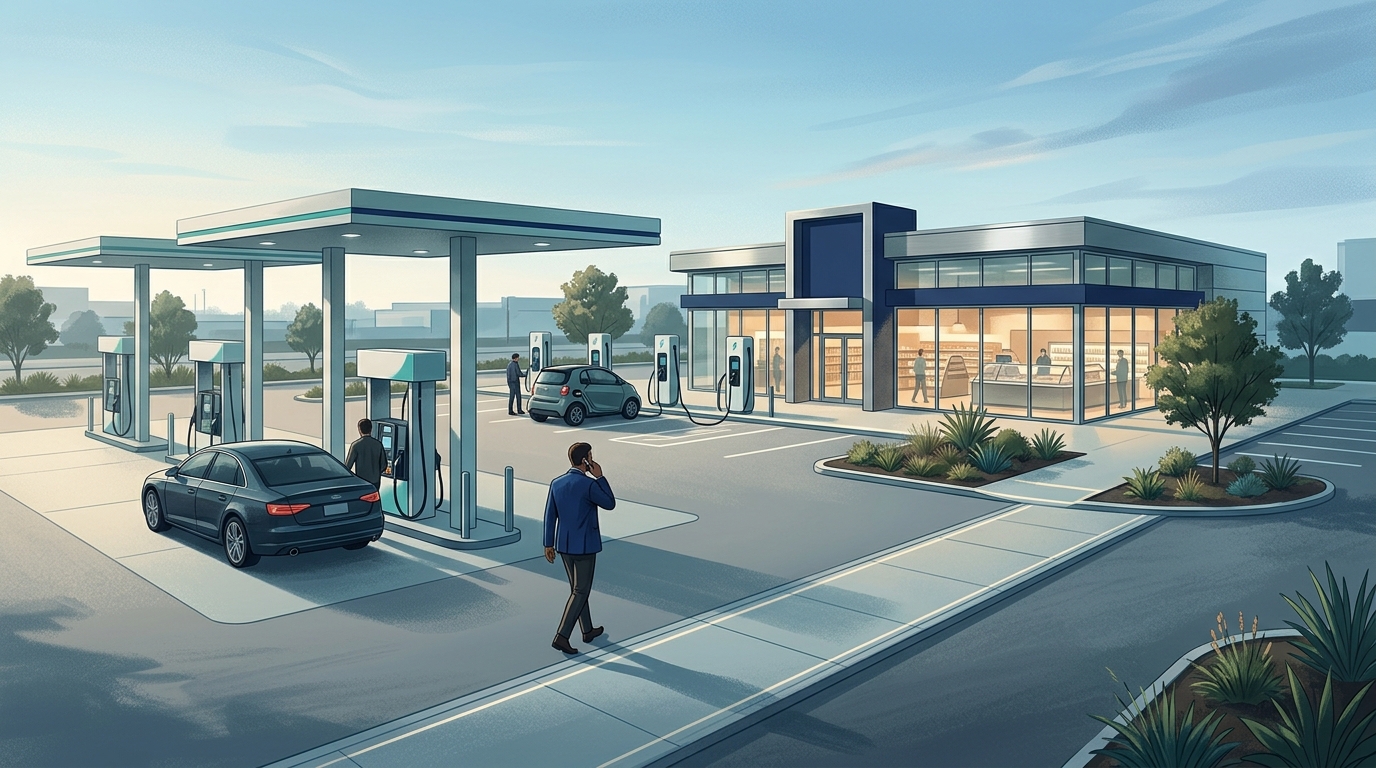
Editorial illustration
Fuel Retail
Unified Commerce Platforms in Regional C-Stores: Enterprise Software Standardization and Fleet Workflow Integration
Unified Commerce Platforms in Regional C-Stores: Enterprise Software Standardization and Fleet Workflow Integration
In modern downstream fuel retail and convenience store operations, legacy IT architectures frequently rely on disparate systems for front-counter point-of-sale (POS), kitchen execution, and forecourt payment routing. Transitioning to a single enterprise software platform represents a structural shift in how regional operators manage data synchronization, payment processing, and hardware maintainability across multi-state footprints.
Sourced Network Infrastructure Deployment
As reported by MobilityPlaza, York, Pennsylvania-based convenience operator Rutter's signed a multi-year enterprise agreement with technology provider NCR Voyix to update POS systems across its 94 stores located in Pennsylvania, Maryland, Virginia, and West Virginia.
The technology deployment incorporates Voyix POS for CFR, Voyix Kitchen, and Voyix Connect, accompanied by vendor managed services and field support. For forecourt and payment terminal operations, the platform accepts commercial fleet card payment processing from Corpay, WEX, and Voyager.
In an executive statement, Scott Hartman, President and CEO of Rutter's, stated: "As consumer expectations continue to evolve, we are investing in technology to create a more seamless and personalized experience across customer touchpoints".
Founded in 1747, family-managed Rutter's self-identifies as the oldest vertically integrated food company in the United States. Operational recognitions reported for the chain include winning the CSP Mystery Shop award for Best Customer Experience five times—including in 2026—and being named Best Foodvenience in the World by Global Convenience in 2025.
Analytical Perspective: Evaluating Enterprise Platform Integration
*Note: The following analysis represents an independent evaluation of enterprise IT architecture and is distinct from sourced factual reporting.*
Platform Architecture vs. Best-of-Breed Middleware
Selecting a single primary platform vendor simplifies vendor governance, patch management, and support escalations across store networks. However, operators must balance unified vendor reliance against modular flexibility.
When deploying integrated kitchen management (such as Voyix Kitchen) alongside forecourt POS platforms, the key operational trade-off centers on real-time order synchronicity across touchpoints (kiosks, counter POS, mobile apps) versus the potential lock-in to proprietary hardware peripherals and software release cycles.
Unmeasured Benefit Hypotheses and Suggested Operator Testing
Supplier and operator statements often emphasize enhanced customer experiences or streamlined workflows during enterprise rollouts. In accordance with rigorous operational governance, these potential benefits should be framed as hypotheses requiring empirical verification rather than baseline guarantees.
- Transaction Velocity and Order Accuracy Hypothesis: Deploying a single enterprise software engine across store POS and kitchen display modules reduces peak-hour kitchen order processing bottlenecks and customer wait times.
- *Proposed Test Plan*: Establish a baseline measurement of order throughput time, order defect rates, and checkout transaction latency across 10 control stores using legacy middleware. Compare these against 10 trial locations implementing the unified platform over a 120-day operational review window during morning and evening rush dayparts.
- Fleet Card Authorization Continuity Hypothesis: Consolidating forecourt payment routing under a modern enterprise POS module maintains uninterrupted acceptance for specialized fleet cards without increasing pump authorization drop-outs.
- *Proposed Test Plan*: Audit transaction approval response times, prompt exception rates (such as driver ID or unit number rejection), and offline fallback occurrences for Corpay, WEX, and Voyager card swipes across 50,000 forecourt transactions post-cutover.
Strategic Considerations for Multi-State Forecourts
For regional chains operating across multiple state jurisdictions (such as Pennsylvania, Maryland, Virginia, and West Virginia), centralized software platforms must dynamically support regional tax rules, local product restrictions, and varying fleet contract parameters. Ensuring field support SLAs and managed services cover dispersed store footprints is a critical contingency when transitioning to centralized IT management.
EV Charging
Evaluating Ultra-Fast EV Charging Infrastructure and Forecourt Amenity Integration in Germany
German Highway Charging Infrastructure: Analyzing High-Power Hardware and Forecourt Retail Integration
Sourced Network Expansion and Site Infrastructure
In October 2026, Aral pulse expanded its EV charging presence in Germany by bringing four new ultra-fast charging columns into operation at an Aral forecourt on Dortmunder Straße 110 in Iserlohn, situated near the A46 motorway (MobilityPlaza). Each newly commissioned column contains two charging points, adding eight high-power charging access points to the site.
The deployed hardware carries a maximum rating of up to 400 kW per column. Based on standard hardware power ratings, units operating at this maximum level can deliver up to 300 km of driving range in ten minutes. This location-specific addition sits within Aral’s wider national footprint, which comprises over 4,000 charging points across approximately 600 sites nationwide.
In independent testing, Aral pulse secured a "very good" rating in the 2026 Connect charging network test, marking its fourth consecutive year as the country's top charge point operator, alongside recognitions from Electricar and Vision Mobility. Commenting on customer uptake, Alexander Junge, Board Member for E-Mobility at Aral, stated that the organization aims to be the "first choice for our customers" and noted that the ultra-fast charging offer is being very well received.
Tariff Options, Payment Protocols, and On-Site Amenities
Access and billing at the Iserlohn site rely on multiple physical and digital payment mechanisms. Aral has maintained an official partnership with the German automobile club ADAC since 2024, enabling drivers to utilize the ADAC e-Charge tariff within the Aral pulse mobile app. Drivers can additionally complete charging payments using the Aral pulse charging card or directly via payment options provided on the charger hardware.
The physical forecourt layout surrounding the charging infrastructure integrates conventional convenience and vehicle maintenance amenities. On-site facilities include dedicated site lighting, restrooms, a REWE To Go convenience store, and an automated car wash.
Analytical Perspective: High-Power Station Integration Metrics
*(Note: The following analysis is an independent evaluation and is explicitly distinguished from the sourced factual reporting provided above.)*
Differentiating Rated Maximums from Field Performance
Forecourt operators reviewing high-power EV deployments must carefully distinguish between peak equipment ratings and actual delivered charging throughput. While a 400 kW rating represents maximum potential output, real-world energy transfer rates depend on several operational parameters:
- Vehicle Intake Limits: An EV's battery management system (BMS), ambient temperature, and current state of charge dictate maximum power acceptance. Most current passenger EVs cannot sustain 400 kW power draw throughout an entire charge cycle.
- Dynamic Site Power Allocation: Dual-port columns delivering up to 400 kW frequently employ dynamic power sharing when two vehicles plug in simultaneously, halving available per-plug throughput unless adequate grid capacity is actively supplied.
Monetizing Dwell Time: Hypotheses and Empirical Testing
Pairing ultra-fast charging with co-located retail amenities (such as REWE To Go) and automated vehicle washing presents a logical hypothesis regarding dwell-time revenue enhancement.
- Hypothesis: Broadening amenity options at motorway-adjacent charging locations increases non-fuel retail margins by converting waiting EV drivers into store shoppers and car wash customers during a 10-to-20 minute charging pause.
- Unmeasured Benefit Warning: Operators cannot assume that installing 400 kW chargers automatically expands store profit, reduces labor requirements, or guarantees customer satisfaction. Conversion depends on site design factors such as clear footpaths, site lighting, canopy protection, and retail store positioning relative to charging bays.
- Proposed Testing Methodology: To evaluate whether charging infrastructure drives incremental retail sales, operators should conduct a 90-day comparative study. This involves tracking point-of-sale (POS) transaction timestamps, basket sizes, and store conversion rates at charging-enabled sites against matched control forecourts lacking EV charging infrastructure.
C-Store
Category Management and Industry Events: Navigating Flavor Diversity and 2027 Trade Planning
Assortment Realignment: Capitalizing on Adventurous Snacking Trends
Data from market research firm Circana indicates that U.S. snack sales grew 3.2% in 2025. Additionally, consumer research covering Europe, the Middle East, and Africa (EMEA) revealed that 52% of surveyed consumers reported exposure to foods from diverse cultures changed their preferences, while 58% expressed interest in experimenting with new snack flavors. According to reporting by CSP Daily News, Sally Lyons Wyatt, Circana's global chief advisor of consumer goods and foodservice, highlighted that finding broad growth across fast-moving consumer goods remains difficult, making specialized snacking pockets increasingly vital for convenience store operators.
To capture this shifting consumer demand, convenience store retailers can re-evaluate store-level assortments across packaged retail foods and fresh foodservice programs. Rather than replacing established high-volume inventory, operators are advised to protect core performers—such as regional taquitos or hot dogs—on a location-by-location basis. Incremental variety can then be introduced through structured flavor rotations and limited-time offers (LTOs) across different dayparts, catering to shoppers acting as "flavor tourists."
Analysis & Hypothesis: *Analytical Framing:* While introducing global snack flavors and limited-time bakery rotations is hypothesized to increase basket size and store dwell time, this outcome is not an established guarantee for every store footprint. Variations in transient commuter traffic versus local residential demographics can significantly affect product turn rates. *Proposed Operational Test:* Operators should select a representative 10-store sample to execute a 6-week trial comparing standard core inventory against a localized menu rotation featuring emerging flavor profiles. Basket size, gross margin contribution, and inventory shrink should be tracked weekly against control stores to verify commercial viability prior to network-wide deployment.
---
Strategic Industry Calendar: Key Conferences and Trade Expos for 2027
As operators re-evaluate store assortments, long-term planning requires active engagement with industry educational forums and supplier technology showcases. A comprehensive schedule of major convenience retail trade events for 2027 has been compiled by C-Store Dive.
Key upcoming industry gatherings for 2027 include:
- Conexxus Annual Conference (Jan. 26–29, 2027): Taking place in Newport Beach, California, this event focuses on technical standardization, retail automation, and data security.
- NATSO Connect (Feb. 24–26, 2027): Hosted in Grapevine, Texas, this travel center and truck stop conference represents leaders across more than 16,000 locations and 75 vendor partners, addressing highway retail growth and federal policy developments.
- Convenience Retailing University (March 2–4, 2027): Located in Austin, Texas, this category management forum features speakers including Kevin Smartt (CEO of TXB), John Pszeniczny (Director of Operations at Nouria), and Adit Gupta (CEO of Lula Commerce).
- NACS State of the Industry Summit (April 21–23, 2027): Held in Fort Worth, Texas, providing financial benchmarks and operational performance metrics based on the annual "State of the Industry" findings.
- National Restaurant Association Show (May 22–25, 2027): Hosted at McCormick Place in Chicago, Illinois, offering foodservice trend insights and high-speed kitchen technology showcases.
- Outlook Leadership Conference (Aug. 3–5, 2027): Held in Rancho Palos Verdes, California, focusing on executive strategy, licensing, and store experience design.
- McLane Engage (Aug. 10–12, 2027): Convening in Orlando, Florida, featuring over 100 exhibitors showcasing supply chain solutions and distributor technological updates.
- The NACS Show (Oct. 5–8, 2027): The convenience retail industry's largest dedicated U.S. event, taking place in Atlanta, Georgia, bringing together more than 23,000 industry professionals.
- C-Store Connect (Oct. 14, 2027): Organized by the Horizon Retailers Association for Southeastern regional operators and regional suppliers.
- SIGMA Annual Conference (Nov. 2–4, 2027): Held in Tucson, Arizona, concentrating on fuel marketing dynamics, market pressures, and wholesale fuel supply strategies.
---
Operational Takeaways for Forecourt Retailers
Forecourt operators must balance near-term inventory optimization with long-term technological and educational planning. Customizing shelf assortment based on surrounding neighborhood cohorts—supported by targeted loyalty application messaging—allows retailers to test adventurous flavor lines without diluting core revenue drivers. Concurrently, participating in specialized trade forums enables operational leaders to evaluate emerging store automation and supply chain solutions necessary to sustain margin performance.
QSR & Foodservice
Capital Remodeling and Trade Event Calendar: Foodservice Infrastructure and Conference Planning for Operators
Forecourt Store Remodel Commitments
Forecourt operators are actively committing capital toward updating store amenities to support expanded foodservice programs. As detailed by CSP Daily News, RaceTrac invests $63M to remodel 98 Florida convenience stores with pizza bars, coffee upgrades. This substantial investment highlights a deliberate pivot toward prepared food infrastructure and upgraded beverage counters across a major regional cluster.
When planning store remodels of this scale, multi-site convenience operators often seek to enhance customer throughput and elevate food presentation. While hardware upgrades such as dedicated pizza bars and modernized coffee dispenses are intended to drive fresh food sales, operators must analyze site-level operational data to determine actual performance gains.
Analysis: Hypothesizing Foodservice Remodel Lifts
While adding pizza bars and modernized coffee stations is widely anticipated to increase daily basket size and customer dwell time, these operational improvements remain hypotheses until empirically validated across varied store locations. A structured test procedure can isolate the effect of store remodels:
- Hypothesis: Upgrading forecourt layout with dedicated pizza bars and modernized coffee equipment increases foodservice daily transactions and average ticket size without degrading front-counter speed of service.
- Proposed Operational Test: Compare a control group of 20 unremodeled stores against a test group of 20 remodeled stores over a 12-week post-launch monitoring period. Measure daily transaction counts for prepared foods, average hot-beverage sales volume, total basket value per visit, and customer transaction times at checkout.
---
Industry Event and Trade Show Calendar (2026–2027)
To stay informed on emerging technology, financial strategies, and menu innovations, forecourt and foodservice operators rely on regional and national trade events. A recent roundup published by Restaurant Dive outlines several key industry gatherings scheduled across late 2026 and 2027:
- Restaurant Finance & Development Conference: Scheduled for Nov. 9-11, 2026 Wynn, Las Vegas, Nevada. This event focuses on capital raising, third-party delivery economics, and restaurant sector investments.
- ICR Conference: Held Jan. 11-13 JW Marriott, Orlando Grande Lakes, Orlando, Florida. This invite-only forum convenes executive leadership teams, institutional investors, and analysts to discuss commercial performance and growth models.
- IFA Annual Convention: Taking place Feb. 22-24 Mandalay Bay Convention Center, Las Vegas, Nevada. Hosted by the International Franchise Association, the convention provides business development strategies and networking for franchise operators.
- Restaurant Franchising & Innovation Summit: Set for March 8-10 New Orleans. Focuses on technology deployments, marketing strategies, and menu innovations across franchised systems.
- MURTEC (Multi-unit Restaurant Technology Conference): Scheduled for March 15-17 Caesars Palace, Las Vegas, Nevada. Explores technology applications across restaurant operations, marketing, and customer service.
- Restaurant Leadership Conference: Scheduled for April 4-7 JW Marriott Phoenix Desert Ridge Resort and Spa, Phoenix. Brings together executive leadership from growth brands to discuss strategic planning and market expansion.
- National Restaurant Association Show: Scheduled for May 22-25 McCormick Place, Chicago. Showcases supplier exhibits, kitchen equipment demonstrations, culinary trends, and digital tech displays.
- FS/TEC: Scheduled for Sept. 15-17 Gaylord Texan Resort & Convention Center, Grapevine, Texas. Focuses on foodservice technology, including artificial intelligence, labor optimization tools, and customer management systems.
---
Strategic Alignment for Forecourt Foodservice Operators
Participating in focused trade events offers convenience and QSR operators an opportunity to evaluate next-generation equipment, digital ordering workflows, and capital deployment strategies. As forecourt retailers transition toward higher-margin prepared foods and dedicated hot beverage programs, evaluating technology standards and franchising best practices at industry trade shows helps operators align their multi-year investment roadmaps.
By systematically pairing capital remodeling projects—such as localized pizza bar retrofits and elevated coffee stations—with rigorous A/B testing frameworks, forecourt retail teams can ensure that store-level capital expenditures deliver measurable improvements in transaction throughput and category profitability.
Host
Welcome to the Executive Briefing. Today, we analyze four source-backed industry reports covering enterprise software standardization in regional fuel retail, ultra-fast EV charging expansion in Germany, flavor category management alongside the 2027 C-store trade calendar, and major QSR capital remodels paired with foodservice event planning.
Co-Host
Starting in fuel retail, York, Pennsylvania-based convenience operator Rutter's signed a multi-year enterprise agreement with NCR Voyix to update point-of-sale systems across its 94 stores located in Pennsylvania, Maryland, Virginia, and West Virginia. The technology deployment incorporates Voyix POS for CFR, Voyix Kitchen, and Voyix Connect, backed by vendor managed services and field support. For forecourt operations, the platform accepts commercial fleet card processing from Corpay, WEX, and Voyager. Rutter's President and CEO Scott Hartman stated that as consumer expectations evolve, the organization is investing in technology to create a more seamless and personalized experience across customer touchpoints.
Host
From an analytical standpoint, consolidating under a single enterprise platform vendor simplifies patch management and support escalations across store networks, but operators must balance unified vendor reliance against modular flexibility. Crucially, supplier and operator claims of streamlined workflows or enhanced customer experiences represent hypotheses rather than guaranteed outcomes. Independent analysis suggests structured operator testing, such as comparing checkout latency and kitchen order processing times across 10 trial locations using the unified platform against 10 control stores using legacy middleware over a 120-day review window. Additionally, operators should audit approval response times and exception rates across 50,000 forecourt fleet card transactions.
Co-Host
Turning to EV charging infrastructure, Aral pulse expanded its presence in Germany in October 2026 by bringing four new ultra-fast charging columns into operation at a site on Dortmunder Straße 110 in Iserlohn, near the A46 motorway. Adding eight high-power charging access points, each column carries a maximum rating of up to 400 kW, which at peak equipment capacity can deliver up to 300 kilometers of driving range in ten minutes. Aral pulse operates over 4,000 charging points across roughly 600 nationwide sites and secured a 'very good' rating in the 2026 Connect charging network test. On-site amenities include restrooms, dedicated lighting, an automated car wash, and a REWE To Go convenience store, with payment supported via the ADAC e-Charge tariff on the Aral pulse app.
Host
An analytical review requires distinguishing peak equipment ratings from actual field performance. While a 400 kW rating represents maximum potential output, real-world energy transfer depends on vehicle battery intake limits, ambient temperature, state of charge, and dynamic power sharing when two vehicles plug into a single column simultaneously. Furthermore, while pairing charging bays with retail amenities creates a logical hypothesis regarding dwell-time revenue enhancement, increased retail margin is an unmeasured benefit hypothesis rather than a certainty. Independent analysis recommends a 90-day comparative study tracking POS transaction timestamps and basket sizes at charging-enabled sites against matched control forecourts lacking charging hardware.
Co-Host
In C-store category management, data from market research firm Circana indicates that U.S. snack sales grew 3.2% in 2025. Consumer research covering Europe, the Middle East, and Africa showed that 52% of surveyed consumers reported exposure to diverse cultures changed their preferences, while 58% expressed interest in experimenting with new snack flavors. Circana global chief advisor Sally Lyons Wyatt noted that finding broad growth across fast-moving consumer goods remains difficult, making specialized snacking pockets vital. Industry advice encourages operators to protect core performers like regional taquitos while introducing limited-time offers to capture flavor-seeking shoppers.
Host
Analytically, introducing localized flavor rotations is hypothesized to increase basket size, but store footprint variations mean operators should run a 6-week trial across representative stores to measure gross margin contribution and shrink before broad rollout. To align future operations, operators can consult the 2027 industry conference calendar compiled by C-Store Dive. Key trade events include the Conexxus Annual Conference in January focusing on technical standards, NATSO Connect in February, Convenience Retailing University in March, the NACS State of the Industry Summit in April, the National Restaurant Association Show in May, McLane Engage in August, and The NACS Show in October in Atlanta.
Co-Host
Moving to QSR and foodservice infrastructure, RaceTrac is committing 63 million dollars to remodel 98 convenience stores in Florida. As reported by CSP Daily News, this substantial capital investment incorporates dedicated pizza bars, expanded foodservice layouts, and modernized coffee equipment upgrades across a major regional cluster. This project demonstrates a deliberate strategy by regional operators to pivot toward fresh prepared food programs and modernized beverage counters.
Host
From an analytical perspective, while retrofitting dedicated pizza bars and coffee stations is intended to drive fresh food sales, sales lifts remain unverified hypotheses until backed by site-level data. A structured testing methodology suggests evaluating a test group of 20 remodeled stores against a control group of 20 unremodeled stores over a 12-week post-launch period, tracking daily prepared food transactions, total basket value, and checkout speed. Foodservice leadership can also leverage the 2026–2027 event calendar reported by Restaurant Dive, including the Restaurant Finance & Development Conference in November 2026, the ICR Conference in January 2027, MURTEC in March, and FS/TEC in September.
Co-Host
To close today's briefing, operational leaders should evaluate several key strategic questions for their own store networks. First, regarding fuel retail enterprise software, what specific empirical testing procedures is your IT team using to audit fleet card authorization drop-outs and kitchen order synchronicity during single-platform cutovers?
Host
Second, for EV charging and category management, how are you measuring whether 10-to-20 minute charger dwell times actually convert into higher non-fuel retail margins, and how will you structure localized trial rotations for emerging snack flavors without eroding core product volume?
Co-Host
Finally, on capital remodeling and long-term planning, what 12-week A/B testing framework will you deploy to isolate the true transaction and margin lift of major store retrofits like pizza bars, and which targeted 2027 trade conferences will best support your executive team's multi-year investment roadmap? That wraps up today's executive briefing.