Store Network Refranchising and Drive-Thru AI: Operational Governance in Large Retail Footprints
As 7-Eleven initiates refranchising for over 2,000 North American stores alongside tiered capital remodels, Bojangles expands voice-AI ordering across 600 drive-thrus with queue-responsive dynamic upselling.
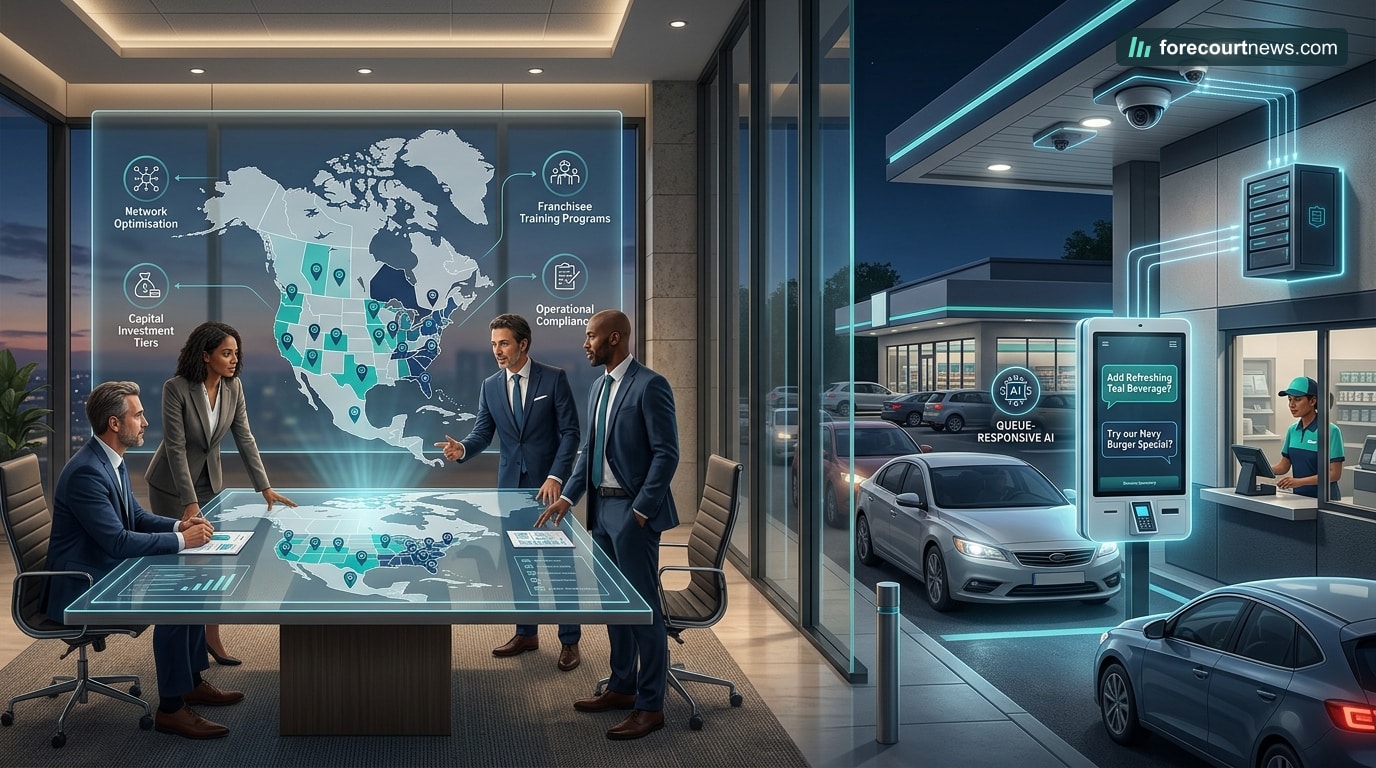
Editorial illustration
Portfolio Restructuring and Tiered Capital Allocation
In retail network transformations, multi-site operators frequently face capital allocation trade-offs between portfolio preservation and concentrated flagship investments. According to reporting by C-Store Dive, 7-Eleven CEO Mauricio Leyva presented a three-pronged transformation strategy at Seven & i Holdings' November 2026 Investor Day. The strategy separates store remodels into distinct tiers based on store profitability, financials, and location. Under this framework, selected locations will receive only basic physical upgrades, including new lighting and updated building fixtures. In contrast, higher-performing or strategically situated locations will receive full-fledged remodels that position proprietary food and quick-service restaurant (QSR) offerings at the center of the customer experience, continuing the deployment of "new standard stores" that incorporate in-store dining.
Simultaneously, 7-Eleven is executing ongoing plans to convert over 2,000 company-operated stores across North America to its franchise network. This capital and organizational shift takes place against an operating backdrop where convenience retail profitability in the United States has faced headwinds driven by softer consumer sentiment in a challenging economic climate.
Analysis: Operational Risks in Refranchised Network Upgrades
Transferring operational governance to franchisees while executing differentiated remodel specifications introduces brand consistency risks. When capital improvements are tiered, an operator risks customer confusion if brand perception does not align with store-level reality across company-operated and franchised doors. Basic fixture upgrades maintain baseline illumination and cleanliness, but they cannot deliver the basket-building food assortment of fully remodeled foodvenience formats.
To manage this transition, operators should verify whether contractual remodel obligations and operational audits are embedded directly into franchise conversion agreements. Rather than assuming that independent franchisees will maintain complex foodservice execution without friction, operators can test whether compliance audits and localized supply chain support stabilize gross margin margins in newly refranchised stores before accelerating portfolio conversions.
Automation at the Order Point: Voice AI in Drive-Thru Channels
While convenience store networks optimize store-level physical footprints, restaurant and forecourt-adjacent foodservice brands are automating ordering workflows to protect speed of service. According to Restaurant Dive, chicken chain Bojangles expanded its multi-year partnership with technology provider Hi Auto to deploy its "Bo-Linda" voice artificial intelligence system across 100 additional drive-thrus by mid-2027. This expansion adds to the 500 units already using the platform, bringing coverage to approximately two-thirds of the chain's 890 restaurant footprint.
Supplier and company figures indicate that the voice-AI ordering platform processes more than 1 million orders per week at Bojangles, operating at a stated 98% accuracy level. Beyond initial order taking, the updated commercial contract incorporates dynamic upselling algorithms. This feature adjusts product recommendations according to the length of the drive-thru queue: the software prioritizes fast-turnover item add-ons during peak queues, while recommending more time-intensive preparation items during slack hours. Furthermore, to address vehicle order confusion in dual-lane drive-thru layouts, the platform links captured digital photos of customer vehicles with their respective order tickets, allowing kitchen staff to verify vehicle identity as lanes merge.
Analysis: Evaluating Drive-Thru AI Workflow Constraints
Drive-thru order automation presents measurable operational trade-offs for forecourt and convenience operators evaluating similar ordering kiosks or speakers. Automated voice systems can theoretically reduce voice-order friction and enforce upselling discipline. However, upselling rules must be integrated directly with real-time kitchen line capacity, not merely vehicle line count. Recommending high-prep items during low queue counts could backfire if shift labor in the kitchen is simultaneously reduced during non-peak periods.
Retailers considering voice AI should execute controlled trials measuring total transaction dwell time, kitchen ticket fulfillment latency, and order accuracy before standardizing fleetwide rollouts. Combining order-point vehicle recognition with POS ticket dispatch offers an operational safeguard against merge-point errors, but its efficacy depends on camera line-of-sight and lighting conditions across variable forecourt environments.