Convenience Foodservice Equipment Gaps: Multi-Zone Holding, Ventless Smoke Limits and Batch Scheduling
Foodservice leaders at Rutter's, Tri Star Energy, and Gate Petroleum identify critical technology gaps in convenience kitchens, highlighting holding-cabinet degradation, ventilation costs, and disconnected batch production.
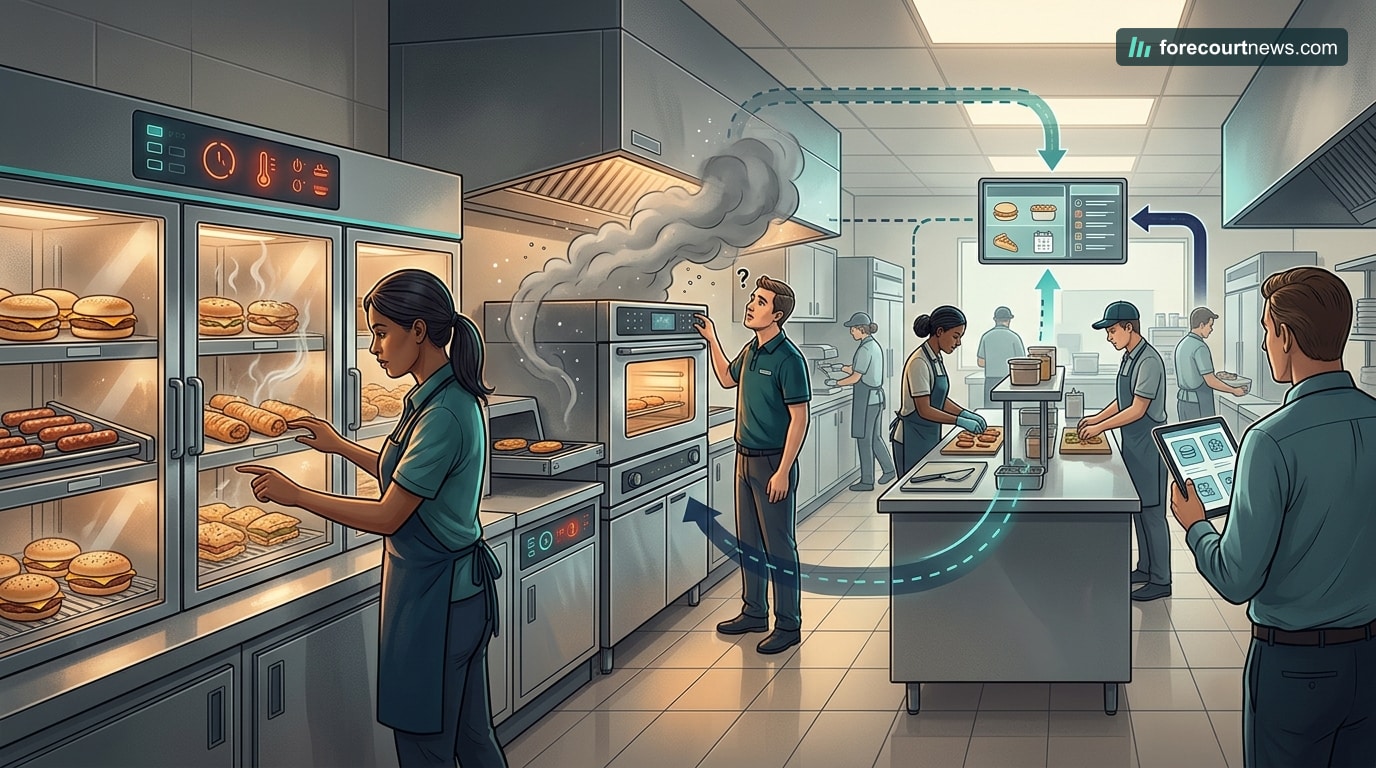
Editorial illustration
Operational Gaps in Forecourt Foodservice Infrastructure
Convenience store operators expanding prepared food programs face mechanical and operational bottlenecks at the kitchen counter. While forecourts increasingly rely on hot grab-and-go items to drive foot traffic and basket size, off-the-shelf commercial equipment frequently fails to address the operational constraints of convenience retail.
According to an industry survey by CSP Daily News, culinary and foodservice leaders from regional chains including Rutter's, Tri Star Energy, and Gate Petroleum report that current hardware forces difficult trade-offs between product consistency, capital expense, and shrinkage. Operating within small footprints without dedicated culinary specialists requires equipment that actively coordinates cooking cycles, preservation environments, and demand forecasting.
Multi-Zone Holding Dynamics and Product Quality
A primary vulnerability in grab-and-go execution lies in display cabinet thermodynamics. Rachel Saddler, director of foodservice innovation at Nashville-based Tri Star Energy—which operates White Bison Coffee, Twice Daily, Sudden Service, and Little General c-stores—points out that standard warmers apply uniform thermal conditions across disparate food categories. As Saddler noted, "Today, most grab-and-go warmers hold everything at roughly the same heat."
Applying a single temperature profile creates rapid texture degradation across mixed menus: high-moisture items like breakfast burritos turn soggy, handheld breakfast sandwiches dry out, and fried items lose crispness within standard holding windows. Saddler advocates for multi-zone cabinets configured with independent temperature, humidity, and airflow settings for each product category. Furthermore, replacing simple elapsed-time clocks with camera- or sensor-based freshness monitoring would allow staff to intercept degrading product before visual or culinary quality declines, rather than discarding items solely when an arbitrary timer expires.
Predictive Kitchen Batching vs. Static Hold Timers
Beyond holding cabinets, front-line kitchen workflows suffer from disconnected batch forecasting. Philip Santini, senior director of food service and bar strategy at York, Pennsylvania-based Rutter’s, explained the core operating tension: "For convenience retail , the challenge is always balancing speed, freshness, consistency, labor and waste."
Santini outlines the need for intelligent, networked cooking and holding platforms that ingest real-time point-of-sale data by daypart. Rather than relying on store clerks to guess replenishment quantities, an integrated production system would calculate run rates, cue staff on what items to cook and when, automate cycle selection on combi-ovens or fryers, and track each batch through its holding lifecycle. Linking holding cabinets directly to back-of-house production planners and external variables—such as store-level historical volume, local weather, and dayparts—would automate the cutover between morning, midday, and late-night menus while provisioning dedicated, temperature-controlled staging compartments for mobile and digital pickup orders.
Ventilation Constraints and Capital Expenditure Limits
Footprint and facility limitations present an equally steep operational barrier for hot food differentiation. Andy Spink, research and development chef at Jacksonville, Florida-based Gate Petroleum, identified ventilation as a major roadblock to menu development, specifically regarding wood smoke and intense aromatics. Spink emphasized that although ventless appliances exist for standard cooking, "ventless will not filter the air of smoke."
Because true smoke dissipation currently cannot be handled entirely within closed-loop ventless hoods, operators seeking smoky flavor profiles must install traditional Type 1 commercial hood systems and exterior exhaust ductwork. As Spink observed, "A hood or an outside unit is most definitely required," adding that "Smaller operations cannot afford the kind of expenditure involved with having a hood installed". For compact forecourt buildings and travel plazas with structural roof constraints, the capital expenditure of retrofitting overhead ventilation can render hot kitchen programs financially unviable.
Operational Evaluation Framework
For operators assessing foodservice retrofits, these equipment gaps underscore the necessity of measuring real-world shrinkage and labor allocation before investing in new menu categories. Retailers should not assume that adding hot holding capacity automatically translates to higher foodservice margin without validating the operational cost of discarded food.
Operators can test whether advanced holding configurations justify their equipment premium by auditing waste logs over a 30-day period. Dividing shrink into culinary degradation (items discarded because texture or appearance failed before maximum hold time) versus timing expiration (items unsold at the end of the daypart window) reveals whether the primary operational breakdown stems from poor thermal holding or inaccurate production volume.