Sale-Leaseback Monetization and Real Estate Capital Strategy: Analyzing Refuel's $260.9M Property Deal
Getty Realty has acquired 41 Refuel convenience stores across four US states in a $260.9 million sale-leaseback transaction. This report evaluates the transaction terms, store site metrics, and strategic implications of property monetization for fuel retail operators.
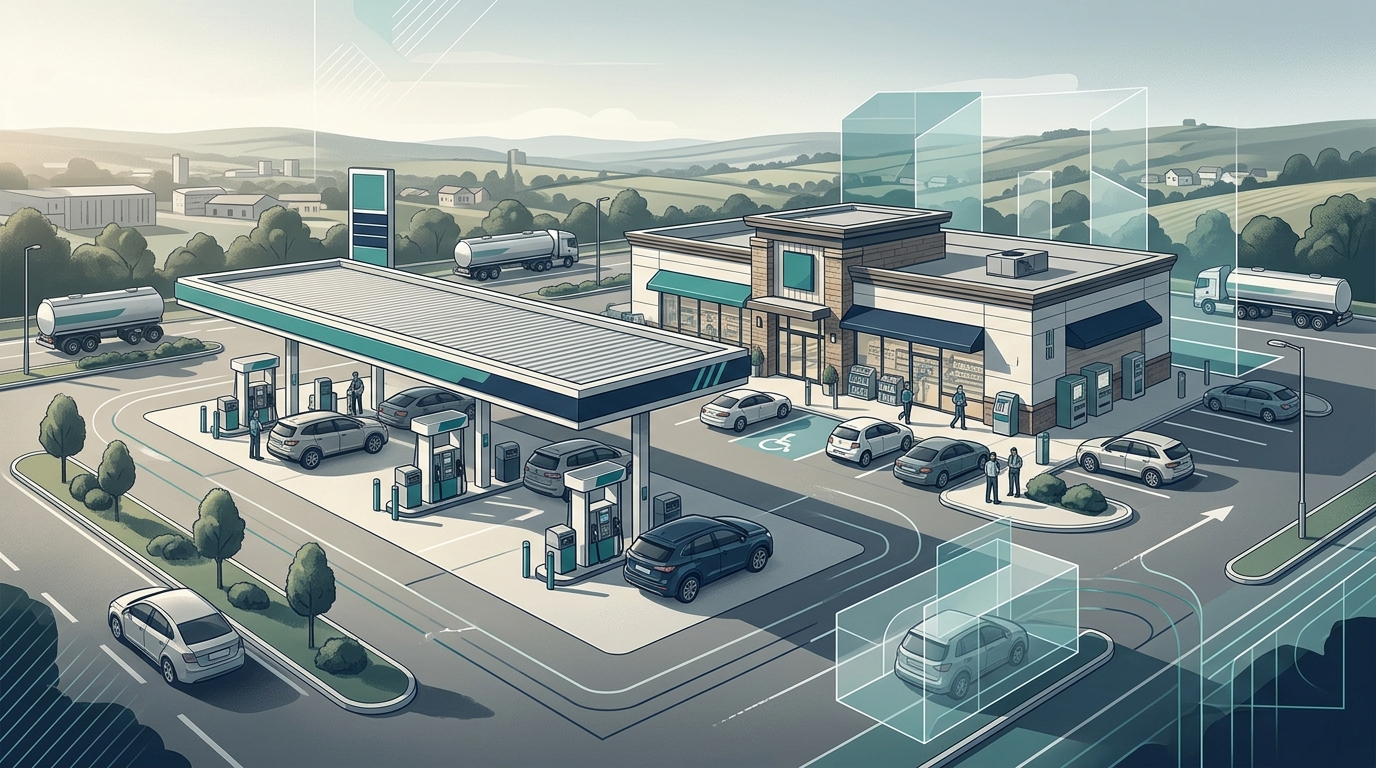
Editorial illustration
Real Estate Capital Allocation in Southeastern Fuel Retail
In September 2026, real estate monetization strategies continued to play an active role in convenience and fuel retail network development. According to reporting from MobilityPlaza, Getty Realty completed a $260.9 million sale-leaseback transaction with Refuel Operating Company. The transaction involves 41 convenience store properties located across four states: 17 locations in South Carolina, 12 in North Carolina, seven in Texas, and five in Mississippi.
Under the contractual structure, Refuel maintains continuous operational control over all 41 properties through four unitary net lease agreements. These leases feature initial duration terms of 20 years, supplemented by options for operational renewals and periodic contractual rent escalations. Prior to this agreement, Getty Realty already owned six real estate assets operated by Refuel. As a result of this transaction, Refuel becomes the third-largest tenant across Getty Realty's property portfolio based on annualized base rent.
Store Specifications and Operational Footprint
The properties included in the agreement reflect modern large-format convenience store engineering designed for high customer throughput and expanded retail services. The acquired sites average approximately 5,000 square feet of interior store space and occupy real estate parcels averaging 2.5 acres. Operatively, many of these locations integrate proprietary foodservice formats alongside third-party branded quick-service restaurant (QSR) concepts.
Refuel maintains an overall operating footprint of approximately 250 convenience store and fuel retail outlets situated across the southeastern United States. The operator conducts business primarily under two retail flags: the Refuel banner and the Double Quick banner. Commenting on the strategic rationale, Refuel Co-CEOs Travis Smith and Jon Rier indicated that the deal "improves the efficiency of our capital structure" while generating operational flexibility to support store investments, staff development, and regional growth.
Analytical Perspective: Sale-Leaseback Risk and Return Hypotheses
Distinction Between Sourced Facts and Operational Hypotheses
The verifiable factual baseline consists of the $260.9 million transaction value, 41 properties across four states, 20-year initial lease durations across four unitary net lease contracts, site physical dimensions (averaging nearly 5,000 square feet and 2.5 acres), and corporate tenant rankings.
Analysis: Transitioning fixed real estate assets into long-term lease liabilities fundamentally changes an operator's balance sheet profile. Converting illiquid land and building equity into liquid capital provides immediate financial resources. However, it replaces capital ownership with long-term fixed lease obligations that persist across changing macroeconomic cycles.
Operational Hypotheses and Proposed Empirical Tests
Hypothesis 1: Reinvesting Monetized Capital into In-Store Foodservice Yields Superior ROIC
- Hypothesis: Reallocating real estate equity into high-margin foodservice technology and store modernizations generates a return on invested capital (ROIC) that exceeds the long-term cost of rent escalations.
- Proposed Test: Convenience operators undertaking sale-leaseback transactions can design a multi-year comparative trial. Track a cohort of 20 monetized stores receiving targeted capital reinvestment against a control group of 20 owned, un-renovated stores over 36 months. Measure net operating profit after tax (NOPAT) minus annualized rental escalations to verify true value creation.
Hypothesis 2: Unitary Lease Clustering Reduces Financing Costs But Restricts Portfolio Flexibility
- Hypothesis: Bundling properties into multi-site unitary leases lowers lease origination friction and secures favorable pricing terms, but reduces local operational agility if local traffic patterns decline over a 20-year horizon.
- Proposed Test: Implement site-level financial stress testing across lease tranches annually. Calculate whether high-performing stores in a unitary lease bundle generate sufficient margin buffer to absorb potential traffic drops at lower-performing locations without jeopardizing total lease coverage ratios.
Strategic Considerations for Forecourt Operators
- Structuring Lease Commitments: Business operators evaluating sale-leasebacks must carefully assess the trade-offs of unitary leases. While unitary net leases streamline administration, they bind groups of stores together, limiting an operator's ability to selectively exit underperforming locations.
- Real Estate Sizing for Modern Formats: The 2.5-acre site footprint and 5,000-square-foot store size highlight how contemporary fuel retail demands larger spaces to accommodate multi-fuel pumps, charging access, and quick-service food options.
- Escalation Management: Financial modeling must align contractual rent escalations with conservative fuel and store gross margin growth projections over two decades.