Capital Restructuring and Technology Integration: Strategic Real Estate Monetization and Regional Forecourt Automation
Convenience store operators are navigating distinct growth strategies across regional markets, balancing asset monetization with technology adoption. In North America, Refuel Operating Company executed a $260.9 million sale-leaseback transaction covering 41 locations with Getty Realty Corp., releasing capital while retaining store operations under long-term leases. Simultaneously, in Latin America, fuel retail technology suppliers are expanding automated checkout, tank monitoring, and EV charging infrastructure, with Brazil representing over 45,000 service stations. This report analyzes real estate capital allocation alongside technology integration models for modern forecourts.
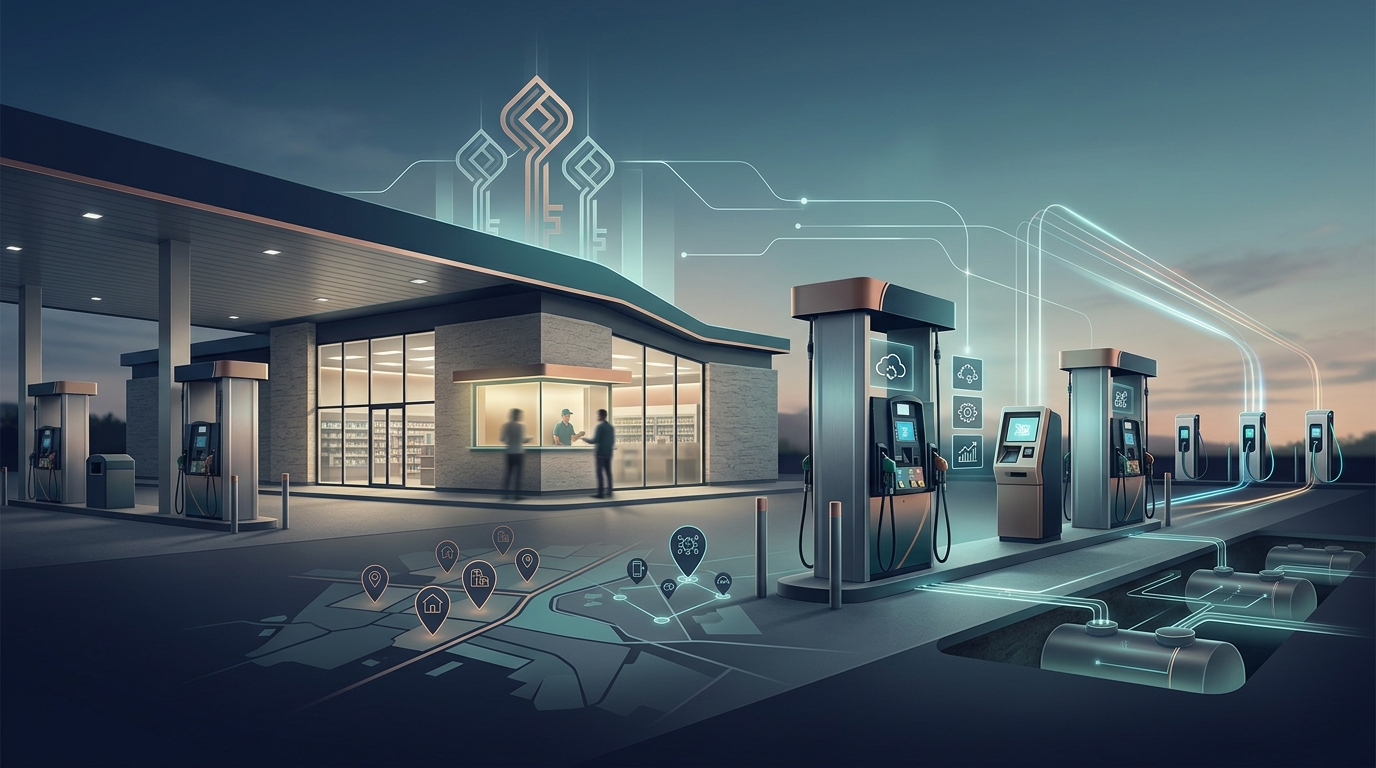
Editorial illustration
Real Estate Monetization: Refuel's Sale-Leaseback Model
Fuel retailers managing large retail footprints are increasingly re-evaluating capital allocation between real estate ownership and operational reinvestment. In September 2026, Refuel Operating Company announced the sale of the real estate for 41 of its convenience stores to real estate investment trust Getty Realty Corp. for $260.9 million (C-Store Dive).
The transaction represents Refuel's first sale-leaseback in its corporate history. Refuel operates approximately 250 convenience stores across five US states; the 41 locations involved in this deal represent roughly 16% of its c-store real estate portfolio. Geographically, the portfolio spans 17 sites in South Carolina, 12 in North Carolina, seven in Texas, and five in Mississippi. The property profile features large-format locations averaging nearly 2.5 acres per site, equipped with proprietary hot food offerings and branded QSR formats (C-Store Dive).
Under the terms of the sale-leaseback, Refuel retains continuous operation of all 41 sites under long-term leases. The operator simultaneously closed a new senior secured credit facility to refinance existing debt. Refuel co-CEOs Travis Smith and Jon Rier stated in the corporate announcement that the deal allows the company to "unlock significant value" while maintaining an attractive network and a strong balance sheet. Getty President and CEO Christopher Constant stated that Refuel's platform and assets "align well with Getty’s underwriting criteria". Prior to this agreement, Refuel was a tenant across six Getty-owned sites, five of which were new-to-industry developments. Following the acquisition, Refuel becomes Getty's third-largest tenant, generating nearly 8% of the REIT's annualized base rent (C-Store Dive).
Regional Technology Deployment: Latin American Forecourt Automation
While North American operators leverage real estate transactions to optimize balance sheets, equipment suppliers in emerging markets are focusing on integrated forecourt technology. At ExpoPostos & Conveniência 2026, held September 8–10 in São Paulo, Brazil, supplier Gilbarco Veeder-Root demonstrated point-of-sale, metering, and digital solutions (MobilityPlaza).
Ariel Dovek, Commercial Director for Latin America, stated that Brazil contains over 45,000 service stations, representing "almost half of Latin America, including Mexico", identifying Brazil as the primary commercial growth market in the region. Product displays at the exhibition focused on forecourt self-checkout, submersible pumps, and EV charging hardware. Gilbarco Veeder-Root introduced FlexPay 6 in Brazil and showcased expanded Red Jacket submersible turbine pumps, TLS wetstock monitoring systems, and digital management suites including Konect, MTA, and FuelONet Prime (MobilityPlaza).
Supplier executives articulated the evolution of forecourt technology beyond fuel dispensing. Marketing Leader Nadia Sarur addressed loyalty engagement and shifting convenience customer behaviors. Convenience Retail Business Leader Daniel Sartini stated that supplier solutions extend "beyond payment and the store", asserting that integrated systems bring greater efficiency to gas station operations (MobilityPlaza).
Strategic Analysis: Capital Allocation and Operational Integration
Real Estate Strategy Analysis
Sale-leaseback arrangements permit operators to monetize non-liquid property assets without sacrificing store locations or operational brand continuity. By shifting real estate into long-term lease obligations, retailers reduce property holding risks and secure capital for balance sheet debt refinancing or store upgrades.
*Hypothesis for Operators*: Converting owned real estate into lease agreements provides net financial flexibility that exceeds the long-term compounding cost of rent payments. *Proposed Test*: Retailers should conduct a financial modeling exercise over a 10-year period comparing a sale-leaseback scenario against traditional real estate ownership. The test must evaluate reduction in annual interest expense against compounding lease liabilities, accounting for site-level EBITDA margin, capital expenditure requirements for QSR and hot-food upkeep, and prevailing debt interest rates.
Technology Integration Analysis
Supplier assertions regarding integrated management platforms highlight the industry's shift toward unified store and pump environments. However, operational gains depend heavily on site layout, customer traffic density, and system interoperability.
*Hypothesis for Operators*: Implementing self-checkout terminals on forecourts reduces counter queue dwell time without increasing shrinkage or payment failure rates. *Proposed Test*: Retailers should run a 90-day controlled trial across 10 high-volume sites, comparing 5 locations equipped with self-checkout kiosks against 5 control sites utilizing conventional cashier checkouts. Operators should track average transaction duration, peak-period customer throughput, basket conversion rates, and audit logs for inventory variance.