QSR Ordering Infrastructure and Menu Innovation Trends in Forecourt Retail
Convenience retailers Pilot and Rutter's are advancing foodservice strategies through digital ordering hardware and crowdsourced menu innovations. Pilot added 156 kiosks across 78 Wendy's sites, while Rutter's launched a customer menu contest offering free fuel for a year.
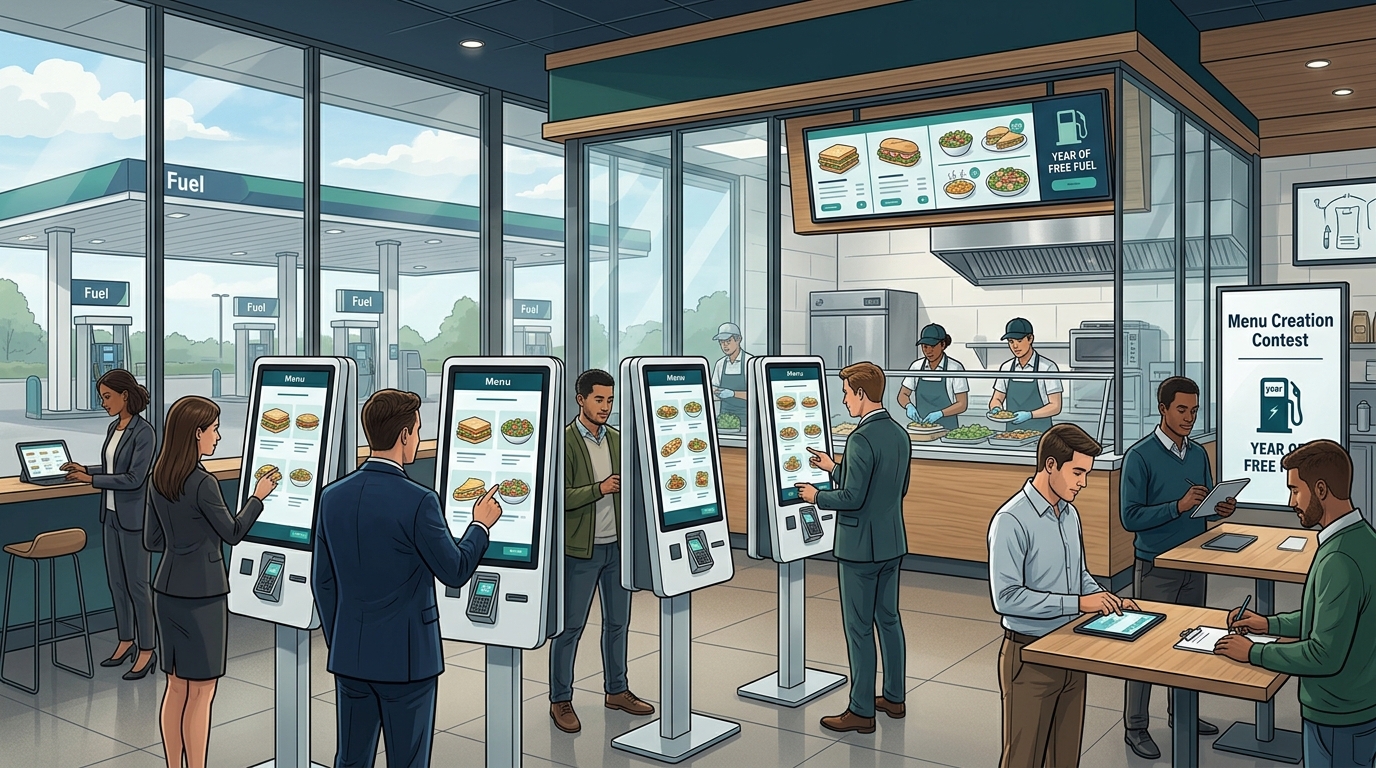
Editorial illustration
QSR Ordering Infrastructure and Menu Innovation Trends in Forecourt Retail
Industry Background and Strategic Context
Convenience store and travel center operators are adjusting foodservice operations to accommodate digital ordering channels and crowdsourced product development. In September 2026 announcements, travel center operator Pilot and convenience chain Rutter's detailed parallel initiatives focused on quick-service restaurant (QSR) ordering integration and consumer menu creation. Detail on both programs is available from Pilot QSR technology upgrades and the Rutter's Customer Craving Contest.
Pilot Upgrades Quick-Service Restaurant Tech Infrastructure
Pilot has implemented digital ordering updates across its quick-service restaurant footprint to mirror systems used by its partner brands. The hardware expansion includes adding 156 self-order kiosks across 78 Wendy's locations within Pilot travel centers.
Pilot completed technology upgrades at its Wendy's and Arby's sites, while systems integration remains underway across its Subway locations. Pilot did not state the total number of locations receiving the technology modifications.
The integrated systems expand customer access across multiple ordering touchpoints:
- Traditional counter service
- Self-service ordering kiosks
- Brand-specific mobile software applications
- Third-party delivery channels
Selected participating sites also provide access to brand rewards programs, digital deals, and promotional offers. Gemma Patterson, senior director of restaurant relations and e-commerce at Pilot, stated that bringing partner digital platforms into travel centers is "improving speed of service and creating a more consistent guest experience."
These technology integrations follow earlier operational shifts by Pilot, including the establishment of 24/7 restaurant operational hours and the completion of a network-wide mobile ordering rollout approximately six months prior.
Rutter’s Solicits Crowdsourced Menu Development
Convenience retailer Rutter's initiated its "Customer Craving Contest," inviting loyalty program members to create custom menu concepts for potential rollout as a limited-time offering (LTO). Submissions are open from Tuesday through September 25.
Rules and Scope of Participation
Participation is subject to specific primary provisions and scope requirements:
- Age Requirement: Entrants must be at least 18 years of age.
- Membership Condition: Entrants must hold an active Rutter's Rewards account.
- Submission Criteria: Submissions must include the concept name, ingredient list, assembly instructions, explanation of appeal, reasons it should win, contact information, and rewards details. Conceptual photographs are permitted but optional.
Judging Schedule and Award Structure
Following the close of submissions, Rutter's will select the Top 10 creations. Five selected finalists will advance to public voting across social media channels from October 12 through October 16. Rutter's will reveal the winning entry on October 23.
The promotional contest establishes two award levels:
- Grand Prize: Free vehicle fuel for one full year, along with featuring the concept as a limited-time menu item across Rutter's locations.
- Runner-Up: A $250 Rutter's store gift card.
Philip Santini, senior director of food and beverage at Rutter’s, noted that loyalty members "are constantly creating their own combinations" and offering creative ideas to the brand.
Operator Geographic Network
Rutter's operates 93 store locations across Pennsylvania, Maryland, and West Virginia. The chain ranks No. 75 on CSP's 2026 Top 202 U.S. c-store network ranking based on store count.
Analysis
*Note: The analysis below reflects independent evaluation of operational considerations and proposed testing methodologies, distinct from reported factual statements.*
Evaluating Kiosk Deployment Density
Pilot's installation of 156 kiosks across 78 Wendy's units represents an average ratio of two kiosks per venue. Pilot claims these kiosks improve efficiency and speed. However, measured operational impacts remain unquantified across the overall network.
To verify whether kiosks reduce counter labor requirements or increase average order value, operators should set up a controlled test hypothesis:
- Hypothesis: Deploying two self-serve kiosks per store increases peak hour throughput without requiring additional kitchen labor.
- Proposed Test: Compare 90-day pre- and post-installation metrics (peak-period queue times, order accuracy, and labor hours per dollar of sales) across kiosk-equipped locations against a control group of non-kiosk locations.
Testing Crowdsourced Menu Concepts
Rutter's crowdsourced menu competition leverages its 93-store footprint to test customer-led menu ideas. While the initiative provides member engagement, sales conversion for the winning item remains unproven until commercial release.
Operators introducing crowdsourced items should benchmark LTO performance against standard menu items by evaluating gross profit per transaction and repeat purchase rate among loyalty members over a 30-day LTO run.