Hospitality AI Deployment Realities: Balancing Order-Taking Automation and Back-of-House Controls
While major restaurant chains test voice automation and artificial intelligence across ordering and inventory, high-profile operational friction and customer pushback highlight the risks of deploying customer-facing AI before back-of-house accuracy is proven.
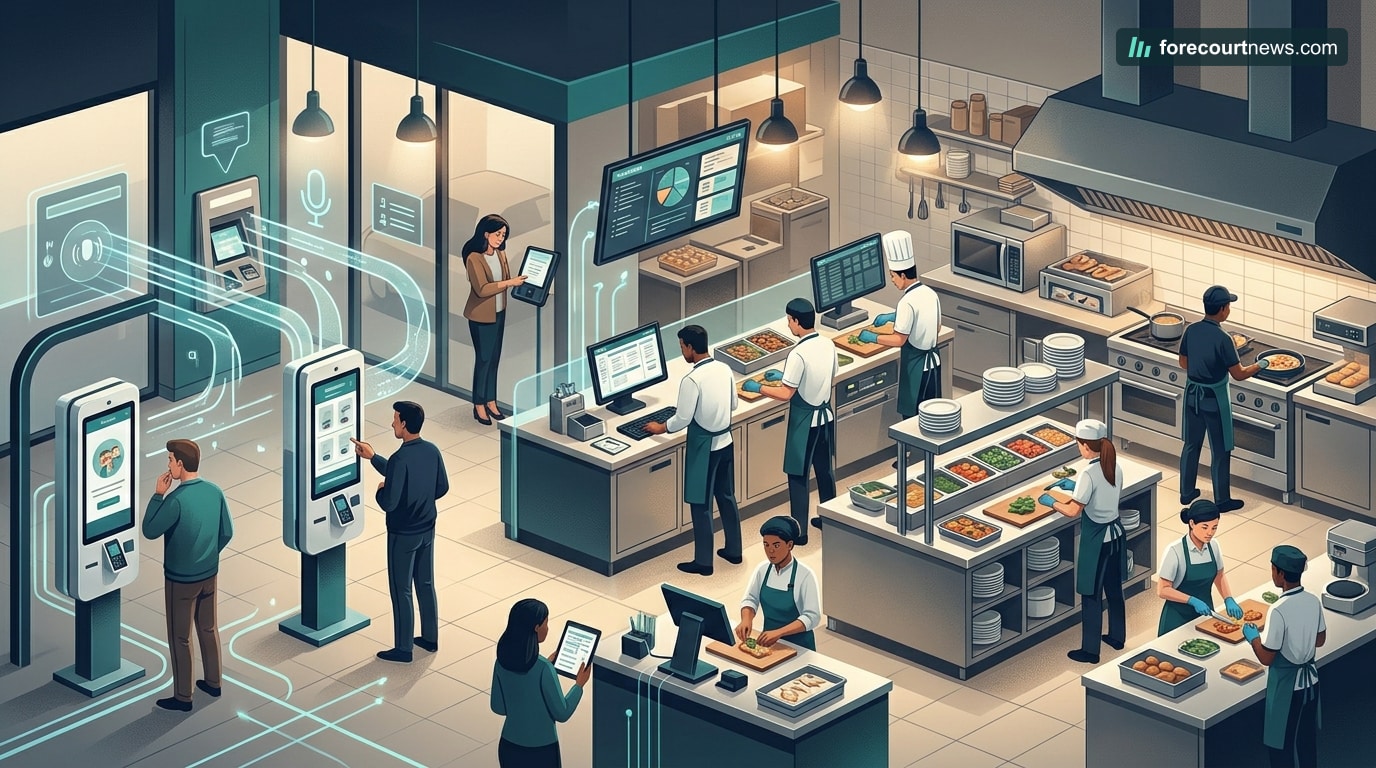
Editorial illustration
Front-Facing AI and Operational Pitfalls
Quick-service and forecourt dining operators face growing pressure to automate customer touchpoints. However, public-facing automated ordering continues to reveal major operational friction. According to industry analysis published by Restaurant Dive, customer and employee frustrations with artificial intelligence have emerged across several major hospitality chains. Front-line failures—such as automated drive-thru systems interrupting ordering guests or prematurely advancing cars to the payment window—demonstrate that consumer-facing speech recognition remains vulnerable to conversational nuance.
High-profile trials underscore these technical boundaries. McDonald's ended its automated order-taking partnership with IBM in 2024 following reports that performance fell short of expectations, subsequently moving in June to test Google-powered drive-thru technology across five U.S. sites. The chain has since outlined plans for ArchIQ, an operating system intended to manage voice ordering, computer vision equipment, and automated inventory. Similarly, Starbucks halted an internal AI inventory management platform in May after nine months because the system miscounted and mislabeled stock.
Public skepticism mirrors these operating hurdles. A Pew Research Center poll conducted in June found that 52% of Americans feel more concerned than excited about increasing AI adoption in daily life. When automated ordering fails, consumer perception frequently frames the initiative as an aggressive cost-cutting maneuver rather than an enhanced service standard, eroding loyalty at the physical counter.
Executive Sentiment Versus Back-of-House Execution
Despite high-profile trial adjustments, commercial investment into hospitality AI remains heavy. A Deloitte survey of restaurant leaders conducted in the fourth quarter of 2024 revealed that approximately 80% of executives planned to raise their AI spending during the following fiscal year. The same survey indicated that 63% of executives already use AI daily to support customer service, while 26% report running pilots or limited implementations.
When asked about primary expected benefits, 60% of surveyed executives pointed to enhanced customer experience, 36% cited improved restaurant operations, and 31% sought stronger loyalty mechanics. However, administrative and governance concerns remain widespread: 48% of leaders expressed concern regarding risk management around AI, with 20% citing intellectual property risks and 16% noting concerns over the misuse of customer and client data.
Operational researchers note that AI implementations succeed most consistently when applied to bounded, data-intensive tasks behind the scenes. Labor scheduling represents one such deployment; McDonald’s significantly cut schedule-generation time across several international markets using algorithmic scheduling tools. Similarly, automated demand forecasting can process sales data without exposing guests to algorithmic errors, allowing operators to refine purchasing without generating front-of-house service friction.
Menu Execution and Seasonal Beverage Workflows
While technology leaders address ordering algorithms, food-to-go operators continue relying on seasonal menu rotation to maintain foot traffic and counter check sizes. In the beverage sector, QSR Magazine reported that 85°C Bakery Cafe rolled out a seasonal Apple Series for the colder months. The launch features an Apple Black Tea combining tea, apple flavor, and sliced fruit, alongside a caffeine-free Apple Cider garnished with cinnamon and apple slices, with both offerings available in hot and iced formats.
Introducing multi-temperature beverages with fresh fruit garnishes places distinct physical demands on preparation stations. For forecourt foodservice operators, balancing such seasonal assembly steps against kitchen throughput requires tight ingredient portioning and consistent staging. Introducing experimental automated ordering during high-volume seasonal beverage promotions presents operational hazards if ordering algorithms misinterpret customization requests like ice levels or caffeine preferences.
Operational Analysis: Phasing Automation Pilots
Operators evaluating automated restaurant software should treat technology claims with rigorous skepticism. An operational hypothesis for retail networks is that testing AI in back-of-house inventory and labor optimization yields measurable cost stabilization without putting brand reputation at risk. Conversely, introducing conversational AI at drive-thrus or order kiosks prior to achieving high baseline accuracy risks increasing cashier intervention labor rather than reducing it.
To manage this transition, hospitality operators should establish strict pilot stage gates. Internal metrics must track intervention rates—measuring precisely how often human staff must override automated systems—alongside order completion times and inventory discrepancy rates. Automating back-office forecasting first provides the data foundation necessary to support reliable kitchen production, ensuring customer-facing service remains dependable.