Convenience Foodservice Formats: From Travel Center Kitchens to Automated Kiosks
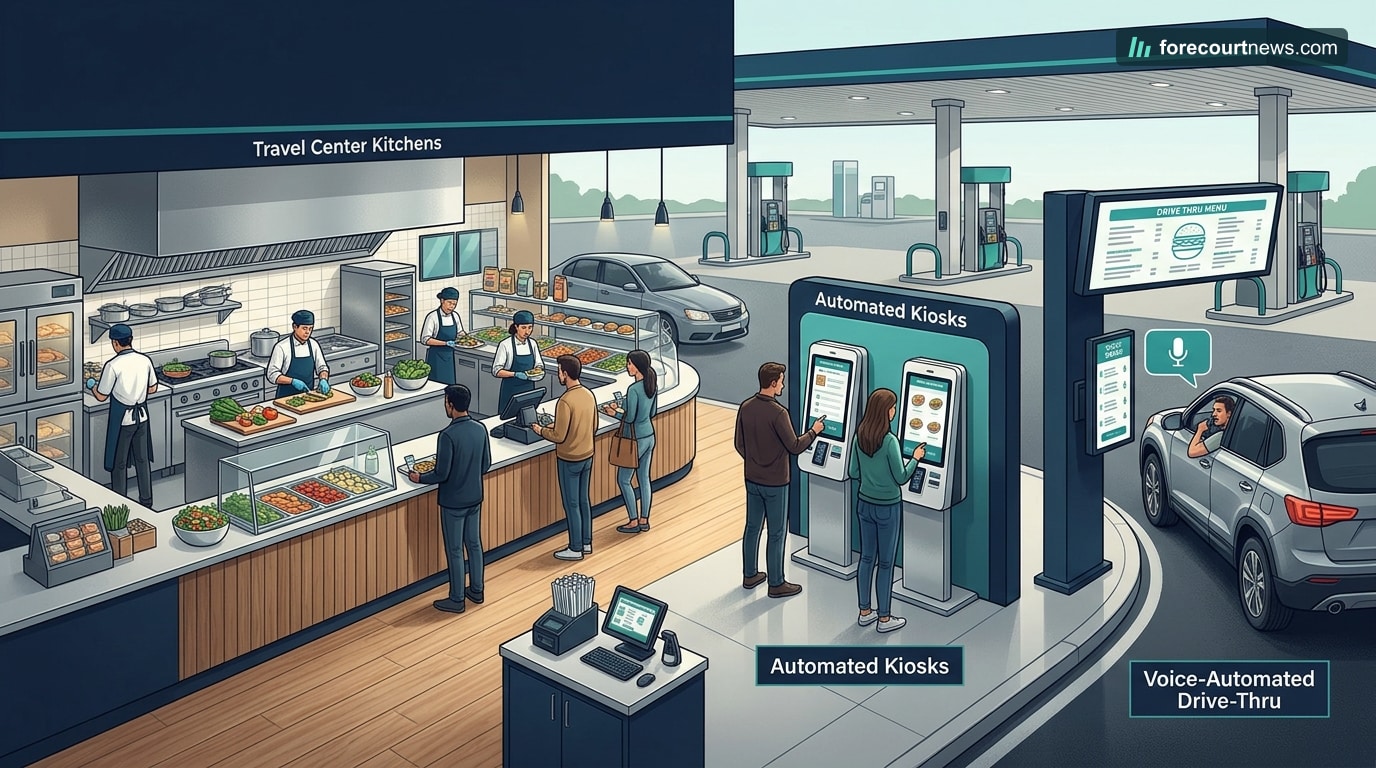
Forecourt and convenience operators are diversifying food operations across two distinct vectors: large-format made-to-order kitchens and compact automated kiosks alongside voice-automated drive-thrus.
Editorial illustration
Retailers and restaurant operators are adjusting their physical footprints and labor configurations to capture foodservice margin while managing store operating costs. As travel centers expand physical footprints for scratch cooking and fresh foods, convenience and quick-service restaurant (QSR) brands are testing modular robotics and voice artificial intelligence (AI) to automate production and order capture.
Expanding Dedicated Prepared Food Footprints
Recent retail openings demonstrate ongoing investment in full-service kitchens and proprietary food-to-go. According to NACS, regional convenience operators continue to pair dedicated food programs with expanded forecourt fueling. Royal Farms is opening two locations in December: a site in Bear, Delaware opening December 14 with 12 fuel dispensers featuring E15 and E85 options, and a location in Wallace, North Carolina opening December 17 featuring 16 dispensers with E-Free fuel. Both company stores operate on a 24/7 schedule and feature Royal Farms' chicken, coffee, grab-and-go selections, and made-to-order food.
At the same time, large-format highway travel plazas continue to prioritize expansive physical hospitality spaces. Buc-ee's opened a 74,000-square-foot travel center near Interstate 24 at the Joe B. Jackson Parkway exit in Murfreesboro, Tennessee. Conversely, urban grocery formats are compressing footprint: Whole Foods Market is launching its smaller Whole Foods Market Daily Shop concept in Queens, New York. The 7,178-square-foot site will operate daily from 8:00 a.m. to 10:00 p.m., offering hot rotisserie chicken, sandwiches, entree salads, and meat assortments sourced from regional suppliers.
Automated Dispensing and Kiosks
To capture hot food spend without committing several thousand square feet to commercial kitchen hoods and line cooks, convenience operators are examining automated dispensing hardware. Restaurant Dive reports that Murphy USA is trialing automated White Castle kiosks through a partnership with Automated Retail Technologies to offer fresh menu items in select large-format convenience stores.
Automated production units are also drawing investment from non-traditional food providers looking to scale footprint with minimal back-of-house labor. Food hall company Wonder deployed an automated makeline in Midtown East, Manhattan, using automated makeline technology it bought from Sweetgreen for $186 million. In the QSR segment, California Pizza Kitchen entered an agreement with retail technology firm T-ROC Global aiming to deploy 1,000 automated kiosks by 2029 to widen customer reach.
Voice AI and Drive-Thru Throughput
Order-taking workflows represent another area where operators seek to curb staffing pressures. Voice ordering technology from Hi Auto is deployed at 267 Checkers & Rally's locations, tracking toward half of the system by early next year, according to Restaurant Dive. At Bojangles, the supplier's voice ordering system operates across 500 restaurants, handling 1 million orders weekly with an attributed 98% accuracy rate, with plans to expand into 100 additional drive-thrus.
Major QSR players are pursuing similar goals at enterprise scale. Taco Bell targets voice ordering technology in 1,500 locations by year-end 2026. McDonald's is targeting nationwide drive-thru voice AI implementation in 2027, with corporate estimates indicating the automated ordering system could save 50 weekly labor hours per restaurant, though some franchise operators have questioned whether guests favor automated ordering or whether it enhances hospitality.
Operational Analysis: Matching Formats to Site Profiles
For forecourt operators, the choice between commercial kitchens and automated dispensing hinges on volume consistency and available footprint. Large-format highway plazas like travel centers benefit from high dwell times and steady daytime traffic, which can sustain the capital expense and crew scheduling required for round-the-clock made-to-order chicken or deli programs.
Conversely, constrained forecourt boxes face tighter staffing limits and unpredictable order spikes. Kiosk solutions such as automated hot food dispensing provide an avenue to test branded QSR items without hood venting or dedicated cook shifts. When considering voice AI or automated kiosks, operators should track order accuracy, maintenance uptime, and customer throughput during peak shifts before reallocating labor hours away from primary customer service stations.