Global Commercial EV Trends and Heavy-Duty Charging Outlook
An independent analyst report examining global electric truck and bus adoption in 2025 based on IEA data, highlighting geographic trends, supplier range claims, regulatory developments, and forecourt charging hypotheses.
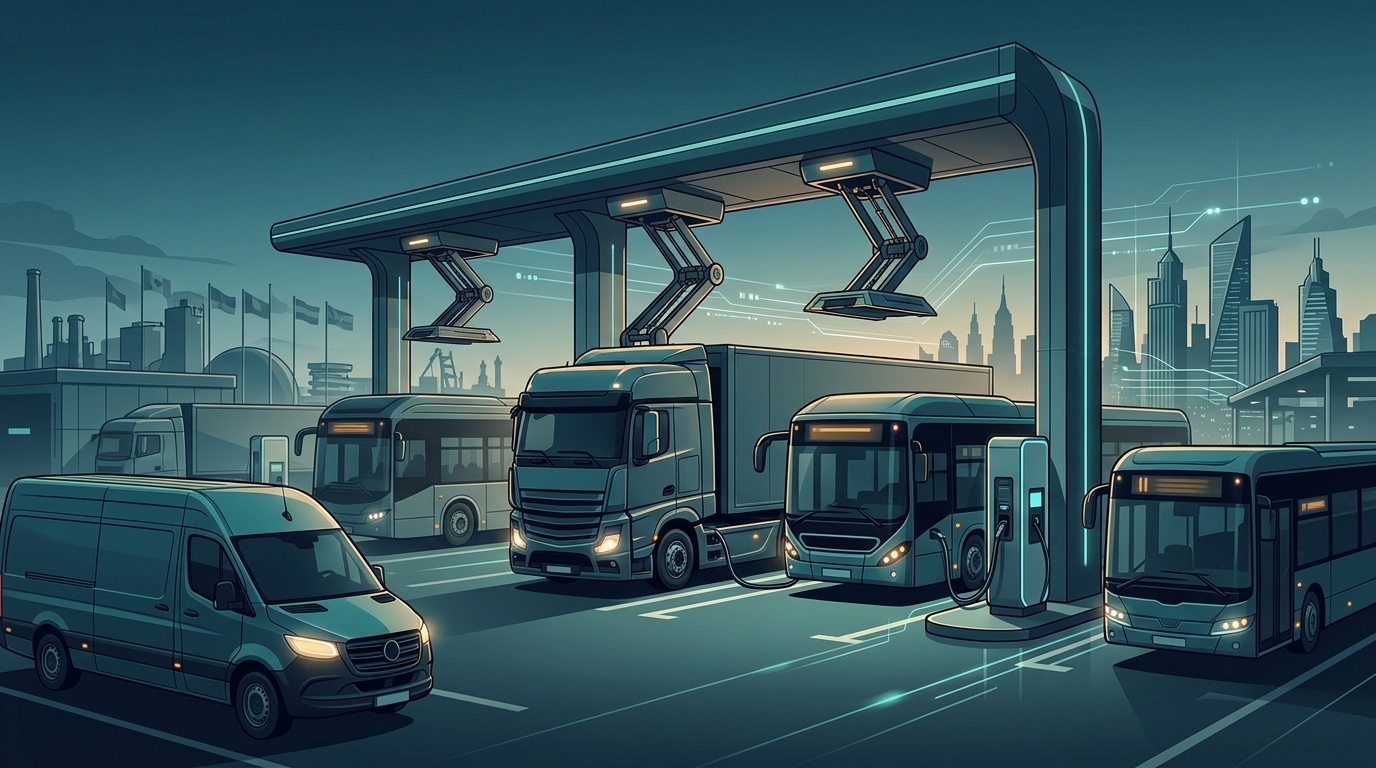
Editorial illustration
Forecourt Analysis: Global Commercial EV Trends and Heavy-Duty Charging Outlook
Commercial vehicle electrification expanded significantly in 2025, presenting new strategic considerations for forecourt operators assessing dedicated heavy-duty vehicle (HDV) charging infrastructure. According to the IEA Global EV Outlook 2026 Report, global electric truck sales doubled in 2025 to exceed 400,000 units, capturing 9% of total truck sales worldwide.
Market Segmentation and Geographic Adoption
Growth in electric commercial fleets remains concentrated primarily in heavy freight trucks (HFT) and medium freight trucks (MFT). Globally, electric HFT sales reached 230,000 units in 2025, while MFT sales expanded 65% to 210,000. Battery electric powertrains accounted for 97% of all electric truck sales worldwide in 2025, driven by greater cost-competitiveness and a higher number of available models compared to plug-in hybrid alternatives.
Regional adoption rates vary markedly due to differing policy environments and economic support:
- China: Accounted for over 90% of global sales in 2025, exceeding 400,000 electric trucks. One in four trucks sold in China was electric. Adoption was driven by total cost of ownership (TCO) advantages, expanding battery-swapping operations—which represented 15% of Chinese electric truck sales—and government incentives. The renewed scrappage scheme provided up to USD 20,000 to replace older trucks, covering roughly 20-50% of the average electric truck price premium. Additionally, Stage 4 HDV fuel consumption standards took effect in July 2025, requiring a 12-16% fuel efficiency improvement over Stage 3.
- Europe: Electric truck sales grew 40% year-on-year to nearly 17,000 units, representing 3% of regional truck sales. Germany led regional volume with 4,400 sales, supported by EUR 1.6 billion in government funding for electric truck charging infrastructure. The United Kingdom led growth with a 55% increase to top 3,000 sales, while France reached 1,900 and Sweden reached 1,000. Regulatory drivers include EU HDV CO2 standards entering into force in 2025, targeting a 15% emissions reduction compared to 2019 levels. It should be noted that while the EU proposed extending road toll exemptions for battery electric and fuel cell trucks, a proposed extension remains distinct from an approved policy.
- North America: US electric truck sales rose 25% to 17,000 units, though over 95% were MFTs, including nearly 10,000 Rivian delivery vans. US policy momentum slowed, as California’s Advanced Clean Trucks regulation was revoked and the US Environmental Protection Agency repealed all GHG emission standards for medium- and heavy-duty vehicles. Canadian sales grew 35% to 2,700 units.
- Rest of the World: Outside major regions, electric truck sales fell 15% to 1,900 units, despite growth in India where registrations rose from 200 to 800 units.
Bus Electrification and Public Transport Infrastructure
Global electric bus sales grew 12% in 2025 to nearly 70,000 units, with battery electric models representing 98% of total volume. China accounted for roughly 60% of global sales, where electric vehicles made up over 60% of total bus sales and nearly 100% of urban bus sales. European sales rose 28% to over 12,000 units, with electric city bus shares exceeding 55%.
Conversely, US electric bus sales dropped 40% in 2025. Although the US Federal Transit Administration announced USD 2 billion in transit grants, none of the 165 funded projects included electric bus purchases or charging installations, favoring natural gas alternatives instead.
Supplier Range Claims and Operational Considerations
Manufacturer developments reflect advancing battery capabilities across heavy commercial segments:
- Volvo: Announced an electric HFT offering a 600 km driving range planned for Q2 2026, alongside an electric bus chassis unveiled in 2025 enabling up to 700 km range.
- Renault: Unveiled an electric truck model capable of a 600 km driving range.
- Sany: Offers an electric HFT model capable of exceeding 800 km on a single charge.
- Tesla: Claims it will begin deliveries of an 800 km-capable semi-trailer truck in 2026.
Average self-declared ranges currently stand at 270 km for MFTs, 310 km for HFTs, and 360 km for urban battery electric buses.
Forecourt Analyst Perspective: Operational Hypotheses
*Analysis*: While high-power megawatt charging and depot infrastructure are critical for long-haul commercial transport, integrating heavy-duty charging bays into traditional retail forecourts presents unproven commercial outcomes regarding throughput and land utilisation.
- Hypothesis A: Adding dedicated high-power heavy-vehicle charging lanes at highway forecourts will increase overall site revenue by capturing fleet dwell-time spend.
- *Proposed Test*: Operators should run a 12-month pilot program measuring revenue per square meter comparing dedicated truck charging bays against standard ultra-fast passenger EV bays on high-density freight corridors.
- Hypothesis B: Offering standardized truck battery-swapping services at strategic hub locations will improve charger utilization efficiency compared to cable-based fast charging.
- *Proposed Test*: Conduct a comparative operational trial at logistics-adjacent forecourts measuring vehicle turnaround times, grid peak-demand charges, and capital expenditure amortization over 24 months.