Evaluating Ultra-Fast EV Charging Infrastructure and Forecourt Amenity Integration in Germany
Aral pulse has deployed four 400 kW charging columns at an Aral service station in Iserlohn, Germany. This analysis examines equipment ratings, payment and tariff structures, and operational methodologies for testing dwell-time retail conversion.
Editorial illustration
German Highway Charging Infrastructure: Analyzing High-Power Hardware and Forecourt Retail Integration
Sourced Network Expansion and Site Infrastructure
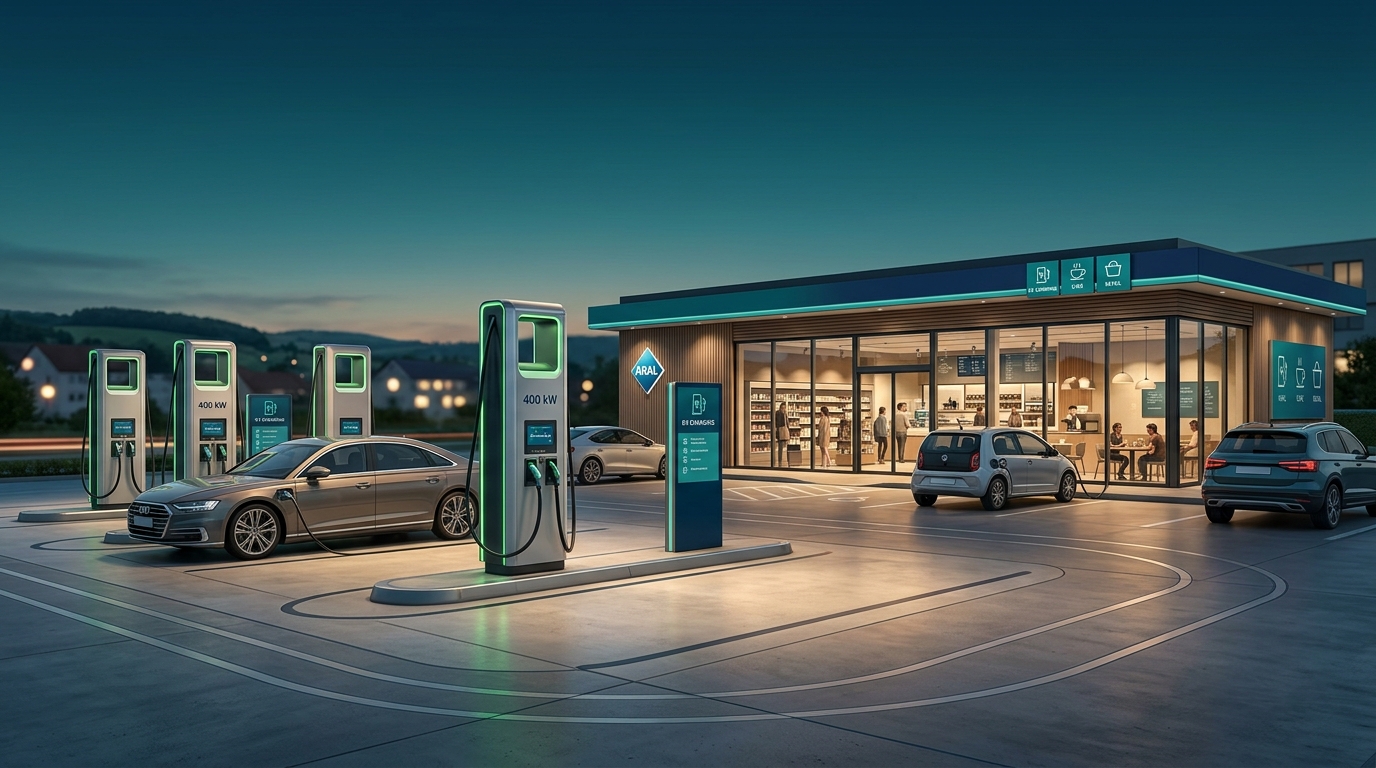
In October 2026, Aral pulse expanded its EV charging presence in Germany by bringing four new ultra-fast charging columns into operation at an Aral forecourt on Dortmunder Straße 110 in Iserlohn, situated near the A46 motorway (MobilityPlaza). Each newly commissioned column contains two charging points, adding eight high-power charging access points to the site.
The deployed hardware carries a maximum rating of up to 400 kW per column. Based on standard hardware power ratings, units operating at this maximum level can deliver up to 300 km of driving range in ten minutes. This location-specific addition sits within Aral’s wider national footprint, which comprises over 4,000 charging points across approximately 600 sites nationwide.
In independent testing, Aral pulse secured a "very good" rating in the 2026 Connect charging network test, marking its fourth consecutive year as the country's top charge point operator, alongside recognitions from Electricar and Vision Mobility. Commenting on customer uptake, Alexander Junge, Board Member for E-Mobility at Aral, stated that the organization aims to be the "first choice for our customers" and noted that the ultra-fast charging offer is being very well received.
Tariff Options, Payment Protocols, and On-Site Amenities
Access and billing at the Iserlohn site rely on multiple physical and digital payment mechanisms. Aral has maintained an official partnership with the German automobile club ADAC since 2024, enabling drivers to utilize the ADAC e-Charge tariff within the Aral pulse mobile app. Drivers can additionally complete charging payments using the Aral pulse charging card or directly via payment options provided on the charger hardware.
The physical forecourt layout surrounding the charging infrastructure integrates conventional convenience and vehicle maintenance amenities. On-site facilities include dedicated site lighting, restrooms, a REWE To Go convenience store, and an automated car wash.
Analytical Perspective: High-Power Station Integration Metrics
*(Note: The following analysis is an independent evaluation and is explicitly distinguished from the sourced factual reporting provided above.)*
Differentiating Rated Maximums from Field Performance
Forecourt operators reviewing high-power EV deployments must carefully distinguish between peak equipment ratings and actual delivered charging throughput. While a 400 kW rating represents maximum potential output, real-world energy transfer rates depend on several operational parameters:
- Vehicle Intake Limits: An EV's battery management system (BMS), ambient temperature, and current state of charge dictate maximum power acceptance. Most current passenger EVs cannot sustain 400 kW power draw throughout an entire charge cycle.
- Dynamic Site Power Allocation: Dual-port columns delivering up to 400 kW frequently employ dynamic power sharing when two vehicles plug in simultaneously, halving available per-plug throughput unless adequate grid capacity is actively supplied.
Monetizing Dwell Time: Hypotheses and Empirical Testing
Pairing ultra-fast charging with co-located retail amenities (such as REWE To Go) and automated vehicle washing presents a logical hypothesis regarding dwell-time revenue enhancement.
- Hypothesis: Broadening amenity options at motorway-adjacent charging locations increases non-fuel retail margins by converting waiting EV drivers into store shoppers and car wash customers during a 10-to-20 minute charging pause.
- Unmeasured Benefit Warning: Operators cannot assume that installing 400 kW chargers automatically expands store profit, reduces labor requirements, or guarantees customer satisfaction. Conversion depends on site design factors such as clear footpaths, site lighting, canopy protection, and retail store positioning relative to charging bays.
- Proposed Testing Methodology: To evaluate whether charging infrastructure drives incremental retail sales, operators should conduct a 90-day comparative study. This involves tracking point-of-sale (POS) transaction timestamps, basket sizes, and store conversion rates at charging-enabled sites against matched control forecourts lacking EV charging infrastructure.