Dynamic Grid Connections in Highway Fast Charging: Operational Lessons from Ampol and Ausgrid
Ampol and distribution network operator Ausgrid have introduced dynamic grid-responsive EV fast charging at the Ampol Foodary M1 Wyong Northbound station. By utilizing Kwetta technology to draw variable supplemental capacity beyond a 500 kVA baseline, the corridor project provides a framework for deploying high-power charging without conventional grid reinforcement.
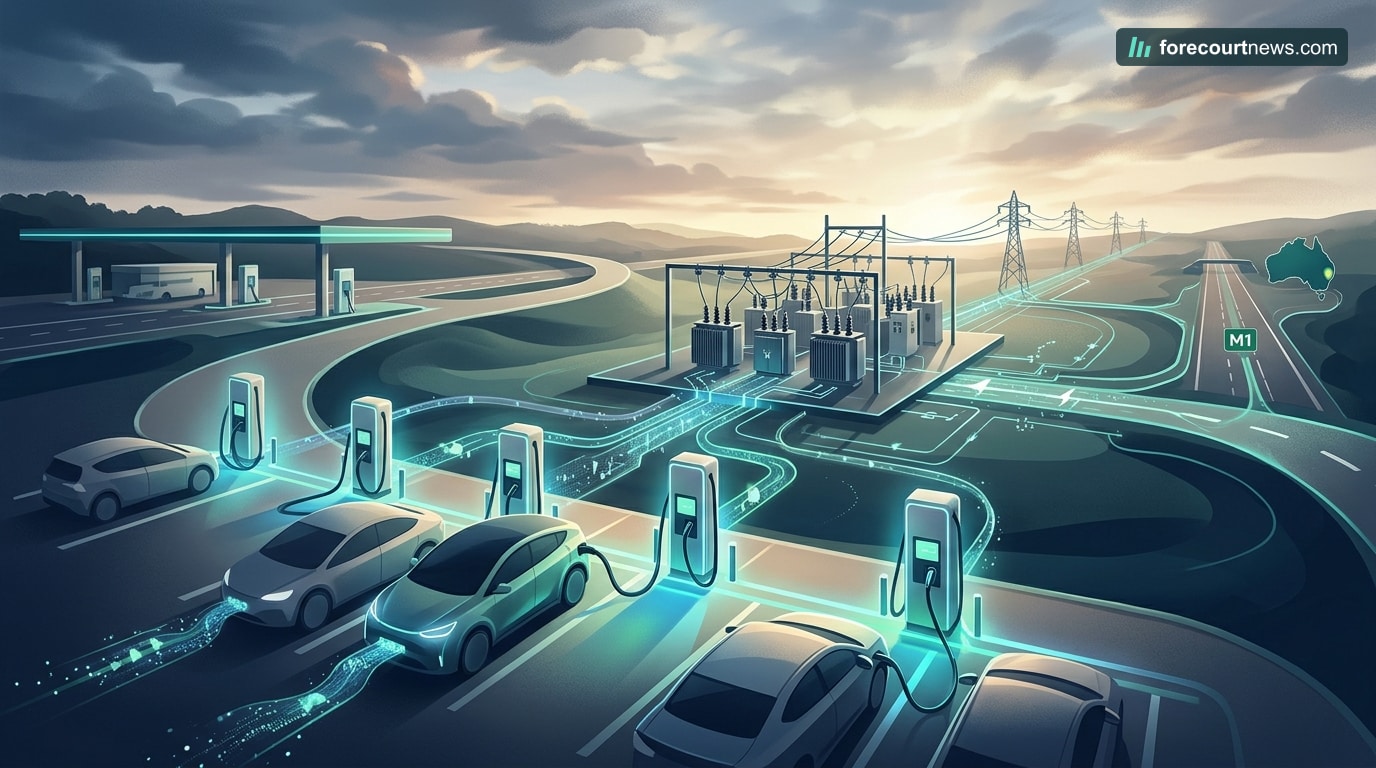
Editorial illustration
Dynamic Capacity Management on Constrained Highway Corridors
Highway service areas face structural electrical limitations when adding high-power DC fast-charging plazas. Traditional utility interconnections require fixed maximum capacity allocations that reflect peak coincident charging events, which frequently necessitates costly substation or line rebuilds and extended development timelines. At the Ampol Foodary M1 Wyong Northbound service station, located on Australia’s busiest inter-capital corridor, fuel retailer Ampol and electricity distributor Ausgrid have deployed an operational alternative: a dynamic network connection.
Under this deployment, each station location operates with 500 kVA of dedicated capacity while retaining software-governed access to draw up to an additional 750 kVA when local grid conditions permit. The underlying power electronics and management software, supplied by Kwetta, interface directly with Ausgrid’s distribution system to modulate charging output in near real time. When network headroom exists, the site scales beyond its baseline connection; during peak distribution grid stress, the station curbs power draws back toward its dedicated allocation. Furthermore, the twin Northbound and Southbound sites are engineered to share electrical capacity under defined grid outage conditions. While the Northbound site is operational, the Southbound installation is scheduled to open later in November 2026.
Layout and Bay Configuration for Towing and Commercial Vehicles
The physical design of highway charging hubs directly impacts traffic flow, turn turnaround, and dwell times. Standard charging stalls are configured as perpendicular pull-in spaces, which create access barriers for vehicles towing trailers or caravans and for medium-duty commercial vans. Drivers of these combinations are often forced to unhitch before charging or occupy multiple adjacent bays, obstructing forecourt circulation.
The Wyong Northbound hub addresses this operational friction by installing eight charging bays, which include two drive-through bays tailored specifically for longer vehicles, commercial fleets, and drivers towing caravans or trailers. The charging hardware delivers up to 200 kW per vehicle, with instantaneous power delivery dependent on vehicle battery architecture, aggregate station load, and dynamic network capacity. Kwetta’s charging infrastructure has also been deployed across 13 public forecourt locations within the Ampol-owned Z Energy network in New Zealand, reflecting a repeatable equipment footprint across regional markets.
Analysis: Operational Hypotheses for Dynamic Connections
Ausgrid described the dynamic connection as a faster and less capital-intensive deployment model compared to conventional network reinforcement. For forecourt operators evaluating similar technology, several commercial and operational factors must be tested rather than assumed:
- Throughput versus Throttling Risk: Dynamic capacity avoids fixed network upgrade costs, but charging speed is subject to local utility curtailment during peak summer or winter grid events. Operators should evaluate the hypothesis that dynamic throttling does not materially depress customer satisfaction or forecourt retail conversion. A proposed test involves tracking average session delivery rates (kW), total session duration (minutes), and auxiliary retail basket size across peak grid periods compared to unconstrained shoulder periods.
- Drive-Through Bay Utilization and Dwell Dynamics: While drive-through bays prevent unhitching bottlenecks, they consume greater physical forecourt area than standard pull-in parking stalls. Operators can test whether drive-through stalls improve space productivity by measuring bay turnover rate, dwell time per transaction, and the proportion of towing or commercial fleet drivers against non-towing passenger cars occupying those specific slots.
- Cross-Carriageway Capacity Sharing: The ability of paired highway sites to share power during localized outages introduces network resilience. Operators can benchmark system reliability by monitoring mean time between service disruptions and verifying whether capacity-sharing logic successfully sustains minimal continuous service at both carriageways without tripping station switchgear.