Forecourt Transaction Dynamics, Foodservice Reallocation, and Regional Technology Exports
An operational briefing examining convenience store transaction trends, foodservice revenue contributions, site consolidation patterns, and regional forecourt infrastructure models.
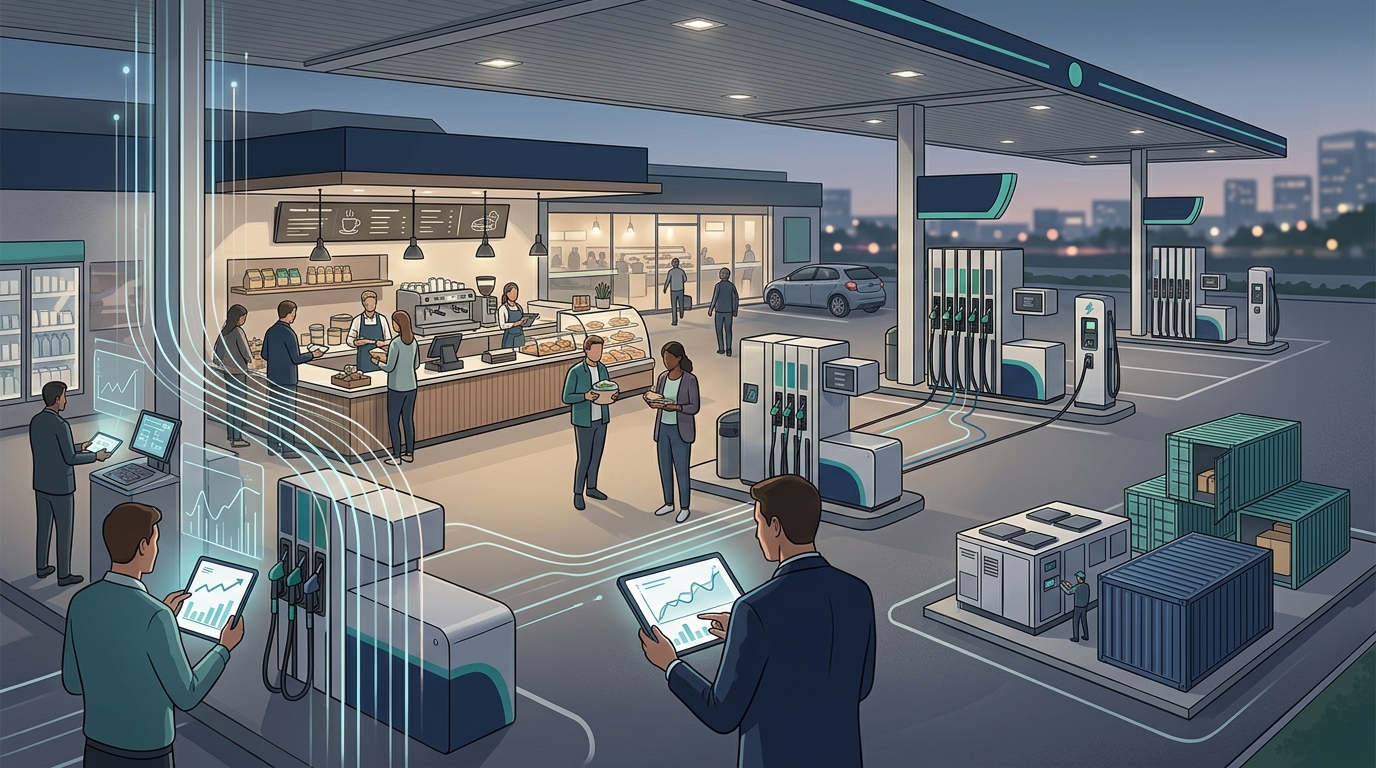
Editorial illustration
Operational Shifts in In-Store Sales and Traffic Volumes
Data from NACS indicates evolving operational dynamics within convenience store retail. In 2025, foodservice represented 28.5% of in-store sales across convenience stores, expanding from 11.9% recorded in 2005. Concurrently, overall foot traffic showed contraction: the average convenience store registered 45,160 transactions per month in 2025, representing a 2.7% decrease compared to 2024 metrics.
This divergence between expanding foodservice sales shares and declining overall transaction volumes highlights a core operational challenge for fuel and convenience operators. While individual ticket values may benefit from prepared food programs, monthly store visits are declining across average sites. Specific regional chains continue to adjust footprint strategies within this market environment. For example, RoadDog recently opened a barbecue Quick Service Restaurant (QSR) inside one of its Ohio locations. In contrast, smaller regional networks—including Earnheart Oil, Fleming Brothers Oil, PowerTrac, FastLane, Big Boss Stores, and Monfort Companies—have exited the retail landscape amid broader consolidation.
Despite ongoing market consolidation, independent operators retain significant network scale. NACS figures demonstrate that 63% of c-stores remain operated by firms managing 10 or fewer locations. Regional operators like TXB, a 54-store chain, maintain positive growth outlooks despite competitive pressures from larger national networks.
Operators can review detailed North American industry data via C-Store Dive.
South American Forecourt Infrastructure and Retail Adaptation
Forecourt operations in South America present distinct regulatory and operational parameters, particularly in Brazil. The Brazilian fuel retail network encompasses more than 45,000 active service stations and approximately 8,500 convenience stores. The market features high ethanol blending mandates and offers pure E100 fuel as a standalone option for flex-fuel vehicle fleets.
Industry infrastructure developments were featured at ExpoPostos & Conveniência 2026, held from September 8 to 10 at São Paulo Expo. Organized by ABIEPS and Fecombustíveis alongside GL Events, the event attracted over 30,000 attendees and featured more than 250 exhibitors.
Supplier developments reflect both local adaptation and international expansion:
- Excel: Founded in 1990, the company introduced an early digital tyre calibrator and currently exports fuel management and fleet control hardware to over 30 countries. Excel President & CEO Cristian Bazaga, who also serves as President of ABIEPS, stated that operating across diverse regional demands within Brazil requires treating hardware deployment as a service model centered on quality and support.
- Grupo Dislub Equador: Marketing Manager David Freidzon outlined the group's franchise strategy with its Convém retail concept. Designed alongside architectural studio Balko, the flagship Convém location in Manaus earned the NACS Convenience Retailer of the Year Award for Latin America at the NACS Show 2024.
- GL Events Exhibitions: Managing Director Tatiana Zaccaro highlighted that trade exhibition focus areas are increasingly shifting toward artificial intelligence, payments, new energy vectors, and expanded foodservice concepts.
Forecourt security and tax governance remain critical operational considerations. Fecombustíveis President James Thorp Neto stated that over 1,000 service stations out of Brazil's total network were identified as having links to organized criminal groups. Furthermore, Thorp Neto emphasized that frequent shifts in tax regulations create operational friction and narrow net retail operating margins.
Further details on Latin American forecourt solutions are reported by MobilityPlaza.
Analysis: Hypothesizing Foodservice and Tech Upgrades
Foodservice Margin Performance Test Hypothesis
*Hypothesis*: Operators adding dedicated internal QSR formats (such as barbecue or hot food stations) can offset lower monthly foot traffic by increasing gross margin contribution per transaction, without expanding overall labor hours per shift. *Proposed Test Methodology*: Measure baseline labor hours, transaction count, and gross margin per customer across five control sites and five converted QSR test sites over a six-month period. Track net store profitability after accounting for waste, specialized kitchen equipment maintenance, and prep time.
Automated Forecourt Services and International Tech Export Hypothesis
*Hypothesis*: Exporting standardized digital fleet management and tyre maintenance devices built for complex multi-fuel environments simplifies forecourt maintenance procedures and reduces fuel loss reconciliation discrepancies in secondary markets. *Proposed Test Methodology*: Deploy digital fuel monitoring and calibrator systems across 20 international trial stations for 90 days. Compare error logs, reconciliation times, and maintenance downtime against existing legacy equipment baselines.