Forecourt Retail Strategies: Regional Partnerships and Digital Foundations
An operational analysis examining regional QSR co-locations in North America and foundational IT infrastructure strategy across European forecourt networks.
Editorial illustration
Forecourt Operations and Regional Partnerships in Fuel Retail
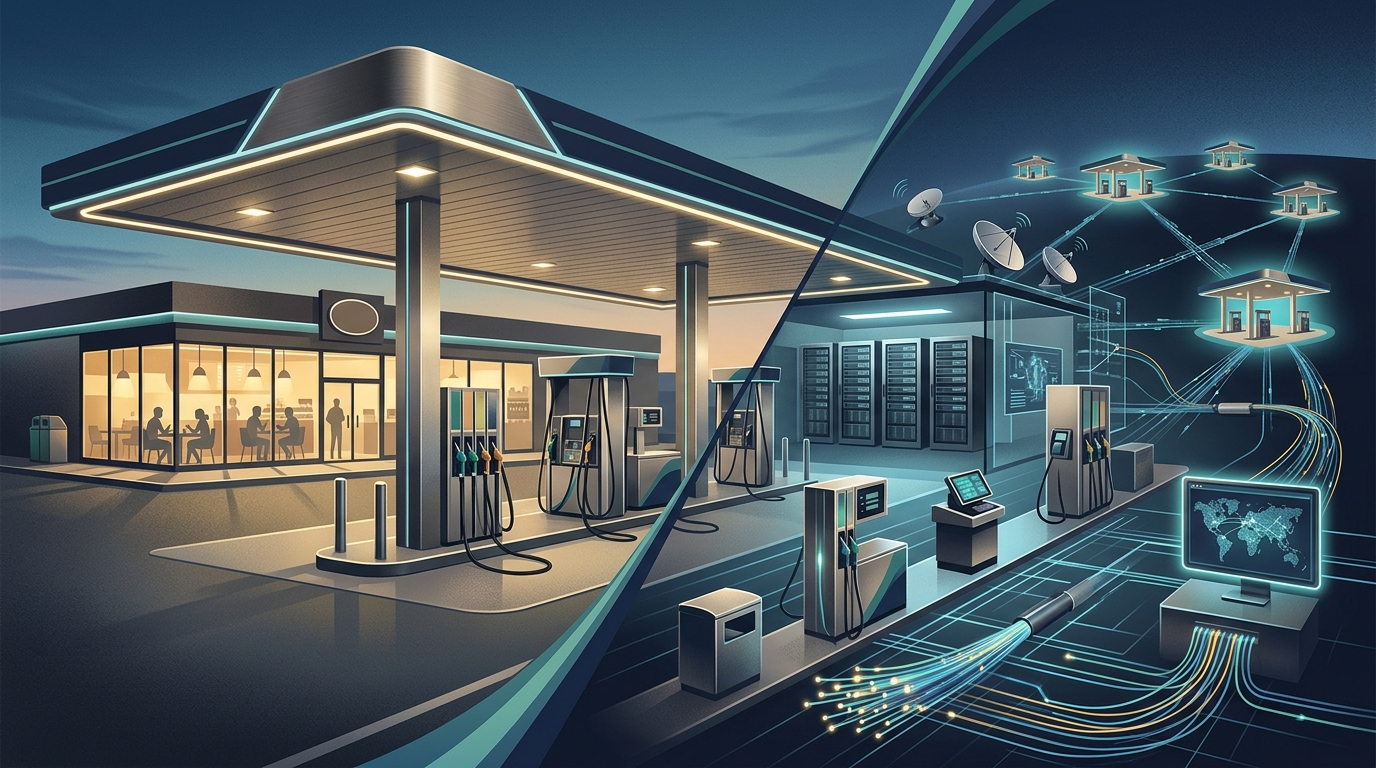
Forecourt and convenience store operators are adapting to shifts in consumer expectations and operational demands. Strategies vary from establishing regional quick-service restaurant (QSR) partnerships in North America to prioritizing core digital systems across European networks.
Regional Foodservice Integration in C-Stores
In the United States retail sector, Kayrouz Petroleum announced a partnership with regional coffee chain Marylou’s Coffee on September 9, 2026. According to Barry Ahern, chief retail and people officer at Kayrouz Petroleum, the partner retailer is integrating a Marylou’s Coffee location inside a new KP Market store situated in Hyannis, Massachusetts.
The coffee concept is expected to launch by the end of September 2026. Marylou’s operates approximately 40 locations in Massachusetts and Rhode Island. The menu featured at the Hyannis site will include hot and cold specialty beverages, frozen drinks, lemonade, breakfast sandwiches, bagels, and stuffed waffles. Kayrouz Petroleum operates 11 locations under its KP Market, KP Market and Liquor, and KP Travel Center banners, having introduced the KP Market banner roughly one year ago. While there are no concrete expansion plans for additional Marylou's units across the remaining estate, Kayrouz Petroleum indicated an openness to future opportunities if suitable locations arise.
Digital Infrastructure and Multi-Service Hub Evolution
In Europe, fuel retailers are facing changing consumer expectations that extend beyond baseline fuel sales. In an interview published by forecourttech, Frederick Beckmann, Chief Executive Officer of German fuel station operator Q1 Energie AG, stated that forecourt sites are transitioning from single-purpose fuel stops into multi-service hubs. Q1 Energie AG operates more than 230 locations across Germany.
Beckmann noted that modern customers evaluate fuel stations against everyday consumer experiences, requiring speed, reliability, and ease of use. To meet these operational requirements, Beckmann emphasized that Q1 Energie AG prioritizes baseline infrastructure, citing investments in "data quality, system integration and robust processes" over premature experimentation with complex technologies like artificial intelligence or robotics. In terms of electric vehicle (EV) charging infrastructure, Q1 Energie AG targets investments specifically where customer demand and a viable business case exist, anticipating that multiple mobility options will coexist concurrently for an extended period.
Analysis: Hypotheses for Retail Execution
Hypothesized Foodservice Revenue Impact
*Hypothesis*: Partnering with an established regional brand (such as Marylou's) instead of building a proprietary foodservice program increases overall store foot traffic and inside sales for independent c-store operators. *Proposed Test*: Compare 90-day post-launch foot traffic metrics, average transaction values, and overall margin performance at the Hyannis KP Market site against a control KP Market location operating without a brand-name QSR partner.
Hypothesized Systems Integration Efficiency
*Hypothesis*: Prioritizing foundational data integration over front-end technology rollouts reduces inventory shrinkage and stockout frequencies during multi-service conversions. *Proposed Test*: Perform a comparative operational audit measuring inventory variance, system downtime, and order fulfillment times across a sample of 20 sites that have undergone backend integration updates versus 20 sites operating on legacy back-office systems.
Hypothesized EV Mobility Hub Performance
*Hypothesis*: Offering high-quality convenience options and seating areas increases customer dwell time and non-fuel spend among EV charging consumers compared to sites without dedicated amenities. *Proposed Test*: Track basket size and total non-fuel revenue from customers utilizing fast chargers over a 6-month period, controlling for time-of-day and charging duration.