Episode 43: EV Charging Protocols, Payments and Retail Integration
This briefing separates the charging-management connection, vehicle authorisation, retail checkout and payment settlement. It explains the questions an operator should resolve before commissioning a combined customer journey.
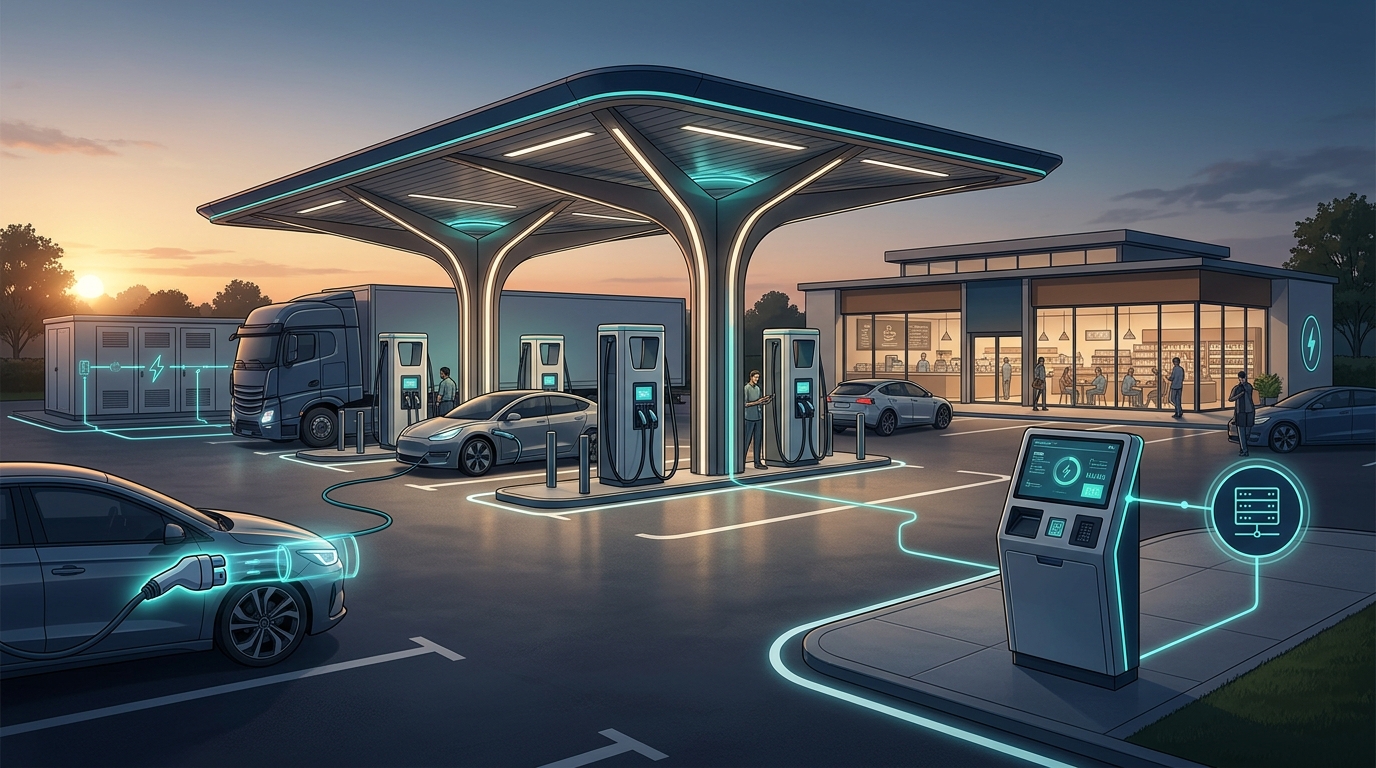
Editorial illustration
This briefing separates the charging-management connection, vehicle authorisation, retail checkout and payment settlement. It explains the questions an operator should resolve before commissioning a combined customer journey.
OCPP is described by the Open Charge Alliance as a protocol between charging stations and management systems. It does not, by itself, define a store-loyalty scheme. Open Charge Point Protocol
The PCI standards distinguish payment-data security from device and encryption requirements. A combined dashboard is not proof that every underlying obligation has been satisfied. PCI security standards overview
The episode’s operating recommendations are analysis: document responsibilities, test exceptions and assess the exact equipment and software configuration. They are not claims of measured results from a deployment.
Host
Welcome to Forecourt News. Today we are looking at the connections behind an EV charging visit: the charger, its management system, payment processing and the store. A smooth experience can involve several organisations. The useful question is whether their responsibilities are clear when something goes wrong.
Co-Host
The Open Charge Alliance describes OCPP as communication between charging stations and charging management systems. That is one connection in the architecture. It does not, by itself, establish a retail loyalty programme or prove compatibility with a particular store point-of-sale release.
Host
Operators should also distinguish vehicle charging authorisation from permission to buy merchandise. A service that starts a charging session does not automatically authorise a coffee purchase. Combining those journeys requires a separate commercial arrangement, a supported integration and appropriate customer permission.
Co-Host
Our recommendation is to trace the complete transaction. Identify who calculates the price, who records the sale, who issues the receipt and who processes the refund. Keep the identifiers that let support teams follow an incident across those systems.
Host
Then test the exceptions. What happens if payment is authorised but charging does not start? What happens if the customer stops early, loses connectivity or asks for a receipt? A demonstration that covers only a successful session leaves important questions unanswered.
Co-Host
Payment security also needs precise language. The PCI Security Standards Council publishes different standards for account-data protection, payment devices and encryption solutions. Buying an approved terminal does not, on its own, resolve every responsibility in the surrounding installation.
Host
For procurement, request a supported configuration rather than a generic architecture picture. Record the software versions, optional licences, integration owner and escalation arrangements. Ask how a planned update will be tested and what the rollback procedure involves.
Co-Host
The commercial assessment should use the operator’s actual costs: licences, support, transaction charges, implementation work and staff effort. We are not assigning a universal margin or a fixed reduction in authorisation time to any product.
Host
The practical outcome is a service that people can understand and staff can support. A single screen may be helpful, but the quality of the underlying handoffs is what the acceptance tests need to establish.
Co-Host
Thank you for listening to Forecourt News. Before your next deployment, choose one difficult customer scenario and follow it through every supplier involved. That exercise can expose a gap that a successful sales demonstration does not show.