Dual-Front Forecourt Innovations: Cloud Payment Unification and On-Site Hydrogen Generation
Recent developments in fuel retail encompass POS software unification across store and pump operations in North America alongside localized biomass-to-hydrogen refueling infrastructure in Europe.
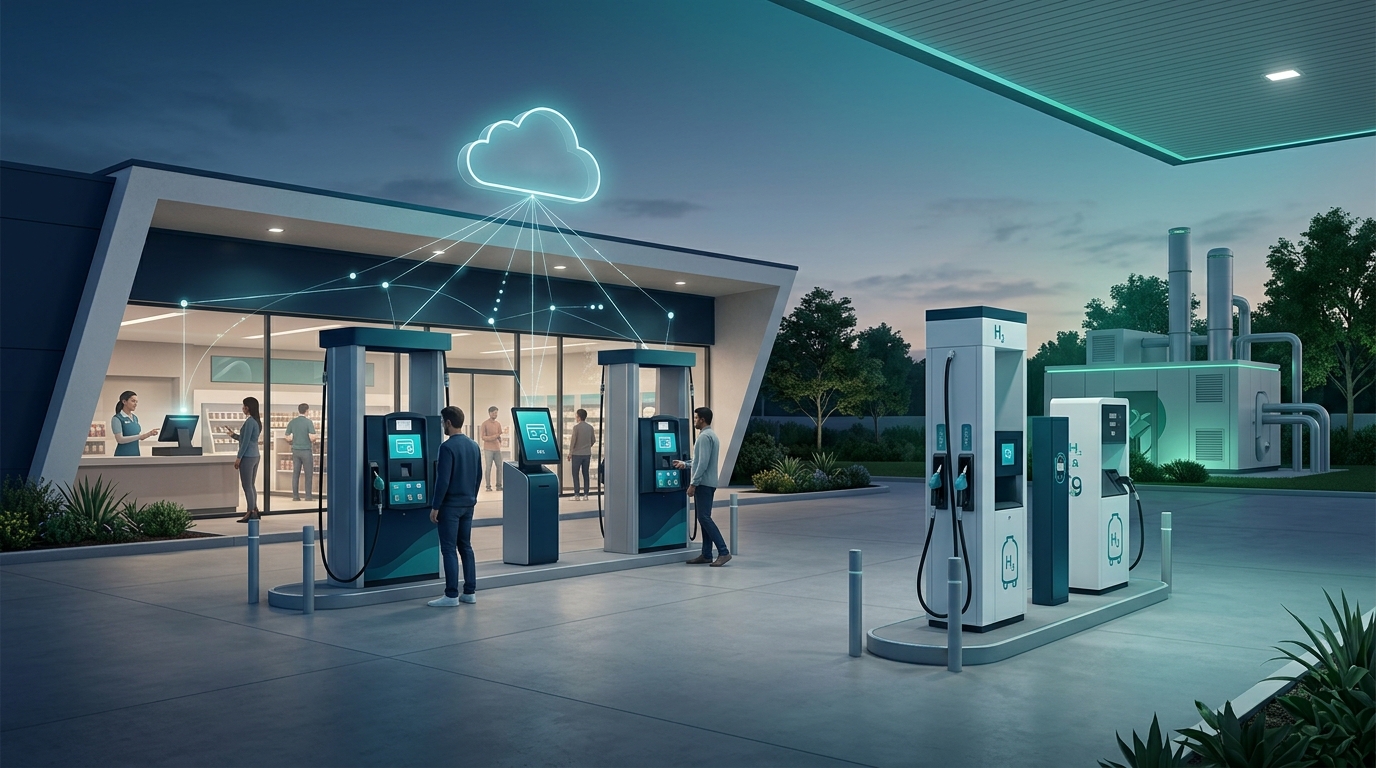
Editorial illustration
Dual-Front Forecourt Innovations: Cloud Payment Unification and On-Site Hydrogen Generation
Fuel retail operators face evolving operational and energy transition choices. Recent market developments highlight two distinct paths of forecourt modernization: software platform consolidation for retail and fuel transactions in North America, and localized, biomass-driven hydrogen generation infrastructure in Europe.
Software Integration: Unified POS and Forecourt Processing
In October 2026, technology provider Toast introduced Toast Fuel, expanding its cloud-native platform to support fuel dispensing transactions alongside foodservice and general convenience store sales (Toast adds fuel payments to its retail platform | C-Store Dive). The solution allows retailers to process payments at the pump—including fleet card transactions—while providing cashiers with a dedicated forecourt management interface inside the store.
To mitigate network reliability concerns, the system features an offline mode designed to continue processing transactions during internet disruptions. Installation logistics and service support are conducted in partnership with OWL Services, a distributor and service provider for petroleum equipment and electric vehicle charging infrastructure.
According to NACS data cited in the release, convenience retailers account for approximately 80% of all fuel purchased in the United States. Omri Traub, chief operating officer of retail at Toast, stated that the company aims to bring "the same innovation powering the country's best restaurants and retailers to c-store operators" so they can focus on customer service rather than managing disjointed IT systems.
Analysis: Operational Hypotheses for Unified Retail Platforms
*Operator Hypothesis*: Consolidating kitchen management, in-store retail checkout, and forecourt fuel transactions onto a single cloud platform reduces administrative overhead and transaction latency compared to operating separate legacy point-of-sale systems.
*Proposed Operational Test*: Measure total checkout processing time, cashier training hours, and IT maintenance ticket volume across a 10-store test group over a 90-day trial period relative to a control group running traditional split POS architecture.
*Network Resilience Hypothesis*: Local offline transaction queuing maintains uninterrupted forecourt sales during short-term WAN outages without increasing chargeback rates.
*Proposed Operational Test*: Conduct controlled network disconnection drills across participating sites during peak hours and track offline authorization success rates, transaction processing times, and financial reconciliation variances.
Hydrogen Infrastructure: On-Site Biomass-to-Gas Refueling Hubs
In European clean energy infrastructure, French technology developer Haffner Energy announced plans to establish an H14 hydrogen refueling station at its Marolles facility in France (Haffner Energy plans hydrogen sales hub at Marolles site | MobilityPlaza). Scheduled for installation in 2027 subject to regulatory approvals, the refueling hub will be supplied by HRS.
The Marolles hub relies on Haffner Energy’s H6 production module, which converts residual biomass into renewable hydrogen. Haffner Energy reported that over 85% of the equipment required for the Marolles production and refueling chain has already been installed or paid for. The planned H14 station incorporates compression, storage, and dispensing capabilities. It will support both off-site distribution to industrial clients via tube trailers and direct vehicle refuel dispensing at dual pressures of 350 bar and 700 bar.
Analysis: Operational Hypotheses for Decentralized Hydrogen Production
*Decentralized Production Hypothesis*: Co-locating biomass conversion modules with dispensing equipment mitigates fuel transport costs and wholesale price volatility for commercial hydrogen fleets.
*Proposed Operational Test*: Compare the levelized cost of hydrogen (LCOH) at the dispenser for on-site biomass conversion against third-party liquid/compressed hydrogen delivered via bulk trailer over a 12-month operational evaluation.
*Dual-Pressure Station Utilization Hypothesis*: Offering 350 bar and 700 bar dispensing alongside tube-trailer filling maximizes equipment capacity utilization across light-duty, heavy-duty, and industrial off-take customer segments.
*Proposed Operational Test*: Log daily compressor duty cycles and dispensing volumes categorized by vehicle type and trailer fills to determine capital efficiency and peak queue management performance.