Market Dynamics in Fuel Retail: Midwest Dealer Acquisitions and European Scale Advantages
An analysis of World Fuel's Midwest dealer contract acquisition alongside scale disparities and digital convenience ecosystems in Poland's forecourt market.
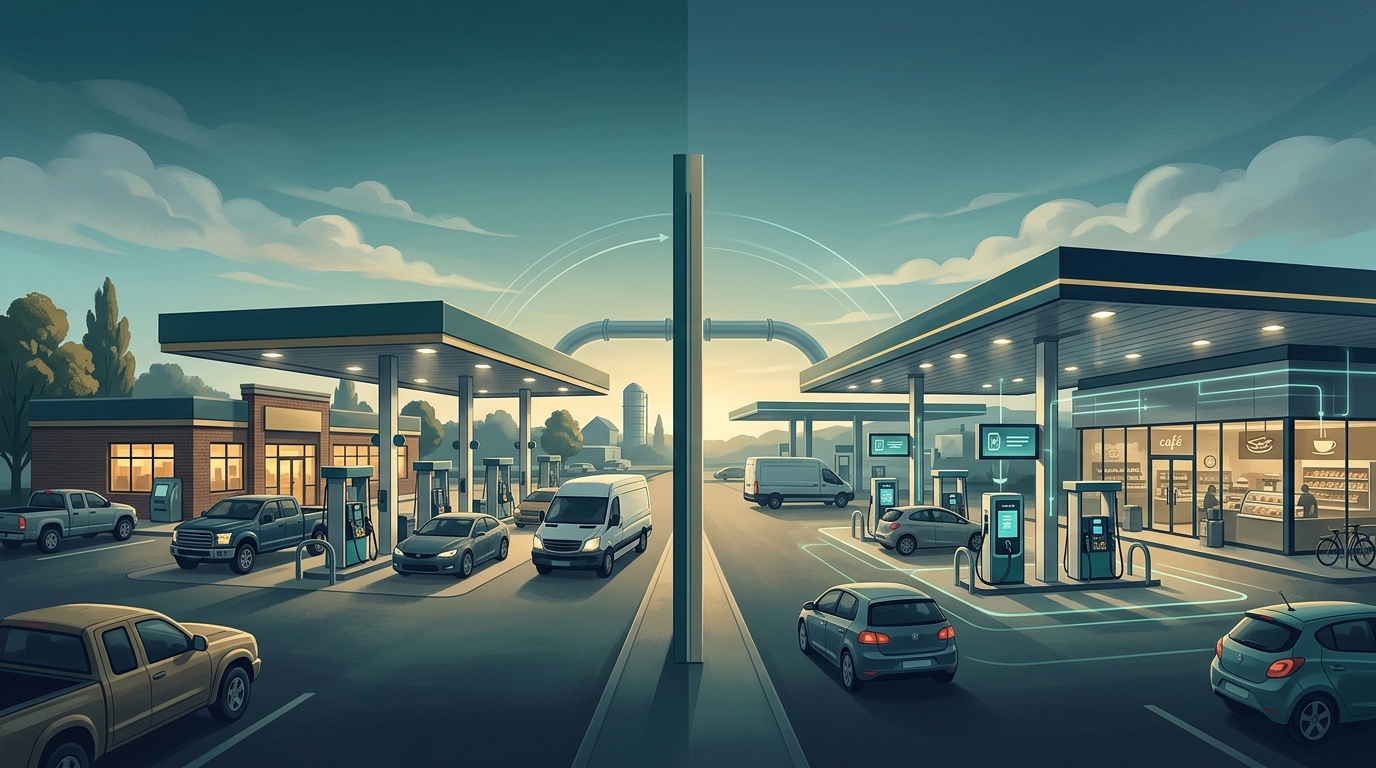
Editorial illustration
Midwest Wholesale Deal Dynamics and European Market Disparities
World Fuel Expands Midwest Distribution Network
In North America, Miami-based supplier World Fuel has completed an acquisition of roughly 33 branded dealer contracts from CF Altitude, as reported by C-Store Dive. These dealer locations are situated across the greater St. Louis metropolitan area spanning Illinois and Missouri. The acquisition strengthens the supplier's footprint in Midwestern wholesale fuel distribution. According to World Fuel spokesperson statements, the organization aims to facilitate a "seamless transition" for station operators while maintaining support tailored to local market conditions.
World Fuel presently provides fuel delivery, major brand portfolios, and related services to over 3,000 independent convenience retailers and truck stop operators across the United States. Bob Kenyon, World Fuel's senior vice president of retail, wholesale, and supply chain, stated that the transaction with CF Altitude "strengthens its distribution network in the Midwest."
The seller entity, CF Altitude, has historical ties to retail operator Alta Convenience. In January 2021, Pester Marketing Company (operating as Alta Convenience) was acquired by a joint venture involving Fortress Investment Group and a subsidiary of Phillips 66. Subsequent SEC documentation from May 2026 noted an association between CF Altitude and Phillips 66. Alta Convenience currently lists more than 100 retail sites across Colorado, Wyoming, and New Mexico, indicating that the newly transferred Midwestern dealer contracts do not involve Alta's core operating store footprint.
Structural Scale and Ecosystem Dynamics in Poland
In European forecourt retail, market dynamics in Poland demonstrate significant structural consolidation among leading entities, detailed in an interview published by forecourttech.com. According to Leszek Jurczak, Member of the NACS Global Industry Engagement Council, market leaders in Poland hold a substantial scale margin over competitors. In the traditional fuel retail sector, state-backed operator ORLEN maintains around 1,900 stations within Poland, whereas the second-largest international competitor, BP, operates approximately 600 sites.
This concentration is even more pronounced in the convenience retail segment. Żabka operates approximately 13,000 stores across Poland, contrasting with Carrefour Express, which operates around 550 locations. Jurczak highlighted "...the extraordinary scale advantage enjoyed by the market leaders." Żabka’s digital penetration is reflected in its Żappka mobile app, which maintains over 10 million registered users out of a national population of approximately 35 million people.
The Polish market context is further characterized by macro-economic growth, with national GDP expanding at around 3.5%. As retail formats evolve, convenience stores are targeting younger consumer demographics, often referred to as the "non-cooking generation," by expanding ready-to-eat foodservice offerings alongside digital customer engagement platforms.
Analysis
Strategic Implications for Wholesale and Dealer Relationships
Wholesale transfers such as World Fuel’s contract acquisition highlight a broader trend toward consolidation among fuel distributors. By acquiring existing dealer contracts rather than developing greenfield sites, distributors secure volume throughput across established regional nodes like the St. Louis metropolitan area. Independent dealers entering new supply agreements must evaluate long-term brand support, contract flexibility, and fuel pricing competitiveness against capital commitment requirements.
Operational Ecosystem Hypotheses for Retail Technology
Industry observers frequently suggest that integrating automated self-service, advanced ordering kiosks, or digital loyalty ecosystems directly leads to labor cost reductions and enhanced operating margins. However, these operational outcomes cannot be generalized without site-specific empirical verification.
- Hypothesis 1 (Labor Cost Reduction via Autonomous Checkout): Deploying unattended retail terminals or self-checkout hardware in high-frequency convenience locations reduces store labor hours required per transaction without decreasing throughput speed.
- *Proposed Empirical Test:* Conduct a 12-month controlled A/B trial comparing labor hours per 1,000 transactions across 20 high-volume sites equipped with automated self-checkout against 20 baseline control sites utilizing standard cashier counter arrangements.
- Hypothesis 2 (Foodservice Integration and Visit Frequency): Implementing expanded fresh food-to-go modules in forecourt stores raises non-fuel transaction frequency among younger consumer segments.
- *Proposed Empirical Test:* Monitor basket analysis and loyalty card scan rates across a representative sample of converted forecourt stores over a six-month post-implementation period to evaluate changes in repeat visit rates and non-fuel basket size.
Operators evaluating operational adjustments or platform acquisitions should treat projected technological efficiencies as hypotheses requiring rigorously measured field trials prior to full-network deployment.