Global EV Market Trends in 2025 and AI Support Advances in Fast-Charging Operations
Global electric vehicle sales surpassed 20 million units in 2025, capturing 25% of the overall new car market. While regional performance diverged sharply due to policy shifts in North America and Europe, operators of fast-charging infrastructure are deploying AI telephone assistants to manage expanding customer support requirements.
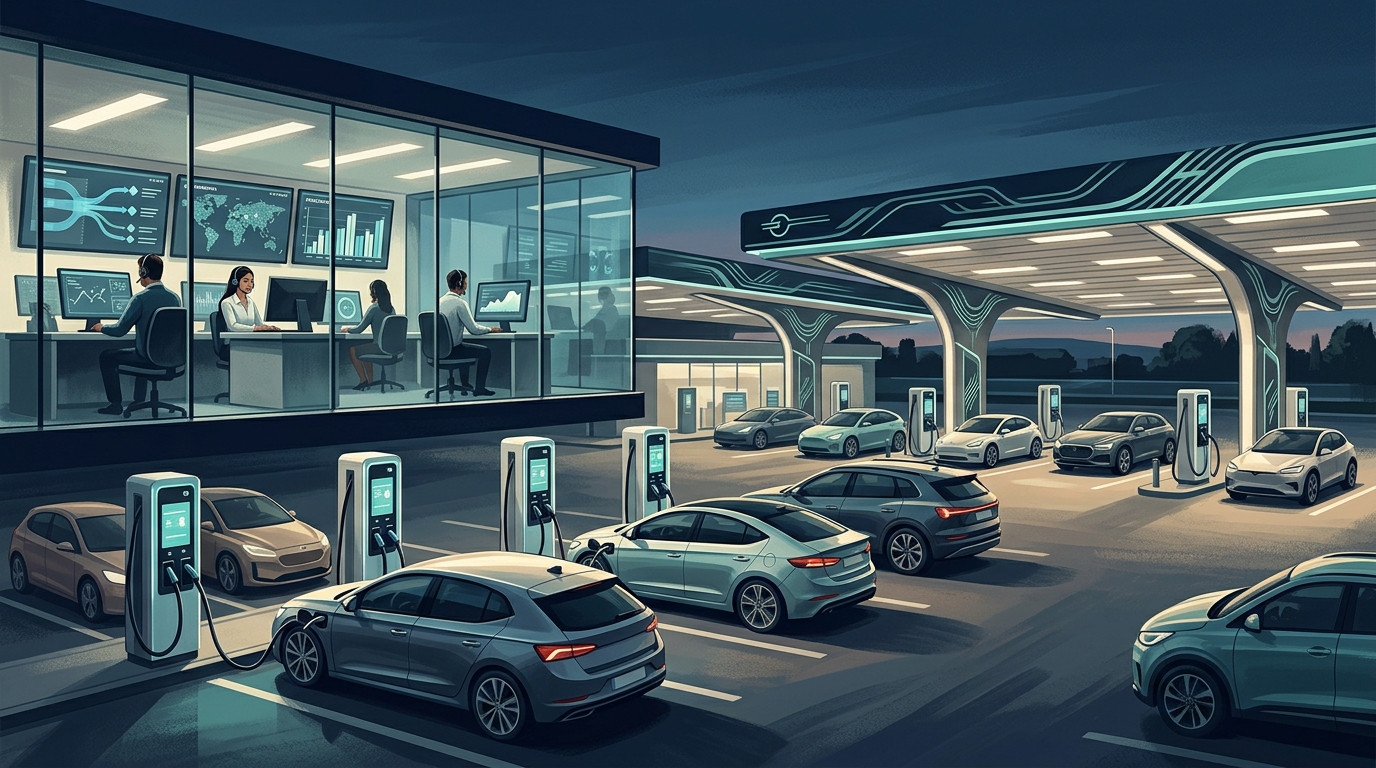
Editorial illustration
Global EV Market Dynamics in 2025
According to figures reported in the IEA Global EV Outlook 2026, global electric car sales exceeded 20 million units in 2025. This expansion represented a 25% market share of total new vehicle sales worldwide, lifting the global electrified car stock to approximately 5% and displacing 1.2 million barrels of oil per day. Battery electric vehicles (BEVs) accounted for 65% of global EV sales in 2025, while extended-range electric vehicles (EREVs) fell to under 7% of sales.
China maintained its position as the largest market, accounting for over 13 million sales and achieving an annual EV sales share of nearly 55%. Total electric vehicle stock on Chinese roads reached an estimated 44 million vehicles. Growth in China was influenced by national policy; the national trade-in program provided CNY 20,000 (USD 2,750) for replacing an older car with a new EV, compared to CNY 15,000 (USD 2,050) for a conventional vehicle. However, the scheme faced temporary local suspensions partly due to the emergence of zero-mileage cars—new vehicles resold immediately on used markets—which estimated accounts suggest represented roughly 4% of 2025 electric car sales.
Regional Policy Shifts and Market Performance
Market dynamics diverged across major geographic regions in 2025:
- Europe: Electric vehicle sales grew by over 30% to reach 4.2 million units (28% sales share), driven by tighter EU CO2 standards targeting a 15% emissions reduction relative to 2021 levels. In Germany, sales rose 50% to 850,000 units alongside a 6% decline in average BEV prices. In the UK, EVs accounted for over one-third of new sales, though BEV registrations (23%) missed the 28% target established by the Vehicle Emissions Trading Schemes. UK policy added a purchase subsidy in July 2025 for eligible BEVs priced under GBP 37,000 (USD 47,400), which applied to more than one-quarter of BEV sales.
- North America: US sales stagnated at approximately 1.5 million units (~10% share). The passage of the One Big Beautiful Bill Act (OBBBA) in July 2025 eliminated non-compliance penalties for fuel economy standards and ended consumer tax credits after September 2025, leading to a 45% year-on-year drop in Q4 sales. In Canada, sales dropped by more than 30% following the termination of the iZEV program, which had provided subsidies up to CAD 5,000 for BEVs and CAD 2,500 for PHEVs.
- Emerging Markets: Emerging economies outside China experienced an 80% surge in sales to nearly 1.2 million vehicles, with Chinese imports making up 60% of these sales. Southeast Asia saw sales double to over 500,000 units, led by Viet Nam where EVs captured nearly 40% of new car registrations.
Automated Customer Support in Fast-Charging Operations
As reported by MobilityPlaza, German charging operator EnBW has implemented an AI-powered voice assistant across its fast-charging network in Germany. Accessible 24/7 in German and English via station phone numbers, the tool addresses driver issues, assists with app and charging card navigation, and suggests alternate stations.
EnBW, which operates Germany's largest fast-charging network and provides access to over 900,000 charging points across Europe via its platform, stated that roughly two-thirds of phone inquiries are resolved directly by the AI system prior to any agent transfer. Lars Jacobs, Chief Commercial Officer E-Mobility at EnBW, stated: "Quality is not only demonstrated during the charging process itself, but also when something does not go as planned."
Analysis: Strategic Implications for Forecourt Operators
The continuous rise in global EV adoption increases call volume and troubleshooting demand across public charging networks. Automated telephone triage systems offer a potential operational model for forecourt network managers seeking to manage customer support costs.
*Hypothesis for Forecourt Operators*: Implementing 24/7 AI-driven voice support at site chargers reduces escalation rates to manual technical support lines without increasing customer drop-off. *Proposed Test*: Forecourt operators can pilot an AI voice assistant across a representative sample of 50 high-volume fast-charging sites over a 90-day period. Key performance metrics to compare against a control group of human-assisted sites include first-call resolution rate, call duration, ticket escalation rate to tier-2 support, and overall site uptime.