Global EV Charging Deployment, Regulatory Mandates, and Megawatt Freight Developments
This analysis covers global light-duty vehicle charging trends from the IEA's 2026 report alongside heavy-duty Megawatt Charging System initiatives in Europe. It highlights global public charger expansion, regional capacity metrics, building code regulations, subsidy expiration dates, and hardware developments for commercial freight.
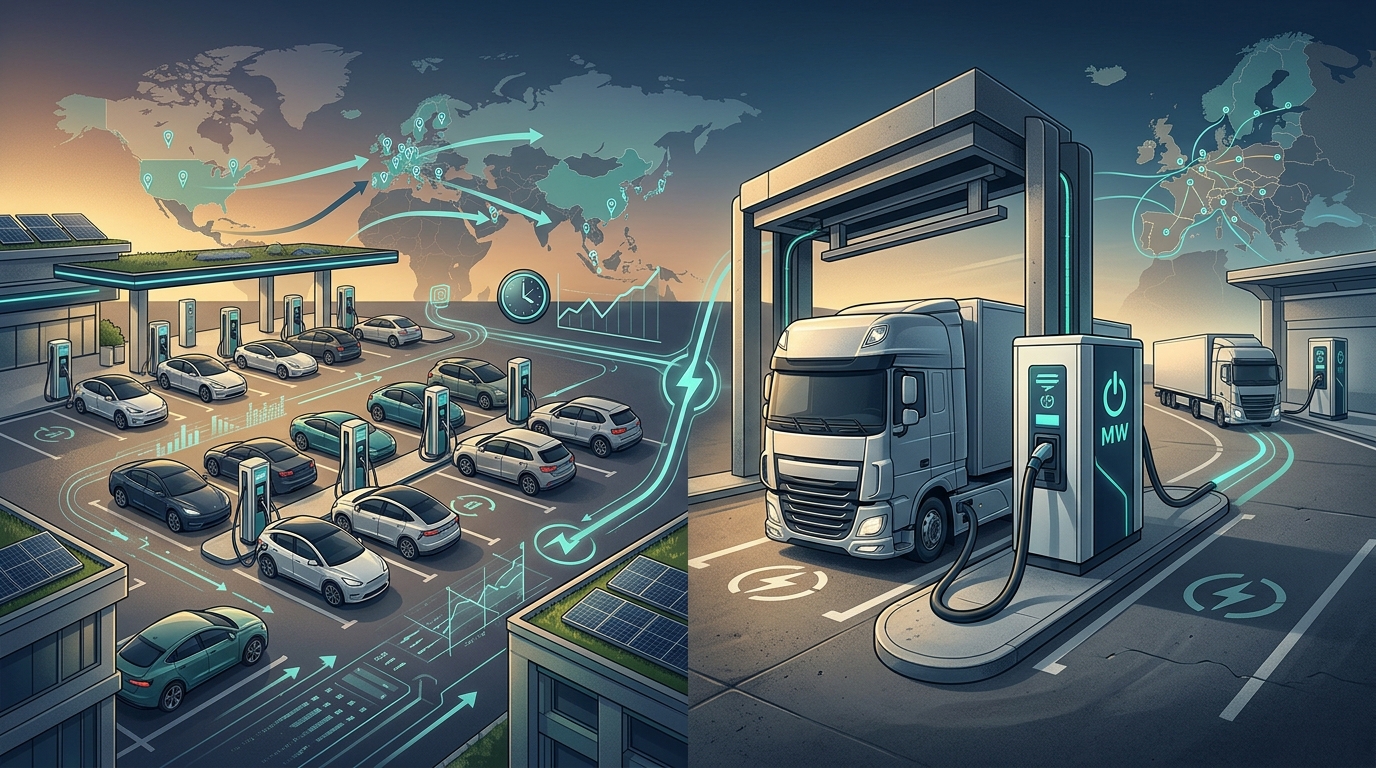
Editorial illustration
Global Public and Private Charging Infrastructure Trends
According to the IEA Global EV Outlook 2026, global private light-duty vehicle (LDV) charging points reached more than 43 million in 2025, supporting a global electric LDV stock of approximately 76 million. In public charging, nearly 1.8 million points were added in 2025, bringing the global public charging stock to over 7 million points. Average global public charging power reached 4.5 kW per electric LDV by the end of 2025, while the global average public charging speed reached nearly 50 kW.
Regional network totals and performance metrics demonstrate distinct market dynamics:
- China: Accounted for over 65% of global public charging points at the end of 2025, with its network expanding to over 4.7 million points. China averaged 10 electric LDVs per public charger and delivered an average charger speed above 55 kW.
- Europe: Public charging points grew by roughly 20% in 2025. The Netherlands led European totals with 210,000 points, followed by Germany (196,000) and France (185,000). The United Kingdom reached approximately 116,000 public points.
- United States: Public charging stock grew by 20% in 2025. Fast and ultra-fast chargers rose 30% to nearly 70,000 points, while slow chargers reached over 160,000 points. The US maintained 33 electric LDVs per public charger, with available public capacity standing at just over 1.5 kW per EV.
Regulatory Frameworks, Building Codes, and Subsidy Conditions
Governments continue implementing primary provisions to enforce charger installation and structured grid integration:
- Building Codes: The European Union revised its Energy Performance of Buildings Directive in 2024 to require pre-cabling in new or renovated buildings. Kenya's 2024 National Building Code mandates that 5% of parking spaces in new buildings be equipped for EV charging. India's 2019 Model Building Bye-Laws require provisions covering 20% of parking capacity for EV charging. In Brazil, a 2026 São Paulo law guarantees condominium owners the right to install charging infrastructure in private parking spaces.
- Subsidies and Timelines: The US federal tax credit, offering 30% coverage for EV charging equipment purchase and installation costs up to USD 1,000 in low-income or non-urban communities, is set to expire on 30 June 2026. Obligations under the US National EV Infrastructure (NEVI) funding program were paused from February 2025 to January 2026. As of April 2026, around 550 NEVI-funded fast charging points were operational across 19 states. In Europe, the EU Alternative Fuelling Infrastructure Regulation (AFIR) mandates the installation of charging stations of at least 150 kW every 60 km along major highway corridors.
Heavy-Duty Transport and Megawatt Charging System Integrations
As reported by MobilityPlaza, hardware manufacturer Alpitronic and charging network operator Milence signed a memorandum of understanding to deploy Megawatt Charging System (MCS) infrastructure along European freight corridors. Alpitronic stated that its HYC1000 charging platform will support both depot and en-route charging needs, utilizing a Depot Dispenser for fleet facilities and an MCS Dispenser for long-haul transport routes.
Commercial Forecourt Analysis
IEA data shows that electricity tariffs at public slow chargers can be up to 150% higher than residential tariffs, while public fast charging tariffs can be up to 240% higher. Consequently, drivers relying exclusively on public fast charging incur higher running costs than comparable gasoline internal combustion engine vehicles. Globally, EV owners perform approximately 75% of charging sessions privately and only 10% at public fast chargers.
*Analysis*: Forecourt operators evaluating high-power charger additions must separate maximum power ratings from measured vehicle acceptance rates. In 2025, only 160 battery electric car models globally supported charging speeds above 150 kW, and only 50 models accepted speeds over 250 kW.
*Hypothesis*: Premium pricing for ultra-fast charging (>150 kW) will improve forecourt gross margins only if session duration decreases enough to increase vehicle throughput per bay during peak hours. *Proposed Test*: Compare monthly net gross margin per bay between 150 kW and 350 kW chargers across sites with identical footfall over six months, measuring exact vehicle intake power and dwell duration.