Global EV Market Shifts and European Fleet Payment Developments
In 2025, global electric car output reached nearly 22 million vehicles while electric truck manufacturing doubled to 440,000 units. Meanwhile, The ai Corporation and Visa partnered in September 2026 to roll out Visa Fleet 2.0 across Europe.
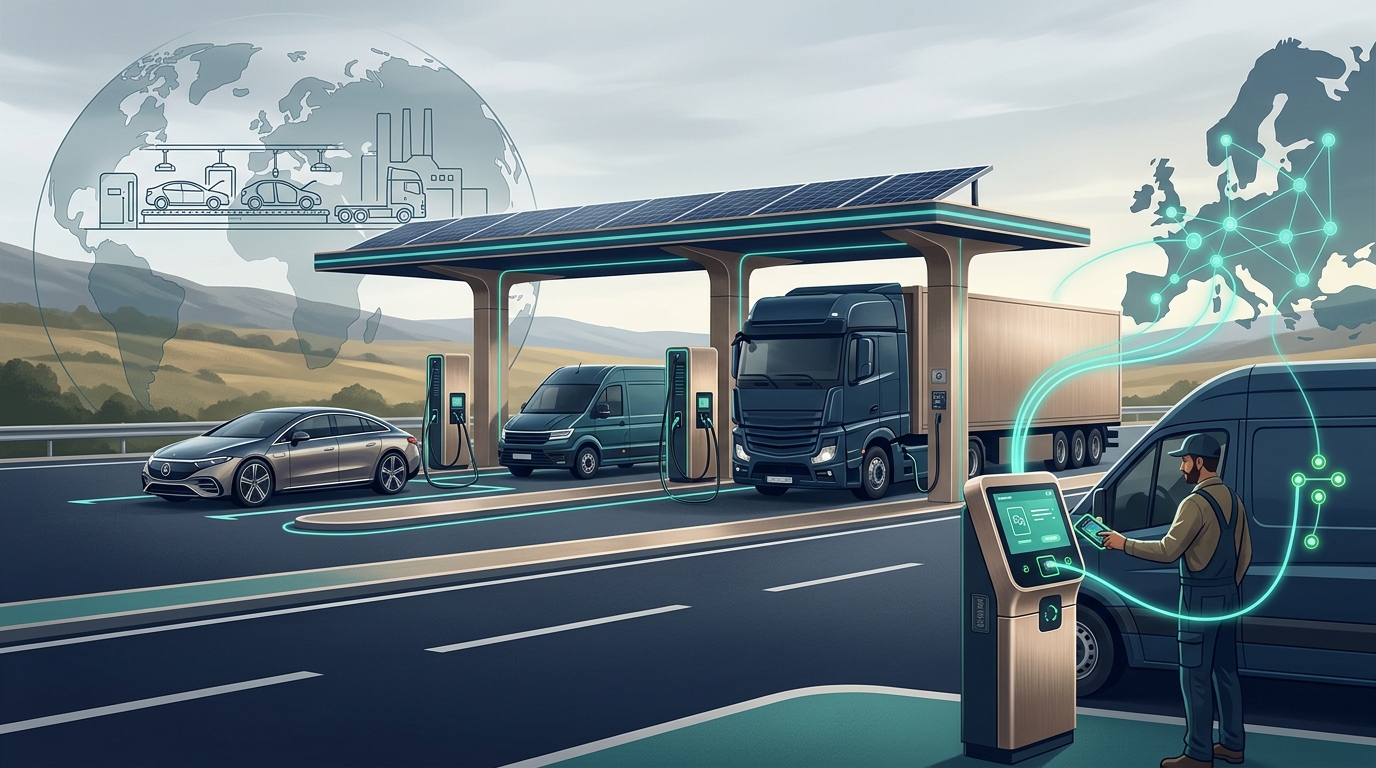
Editorial illustration
Global EV Manufacturing and Export Trends
According to the IEA Global EV Outlook 2026, global electric car production reached nearly 22 million units in 2025, marking an increase of more than 25% compared to 2024. Approximately one-quarter of these vehicles were traded internationally across key demand regions.
China maintained its position as the primary global hub for electric car manufacturing and export, representing nearly 75% of global output and 40% of global trade. In 2025, China produced 16 million electric cars, which outstripped domestic demand by 20%. This supply imbalance drove Chinese electric car exports to double year-over-year to a record total exceeding 2.5 million units. Electric models accounted for over 35% of China's total automobile exports in 2025, up from approximately 20% in 2024.
Trade and policy developments continue to influence international distribution:
- European Union: EU electric car production expanded 30% in 2025 to reach nearly 3.2 million vehicles, maintaining its status as the world's second-largest producer. Net exports exceeded 1 million units, up 25% from 2024. EU imports grew around 35% to over 900,000 units, with Chinese production accounting for nearly 60% of these imports.
- North America: Electric car output increased 10% in 2025, while imports supplied nearly 40% of US electric car sales. Mexico's production grew nearly 5%, supplying more than one-third of US imports.
- Canada: In early 2026, Canada agreed to lower its 100% tariff on Chinese electric cars in exchange for reduced tariffs on Canadian agricultural products. This agreement is subject to an initial cap of approximately 50,000 units.
- Regulatory Measures: In January 2026, the Chinese government introduced export licenses for BEVs to align battery electric vehicle exports with regulatory frameworks applied to other powertrain technologies.
Electric Commercial Vehicle Production and Supply Chains
The IEA Global EV Outlook 2026 reports that global electric truck production reached approximately 440,000 units in 2025, doubling the volume recorded in 2024. Production remains highly concentrated, with China producing over 90% and the European Union accounting for slightly over 3% of the global total.
Unlike light-duty passenger vehicles, cross-border trade of electric trucks remains minimal. Only about 3% of global electric truck production (just over 12,000 vehicles) was traded internationally in 2025. China exported less than 0.5% of its electric truck output, primarily shipping to North America and Europe.
In the European Union, electric truck manufacturing doubled in 2025 to exceed 13,000 units. The EU exported over 2,500 electric trucks (approximately 20% of its regional production), with over 90% directed to non-EU European markets such as the United Kingdom (accounting for about 40% of exports), Norway, and Switzerland.
Fleet and EV Payment Integration in Europe
On September 18, 2026, payment technology provider The ai Corporation entered into a long-term agreement with Visa to expand Visa Fleet 2.0 across Europe, as reported by MobilityPlaza. The Visa Fleet 2.0 program provides technical partners with standardized validation, functionality, and security protocols across fuel, electric vehicle charging, and mobility service transactions.
The agreement enables the issuance of cards accepted globally that extend beyond traditional forecourt retail networks. Attributing supplier statements, Neil Halls, Head of Fleet, Mobility and Benefits at Visa Europe, noted that innovation is reshaping fleet and mobility payments, while Piers Horak, CEO of The ai Corporation, stated that the partnership aims to drive targeted penetration of Visa Fleet 2.0 across European fuel, EV, and mobility sectors.
Forecourt News Analysis
The convergence of surging EV manufacturing and cross-border payment integration creates actionable operational considerations for forecourt operators and fleet managers.
Hypothesis 1: Multi-Fuel Fleet Acceptance *Hypothesis:* Integrating standardized payment platforms like Visa Fleet 2.0 across combined fuel and EV charging infrastructure will streamline transaction handling for mixed-fuel commercial fleets without requiring standalone closed-loop networks. *Proposed Test:* Forecourt operators should compare transaction processing times, reconciliation error rates, and fleet card drop-off rates across 50 trial stations utilizing open-loop fleet frameworks versus traditional closed-loop fuel cards over a six-month period.
Hypothesis 2: Heavy-Duty Charging Infrastructure Allocation *Hypothesis:* Given that European electric truck production doubled in 2025 to over 13,000 units while global trade remains low, regional fleet operators will rely heavily on localized megawatt-level depot and public charging infrastructure. *Proposed Test:* Operators planning heavy-duty charger deployments should monitor local electric truck registration density and track kilowatt-hour utilization per charger over 12 months to verify whether localized truck routes justify high-power hardware capital investments before expanding site footprints.