Fuel Retail Evolution: Infrastructure Investments and Strategic Priorities across European Networks
European fuel and convenience retail is transitioning from basic refuelling sites to integrated customer hubs. This briefing reviews HVR Energy's €20 million Series A funding for Spanish hydrogen stations and outlines the strategic focus areas for the upcoming forecourttech '26 conference in Alicante.
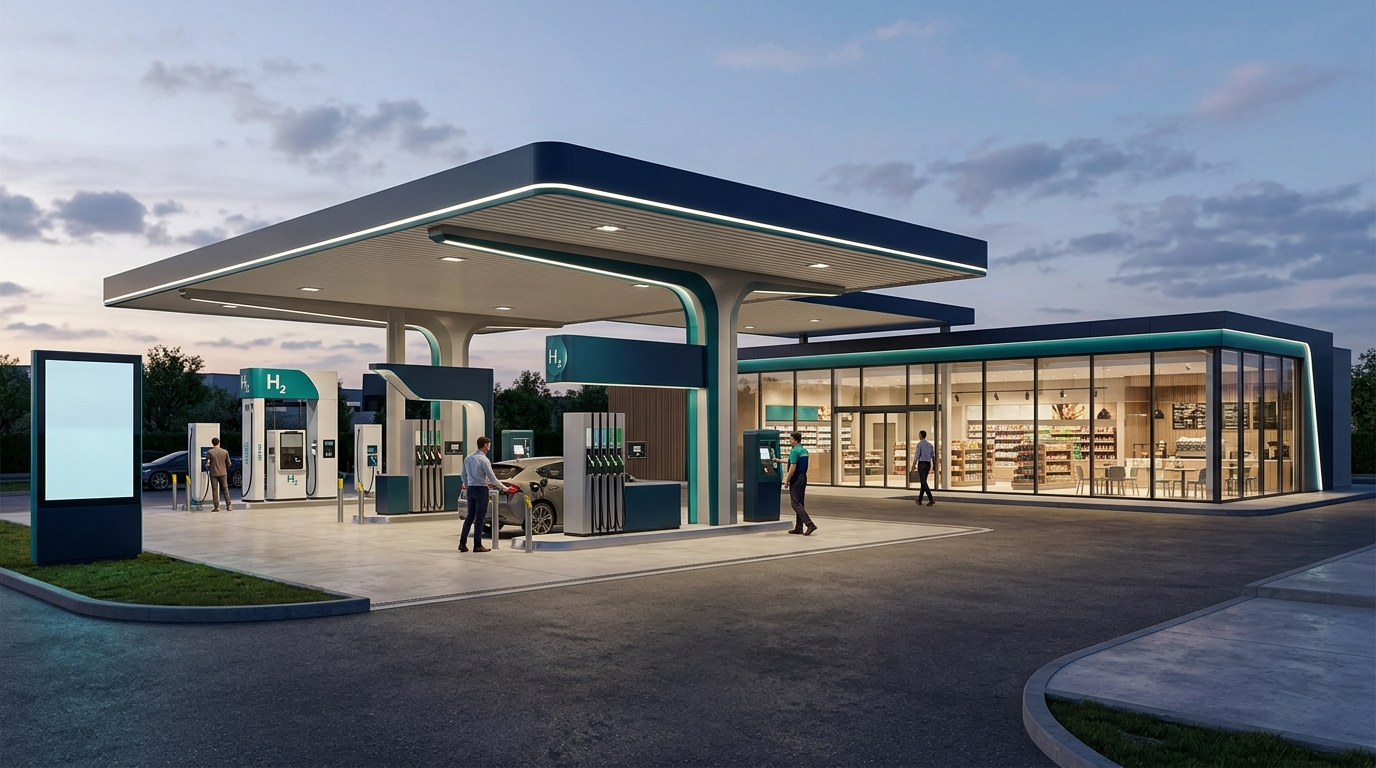
Editorial illustration
Overview of European Forecourt Transformation
European fuel retail operations are undergoing structural shifts, driven by regulatory frameworks such as AFIR and RED III alongside changing consumer demands. Operators are increasingly adapting sites from traditional refuelling locations into multi-service customer hubs. This report examines recent capital investments in alternative fuel networks alongside strategic priorities established for upcoming industry forums.
Capital Deployment: HVR Energy Hydrogen Network Expansion
In network development news published on September 11, 2026, Spanish hydrogen refuelling operator HVR Energy closed a €20 million Series A funding round. According to reporting by MobilityPlaza, the investment round was led by Sandton with a €15 million commitment, alongside €3 million from Barents Re and €2 million from project sponsor Langur.
This funding transaction establishes HVR Energy's valuation at €100 million before the capital increase and €120 million post-money. The operator has mobilized over €53 million since 2025 to support hydrogen refuelling infrastructure. Having opened its initial location in Coslada, near Madrid, in 2023, the business maintains a target to operate 75 hydrogen stations across Spain by 2030, catering to commercial fleets and passenger vehicles. HVR Energy describes hydrogen as "a complementary solution to battery-electric mobility" for applications requiring extended range, high utilization rates, and rapid refuelling times.
Strategic Priorities: forecourttech '26 Focus Areas
Commercial strategies surrounding digital platforms, payments, and margin optimization will be addressed at the forecourttech '26 conference, scheduled to take place in Alicante in October 2026. Organised by Stephen Bozdan, managing director of SAB Events, and chaired by Christian Warning, the event features a two-day agenda focused on forecourt operational economics.
According to the published programme, Day 1 centres on protecting and earning operational margins through digital infrastructure, regulatory readiness, and payment systems. Featured subjects include the Waylet mobility loyalty platform, which reached ten million users ahead of target, and the "Fleet 2.0" mobility payments space, identified as a $315 billion market opportunity spanning open-loop cards, EV charging, tolls, and vehicle maintenance. Day 2 shifts to margin expansion, evaluating global store format design, connected payment orchestration stacks, and customer dwell time economics linked to EV adoption.
Operational Analysis and Testing Hypotheses
*Analysis:* The migration toward integrated roadside retail requires operators to balance infrastructure investments against measurable operational yield. While network expansion milestones—such as HVR Energy's 75-station target across Spain by 2030—provide clear deployment goals, forecourt profitability relies on digital integration and payment efficiency.
*Hypothesis 1:* Integrating unified payment orchestration platforms across forecourt pumps, self-checkout kiosks, and loyalty applications increases non-fuel retail conversion rates during EV charging dwell periods. *Proposed Test:* Operators should conduct an 8-month comparative study across 20 participating locations, comparing 10 control sites using disaggregated legacy point-of-sale systems against 10 pilot sites using a unified payment orchestration layer. Success metrics will include average shop basket size, loyalty program signup rate, and non-fuel revenue per EV charging event.
*Hypothesis 2:* Migrating B2B commercial accounts from closed-loop fuel cards to open-loop mobility cards reduces fleet customer churn and drives cross-merchant retail revenue. *Proposed Test:* Execute a 12-month pilot with 50 commercial fleet accounts, providing 25 accounts with open-loop mobility cards covering EV charging, maintenance, and tolling services. Measure retention rates, average monthly card spend, and in-store purchase frequency against the control group remaining on standard closed-loop fuel cards.