Forecourt Payment Models: Managing Drive-Off Loss vs. Convenience Retail Dwell Time
Escalating fuel prices and global conflicts have led to sharp increases in fuel drive-offs worldwide. Retailers face a strategic choice between mandatory prepayment, which eliminates theft but risks reducing in-store foot traffic, and tech-driven security measures that protect post-payment dwell time.
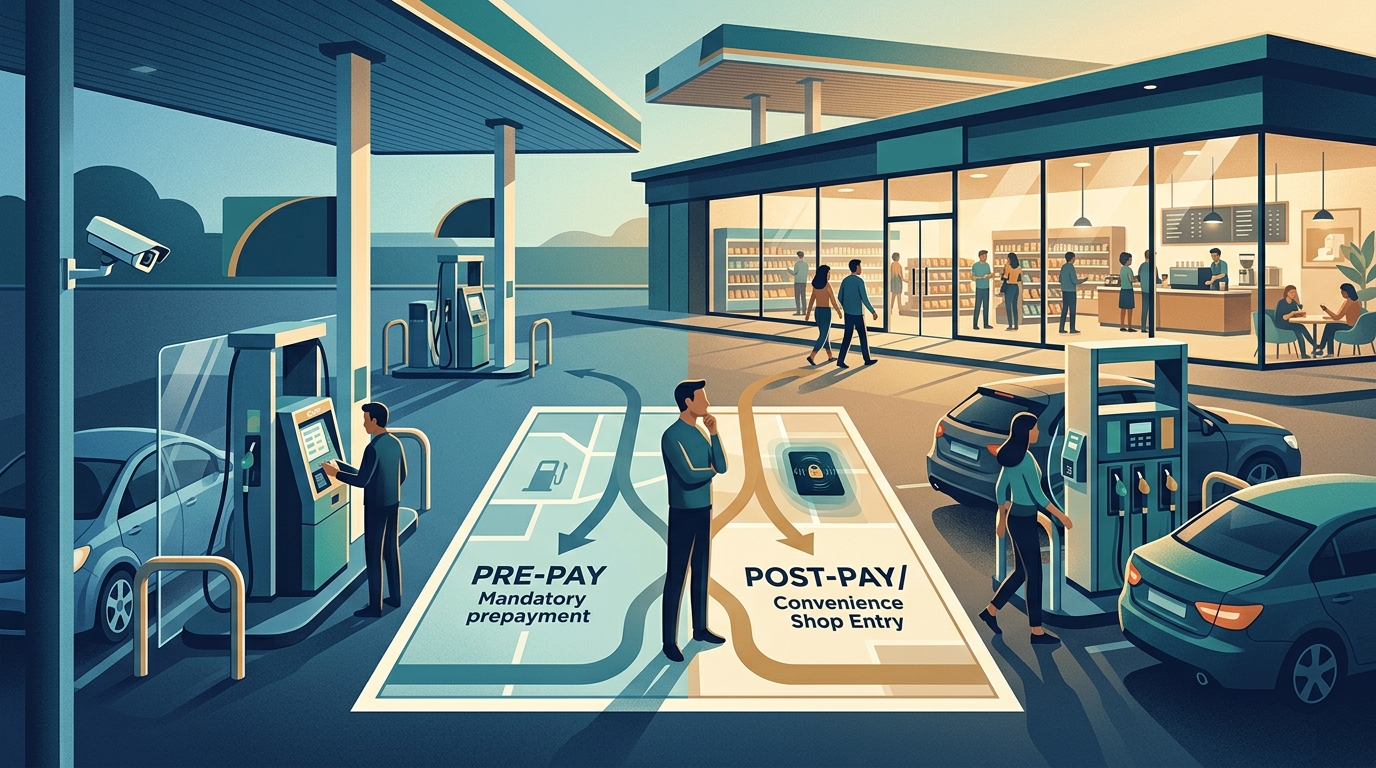
Editorial illustration
Forecourt Payment Models and Theft Prevention Strategies
Rising fuel prices and geopolitical instability have driven sharp increases in unpaid fuel incidents across major global markets. Retailers are consequently forced to evaluate the trade-off between switching to mandatory prepayment systems or investing in hardware-based surveillance and recognition tools.
Global Rise in Unpaid Fuel Incidents
According to reporting by MobilityPlaza, fuel theft incidents have escalated significantly following international conflicts:
- In the United Kingdom, recent data analysis indicated that drivers stole an estimated £194,000 worth of fuel daily in the months after the Iran war broke out. This represents a 20% increase in drive-off incidents and a 48% jump in total stolen value compared to the preceding period.
- In Australasia, the Australasian Convenience and Petroleum Marketers Association recorded a national increase in fuel theft of up to 30% over the same timeframe, costing the fuel retail sector an estimated AU$80 million ($57.2 million) annually.
- Operational responses have varied by region and operator. In 2024, rising theft pushed Petro-Canada to implement mandatory prepayment rules across most of its Ontario stations.
Additionally, data from payment platform Upside highlights how pump prices affect broader store traffic. In-store purchases dropped week-over-week starting in mid-March 2026 as fuel prices escalated, but rebounded after a June US-Iran ceasefire reduced pump prices by approximately 50 cents per gallon.
Strategic Perspectives on Transaction Flow
According to NACS, fueling transactions represent 28% of all transactions at the average convenience store. Maintaining post-payment options allows customers to enter the store to finalize payment, creating opportunities for additional retail purchasing.
Addressing this tension, Aart van Rooijen, CEO of security technology supplier BigBrother, stated that framing payment choices purely as operational decisions overlooks their strategic impact. Van Rooijen argued that when customers no longer enter the store, a site transitions from a retail destination to a commodity fuel point. He noted that license plate recognition, smart data, and real-time alert systems can help manage drive-offs as an operational issue without dismantling customer store flow.
Industry collaboration and dialogue around technology adoption remain active across international forums. As reported on forecourttech.com, Mark Wohltmann, Director of NACS Global, will return as moderator for the forecourttech’26 event. Stephen Bozdan, organiser of forecourttech and managing director of SAB Events, confirmed Wohltmann's role following his moderation of the previous year's event.
Analysis: Operational Hypotheses for Retail Operators
While prepayment software offers an immediate operational reduction in drive-offs without heavy upfront capital expenditure, its long-term impact on overall store basket value requires empirical verification for individual networks.
- Hypothesis 1: Implementing camera-based license plate recognition (LPR) tied to automated pump authorization reduces drive-offs while preserving in-store conversion rates.
- Proposed Test: Conduct a 90-day split-site pilot across 20 high-volume sites, comparing 10 control sites switching to mandatory pre-pay against 10 test sites equipped with real-time LPR alerts and post-payment authorization. Measure net margin by comparing avoided fuel loss against changes in convenience store basket revenue.
- Hypothesis 2: Dynamic payment switching based on time-of-day or customer risk profile mitigates loss during high-risk hours without suppressing peak daytime retail sales.
- Proposed Test: Implement mandatory prepayment exclusively between 22:00 and 06:00 across a 15-station regional trial for six weeks. Track drive-off loss reduction during overnight shifts versus overnight in-store sales volume relative to historical baselines.