EV Reliability: Why a Green Dashboard Is Not a Completed Charging Session
The US federal charging rule measures uptime per port within a defined funding scope. Operators also need evidence of what happens when a driver tries to charge.
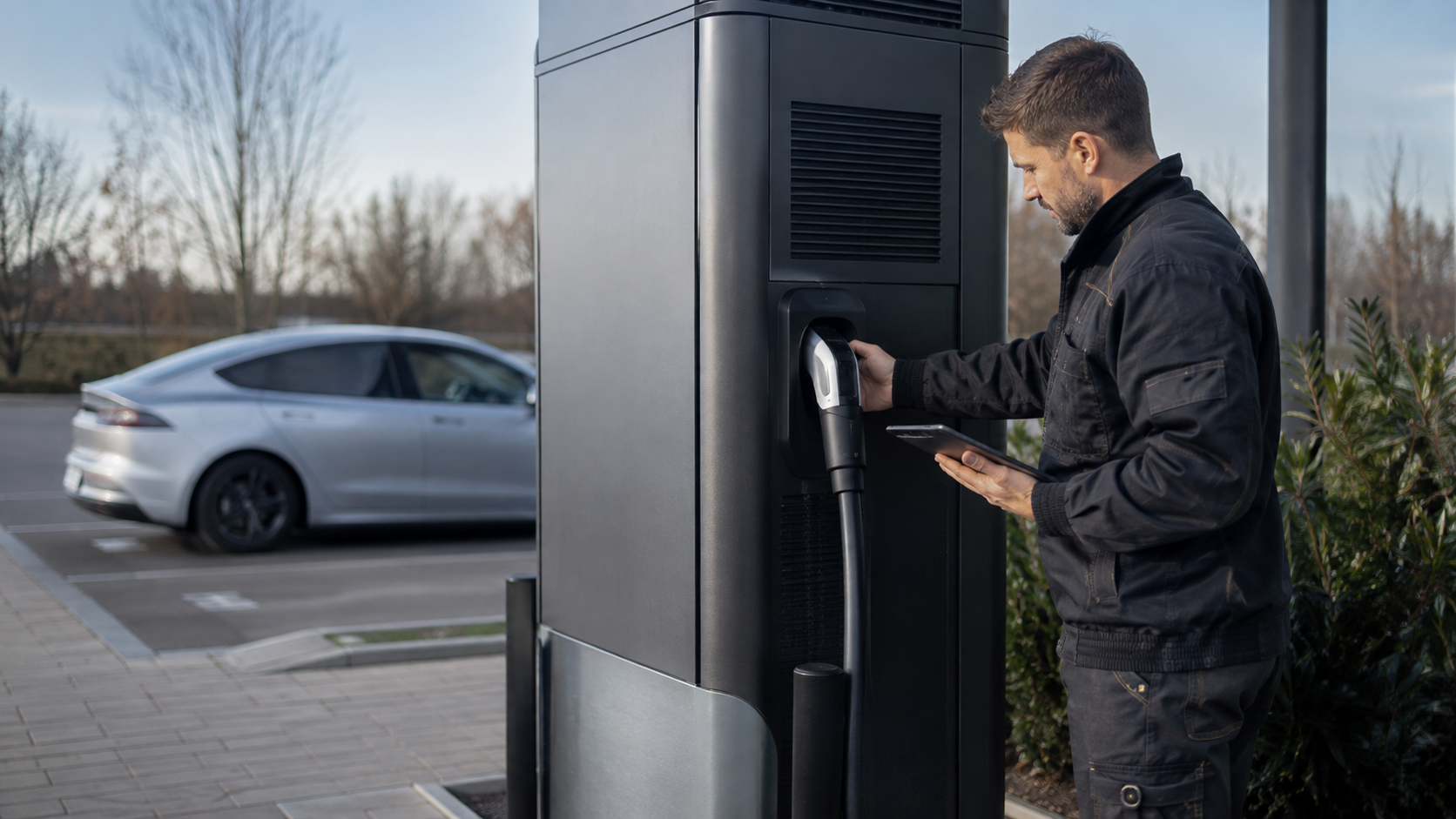
Editorial illustration
A charger can appear connected to its management platform while a driver is unable to start a session. Site owners should therefore ask two questions: what does the applicable reporting rule measure, and what service does the driver actually receive? Those questions overlap, but a single availability label does not answer both.
Read the rule with its scope
Under 23 CFR 680.116, each covered port must have average annual uptime greater than 97%, calculated monthly over the preceding twelve months. The definition includes hardware and software availability and successful electricity delivery meeting the relevant power requirements. It also specifies how documented exclusions enter the calculation. A platform heartbeat alone does not establish that definition. eCFR: uptime definition and calculation
Section 680.102 sets the funding-related applicability, including NEVI Formula Program projects and specified publicly accessible chargers funded under Title 23. The percentage should not be presented as a universal rule for every private charger or every country. Confirm the requirements and award terms for the actual project. eCFR: applicability
Operator analysis: follow the failed attempt
Our recommended service review begins with attempted sessions. Trace discovery, arrival, authorisation, connection, energy delivery and completion. Record the point at which an attempt stops. Decide how retries by the same driver are counted so a repeated failure is not disguised as several unrelated visits.
Maintain a separate operational view of port downtime and customer failures. The first supports availability reporting; the second helps identify payment, vehicle, communications and support problems. Avoid claiming a successful-session rate until the denominator and excluded attempts are defined.
For each incident, preserve the port identifier, timing, relevant logs, support ticket and resolution. If an outage is excluded from a regulatory calculation, retain the evidence for that classification. Our advice is to show the customer effect alongside the adjusted number rather than allowing the adjustment to erase it from the service review.
Contract for recovery as well as equipment
Agree who owns diagnosis when a fault crosses the charger, network and payment providers. Ask how remote recovery is checked, how field service is dispatched and what evidence closes the ticket. A restart command should not, on its own, be accepted as proof that a customer can charge again.
Use a controlled test with supported vehicles and a safe operating procedure to confirm recovery. Include receipts, interrupted sessions and assistance routes. Keep the test results tied to the equipment and software version; the result of an earlier release should not automatically validate an update.
Decide with a balanced scorecard
Our proposed review combines required uptime reporting with completed sessions, repeat failures, restoration time and unresolved support cases. Include maintenance and customer-service costs in the business case. These are management measures to design locally, not published sector benchmarks.
The investment decision should be based on a dependable service commitment and evidence that it is being met. A strong percentage is useful only when its definition, exclusions and customer consequences remain visible.