EV Infrastructure Developments: Hub Expansion and Fleet Payment Integration
TanQyou’s hub and Driivz–WEX billing illustrate different operating options, each requiring site-specific validation.
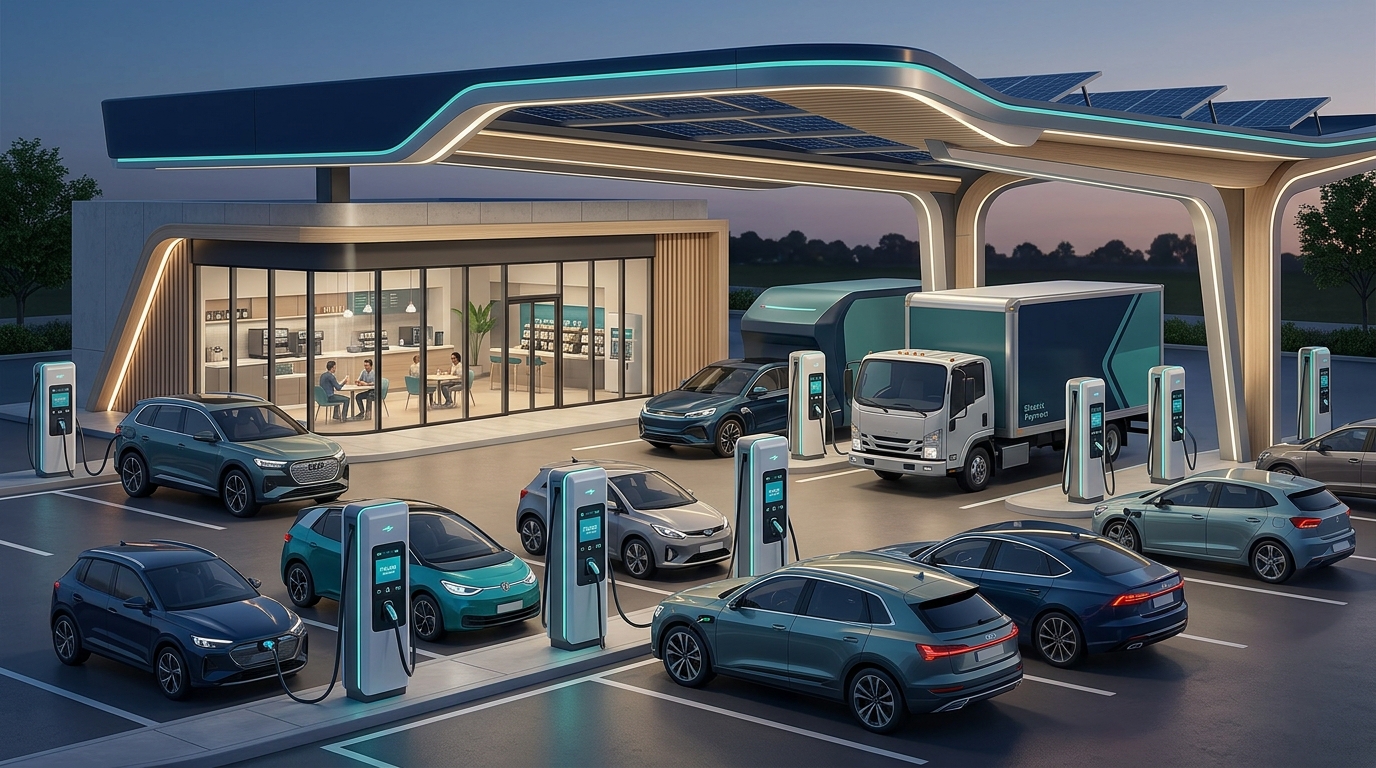
Editorial illustration
Reported hub and payment developments
MobilityPlaza reports that TanQyou opened a 24-hour charging site near SC Cambuur’s Kooi Stadium in Leeuwarden. The report describes eight ultra-fast chargers rated up to 400 kW alongside 30 AC charging points. Equipment ratings are not a promise of simultaneous site output or a charging time for every vehicle. The company’s broad short-session example should not be used as a customer service guarantee. TanQyou site report
A separate report describes Driivz’s integration with WEX for fleet charging payments and an initial integration at a California hub serving medium- and heavy-duty fleets. It describes direct public-session billing and reimbursable home charging. These are reported software capabilities; eligibility, commercial availability and support must be confirmed for an operator’s actual deployment. Driivz and WEX integration report
Operator analysis: match the proposal to demand
An AC and DC mix is an option to evaluate for customers with different dwell times. It is not inherently the lowest-cost or most profitable design. Begin with expected arrival patterns, energy demand and the service commitment made to each customer group.
Assess the grid connection, simultaneous demand, power sharing and utility terms. Compare a mixed layout with other feasible options using the same assumptions. Record the cost of land, equipment, maintenance and customer support. A location next to a stadium may have operating peaks that differ from an ordinary transit forecourt.
Require evidence for the installed configuration rather than inferring delivered performance from the charger’s nameplate. A site acceptance exercise should include representative vehicles, concurrent use and fault recovery under an approved test procedure. Keep the tested limits visible in customer information.
Operator analysis: confirm the fleet agreement
Billing integration can be relevant to a fleet tender, but it does not itself secure a customer contract. Ask which fleets and payment methods are supported, who receives invoices and how disputed or interrupted sessions are handled. Establish the customer-service owner before announcing access.
For home charging, distinguish eligibility for reimbursement from the records and processes needed to execute it. Do not promise that expense reports disappear unless the actual workflow demonstrates that result. Check the treatment of corrections and the responsibilities of the fleet, network and payment providers.
A measured decision
Our suggested trial records successful sessions, billed energy, payment exceptions, support effort and contracted versus actual fleet usage. Identify the costs attributable to the integration and test whether the intended customer benefit is delivered.
The references establish two reported developments. They do not establish a universal demand acceleration, superior retention, secured fleet volumes or a fixed return on a hybrid charging layout. Those conclusions require operating and commercial evidence beyond the announcements.
Editorial clarification — 8 September 2026
Removed generalised charging-time expectations and unsupported claims of optimised capital spending, retention and guaranteed fleet volume. Retained reported capacities with their limits.