The Daily Forecourt Brief — 2026-09-10
An executive audio briefing across fuel retail, EV charging, convenience stores and foodservice.
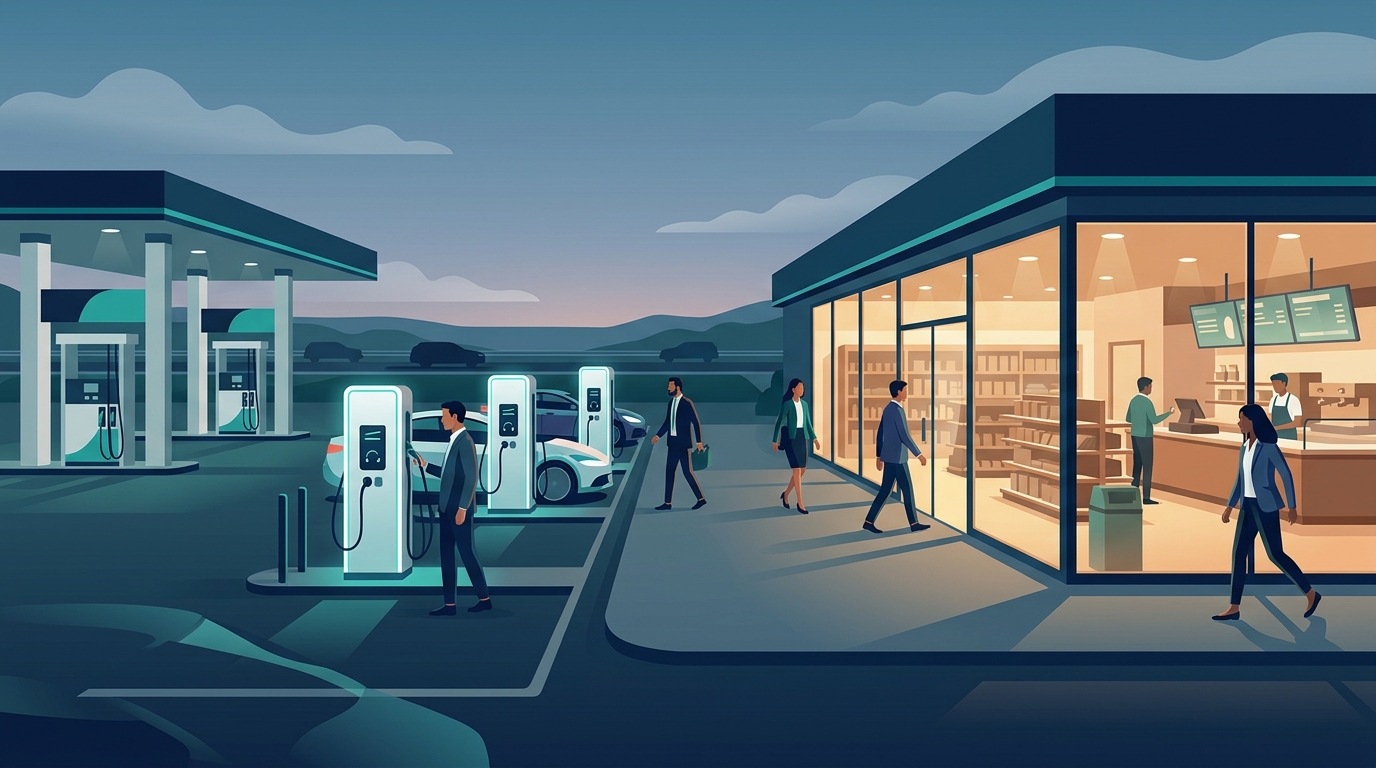
Editorial illustration
Fuel Retail
Forecourt Retail Strategies: Regional Partnerships and Digital Foundations
Forecourt Operations and Regional Partnerships in Fuel Retail
Forecourt and convenience store operators are adapting to shifts in consumer expectations and operational demands. Strategies vary from establishing regional quick-service restaurant (QSR) partnerships in North America to prioritizing core digital systems across European networks.
Regional Foodservice Integration in C-Stores
In the United States retail sector, Kayrouz Petroleum announced a partnership with regional coffee chain Marylou’s Coffee on September 9, 2026. According to Barry Ahern, chief retail and people officer at Kayrouz Petroleum, the partner retailer is integrating a Marylou’s Coffee location inside a new KP Market store situated in Hyannis, Massachusetts.
The coffee concept is expected to launch by the end of September 2026. Marylou’s operates approximately 40 locations in Massachusetts and Rhode Island. The menu featured at the Hyannis site will include hot and cold specialty beverages, frozen drinks, lemonade, breakfast sandwiches, bagels, and stuffed waffles. Kayrouz Petroleum operates 11 locations under its KP Market, KP Market and Liquor, and KP Travel Center banners, having introduced the KP Market banner roughly one year ago. While there are no concrete expansion plans for additional Marylou's units across the remaining estate, Kayrouz Petroleum indicated an openness to future opportunities if suitable locations arise.
Digital Infrastructure and Multi-Service Hub Evolution
In Europe, fuel retailers are facing changing consumer expectations that extend beyond baseline fuel sales. In an interview published by forecourttech, Frederick Beckmann, Chief Executive Officer of German fuel station operator Q1 Energie AG, stated that forecourt sites are transitioning from single-purpose fuel stops into multi-service hubs. Q1 Energie AG operates more than 230 locations across Germany.
Beckmann noted that modern customers evaluate fuel stations against everyday consumer experiences, requiring speed, reliability, and ease of use. To meet these operational requirements, Beckmann emphasized that Q1 Energie AG prioritizes baseline infrastructure, citing investments in "data quality, system integration and robust processes" over premature experimentation with complex technologies like artificial intelligence or robotics. In terms of electric vehicle (EV) charging infrastructure, Q1 Energie AG targets investments specifically where customer demand and a viable business case exist, anticipating that multiple mobility options will coexist concurrently for an extended period.
Analysis: Hypotheses for Retail Execution
Hypothesized Foodservice Revenue Impact
*Hypothesis*: Partnering with an established regional brand (such as Marylou's) instead of building a proprietary foodservice program increases overall store foot traffic and inside sales for independent c-store operators. *Proposed Test*: Compare 90-day post-launch foot traffic metrics, average transaction values, and overall margin performance at the Hyannis KP Market site against a control KP Market location operating without a brand-name QSR partner.
Hypothesized Systems Integration Efficiency
*Hypothesis*: Prioritizing foundational data integration over front-end technology rollouts reduces inventory shrinkage and stockout frequencies during multi-service conversions. *Proposed Test*: Perform a comparative operational audit measuring inventory variance, system downtime, and order fulfillment times across a sample of 20 sites that have undergone backend integration updates versus 20 sites operating on legacy back-office systems.
Hypothesized EV Mobility Hub Performance
*Hypothesis*: Offering high-quality convenience options and seating areas increases customer dwell time and non-fuel spend among EV charging consumers compared to sites without dedicated amenities. *Proposed Test*: Track basket size and total non-fuel revenue from customers utilizing fast chargers over a 6-month period, controlling for time-of-day and charging duration.
EV Charging
Forecourt EV Strategy: Navigating Global Vehicle Uptake and Network Uptime Dynamics
Global EV Growth and Market Trajectory
Global electric car adoption expanded significantly in 2025, with total sales growing 20% to "exceed 20 million in 2025, meaning one-quarter of all new cars sold were electric" according to the IEA Global EV Outlook 2026. European electric vehicle (EV) sales rose over 30% to achieve a 28% market share under tighter European Union CO2 standards. China recorded an EV sales share of nearly 55%, with Chinese automakers accounting for 60% of all global electric car sales.
Looking ahead, global EV sales are projected to reach 23 million in 2026, representing 28% of total car sales. Long-term energy infrastructure implications remain significant: electricity demand from EVs is projected to exceed 1,500 TWh by 2035—a sixfold increase from 2025 levels. By 2035, EV power consumption is expected to increase total electricity demand by over 10% in Europe and under 6% in China.
High-Power Infrastructure and Heavy-Duty Developments
In terms of charging hardware, maximum rated capabilities continue to outpace the existing vehicle stock. The first 1,000-volt vehicle models arrived in 2025, and public claims of sub-10-minute charging times continued into 2026. However, vehicles capable of taking charging rates above 250 kW currently represent less than 5% of the total vehicle stock.
In the heavy-duty sector, specialized charging networks are beginning to scale. The European Union now contains over 1,000 charging points designated exclusively for electric trucks, supporting long-distance transport routes as total cost of ownership (TCO) parity approaches.
Driver Behavior and Network Trust Metrics
Recent survey findings published by MobilityPlaza detail a major shift in how drivers choose charging locations. Research covering over 3,000 EV drivers across North America and Europe indicates that word of mouth and peer recommendations strongly influence charger selection. Specifically, 91% of EV drivers reported they would make a detour to visit a charger recommended by another driver, and 55% would travel more than 5 minutes out of their way. Conversely, 76% of drivers stated they would avoid a charging network entirely following a warning from friends or family.
Commenting on these dynamics, Driivz CEO Shiri Levi-Laor noted that drivers are shifting from asking where a charger is located to asking whether a charger is reliable. Operational priorities among charge point operators (CPOs) reflect this reality: "59% of CPOs now say charger utilization, not expansion, is their primary driver of profitability" according to Driivz survey data, compared to only 15% pointing to network growth. Furthermore, CPOs identify 24/7 network availability (47%) and seamless authentication (43%) as top investment priorities.
Forecourt Analysis and Strategic Hypotheses
*Analysis*: Forecourt operators planning capital expenditure must weigh hardware expansion against asset reliability. While adding high-power DC chargers increases maximum site capacity, peer recommendation loops mean that intermittent uptime or broken authentication software direct revenue away from sites. Maximizing throughput on existing chargers yields higher profitability than speculative expansion into unproven locations.
*Hypothesis*: Displaying live, verified site-level uptime ratings on digital forecourt signage will capture high-margin diverted traffic from adjacent highway routes.
*Proposed Test*: Select 20 forecourt sites along major regional corridors. Install real-time uptime indicators on external roadside price signs across 10 test sites while retaining standard signage at 10 baseline control sites. Track changes in kWh throughput, repeat driver visits, and average non-fuel retail sales over a 6-month trial period.
C-Store
C-Store Industry Overview: Executive Networking and Delivery Channel Expansion
Convenience Retail Trends: Industry Networking and Foodservice Delivery Expansion
Convenience store operators must navigate evolving consumer expectations while maximizing revenue from existing equipment and industry relationships. Recent news highlights both executive networking initiatives in Europe and digital delivery software integrations across North American convenience stores.
European Industry Gathering: Warsaw Convenience Dinner
According to an announcement from forecourttech, the organization sponsored an executive gathering in Poland. The event, known as The Warsaw Friends of Convenience Dinner, was scheduled for Tuesday, 16 June 2026, following the official NACS Convenience Summit Europe Welcome Reception.
The dinner was organized by Christian Warning, who serves as Founder and Chief Executive Officer of The Retail Marketeers, alongside Leszek Jurczak. Stephen Bozdan, managing director at SAB Events and organizer of forecourttech, stated that informal conversations at such gatherings help build partnerships that drive industry progress. Participation in the dinner was intentionally constrained through invitation-only access and restricted seating capacity.
Delivery Integration: Expanding On-Demand Reach
In a development published on 10 September 2026, beverage program vendor f'real announced a software agreement with Lula Commerce, as reported by MobilityPlaza. This partnership allows convenience store retailers using f'real self-serve blending equipment to list milkshakes and smoothies on third-party marketplace channels, including DoorDash, Uber Eats, and Grubhub.
Through Lula Commerce's software, participating operators can handle menu creation, price updates, stock synchronization, and order fulfillment within a single portal. f'real is owned by Rich Products Corporation and maintains equipment across a network total exceeding 17,000 sites in the United States and Canada, including convenience stores, colleges, theaters, and military installations. The automated blending units prepare smoothies and milkshakes directly from frozen cups on site.
Analysis
*Note: The analysis below reflects independent evaluation by Forecourt News and must be distinguished from sourced factual claims.*
Commercial Implications of Third-Party Delivery Integration
Connecting automated frozen beverage machines to third-party marketplaces offers operators a potential secondary channel to sell existing inventory without hiring specialized kitchen labor. Because the equipment utilizes pre-packaged frozen cups blended on demand, order execution relies on existing store hardware.
However, operational advantages such as reduced labor complexity or increased net earnings should be treated as unverified hypotheses rather than guaranteed outcomes.
Hypothesis and Operational Testing Framework:
- Hypothesis: Offering f'real beverages on third-party marketplaces increases total store beverage margin without degrading speed of service or labor efficiency.
- Proposed Test: Implement the Lula Commerce system across a test sample of 20 participating store locations over a 90-day trial. Track incremental order volume, platform commissions, order picking times, cup delivery condition, and store labor impact against a control group of non-delivery locations.
Strategic Takeaways for Convenience Operators
When evaluating tech integrations and executive forums, operators should maintain strict operational distinctions:
- Network Totals vs. New Additions: f'real's network size of more than 17,000 locations represents total legacy installations across diverse venue types, whereas marketplace integration via Lula Commerce is a newly added software capability for participating stores.
- Participation Conditions: Delivery reach is subject to geographic eligibility, store-level hardware installation, participating delivery driver availability, and software synchronization settings across DoorDash, Uber Eats, or Grubhub.
- In-Store Staff Execution: While blending is automated, store workers must manually select frozen cups, supervise machine processing, package products, and transfer orders to delivery drivers. Operators must verify that these tasks do not create bottlenecks during peak store hours.
QSR & Foodservice
Forecourt Foodservice and Coffee Loyalty Strategies: Operational Insights and Digital Growth Models
Overview of Forecourt Foodservice and Loyalty Dynamics
The convenience and forecourt sector is experiencing a strategic pivot where foodservice and high-frequency beverage categories serve as primary profit drivers. According to data reported by NACS, convenience foodservice and merchandise sales reached $341.2 billion in 2025, even as fuel sales fell 5.4% due to lower pump prices. Within this mix, foodservice generated 28.5% of in-store sales while contributing 38.9% of gross profit dollars. Furthermore, CSP Daily News benchmarks indicate that typical foodservice margins average approximately 57%, compared to a 27% margin for general merchandise.
To capitalize on these margin dynamics, operators are targeting high-frequency habits, particularly coffee and hot dispensed beverages. Industry tracking by Datassential indicates that 73% of consumers consume coffee or tea multiple times per week, with 54% drinking it daily. Additionally, data from the National Coffee Association's fall 2025 report revealed that 59% of U.S. consumers bought their coffee through a drive-thru and 38% placed orders via a mobile app.
Innovation in Menu Hacks and Digital Marketing
Convenience operators are actively leveraging digital platforms and specialty menu concepts to drive store traffic. Sheetz—ranked No. 13 on CSP’s 2026 Top 202 ranking of U.S. c-store chains by store count—partnered with media producer First We Feast to launch a three-episode YouTube miniseries titled Fuel Stop Feast. Hosted by Adam Richman alongside Chefs Christian Alquiza and Ian Fujimoto, the program highlights menu customizations using Sheetz’s Made-to-Order platform.
Ryan Sheetz, executive vice president of marketing and supply chain at Altoona, Pennsylvania-based Sheetz, noted that partnering with First We Feast enabled the company "to take the variety and customization behind our Made-to-Order menu and showcase it in a completely new way." Limited-time offerings debuted in the series—including the Lumberjack Breakfast Sandwich, Pizza Bagel Bunz Burger, and Tater Bomb Nachos—were made available to order across all Sheetz locations. Sheetz operates more than 830 stores across Pennsylvania, Maryland, Michigan, North Carolina, Ohio, Virginia, and West Virginia, and plans an expansion into Indiana in 2027.
Driving Frequency Through Integrated Loyalty Ecosystems
Capturing daily beverage buyers requires friction-free digital onboarding and loyalty integration. Paytronix data demonstrates that 60.2% of first-time Beverage and Snack guests return for a second visit, and 87.3% of guests who reach nine visits go on to a tenth. However, while overall loyalty enrolment is widespread—with over 90% of companies operating loyalty programs—Paytronix client data indicates that despite active member rates rising from 66.1% to 71.6% year-over-year, average visits per member declined, pointing to an engagement gap.
Fast-growing drive-thru coffee operators highlight the impact of simplified loyalty models. For instance, 7 Brew expanded from 14 locations in early 2022 to over 700 units across 38 states, increasing systemwide sales from $502 million in 2024 to nearly $1.2 billion in 2025, as covered in MobilityPlaza's analysis. Similarly, Foxtail Coffee doubled its store network to 100 locations over two years, while Wake Up Call Coffee acquired 13 Black Rock Coffee Bar sites in late 2025 to accelerate growth using straightforward stamp-based rewards. International fuel brand strategies mirror this prioritization; BP's Wild Bean Café, operating across more than 320 UK sites, launched its largest-ever UK marketing campaign in 2025 to promote forecourt beverage quality.
Analysis: Hypotheses and Operator Considerations
*Note: The following section represents analytical synthesis and strategic framing distinct from direct source reporting.*
While media partnerships and integrated POS platforms present logical growth avenues, operators must formally test these operational assumptions before capital deployment.
Hypothesis 1: Limited-Time Content Hacks Drive Incremental Store Visits
- Hypothesis: Promoting chef-created menu hacks on video platforms increases impulse food orders among younger cohorts without degrading kitchen throughput.
- Proposed Test: Run a 30-day split-A/B test across 50 matched participating locations. Group A receives digital marketing for complex menu hacks; Group B receives standard promotional creative. Measure order assembly times, ticket size, and loyalty signup rates.
Hypothesis 2: Unified App-POS Loyalty Systems Outperform Standalone Point Solutions
- Hypothesis: Integrating mobile ordering directly with POS and loyalty software reduces second-visit dropout rates compared to decoupled point solutions.
- Proposed Test: Deploy integrated app ordering at 20 test locations while maintaining third-party point solutions at 20 control sites. Track second-to-fourth visit conversion over a 90-day window.
Host
Welcome to the Executive Daily Briefing. Today we examine shifts across fuel retail, electric vehicle charging, convenience delivery, and quick-service foodservice. In fuel retail, Kayrouz Petroleum announced a partnership on September 9, 2026, with regional coffee chain Marylou’s Coffee to integrate a location inside a new KP Market in Hyannis, Massachusetts, launching by late September 2026. Marylou’s operates around 40 locations across Massachusetts and Rhode Island, offering specialty beverages, breakfast items, and stuffed waffles. Kayrouz operates 11 locations under three banners. Leadership noted no concrete expansion plans for additional Marylou's units yet, though they remain open to future opportunities.
Co-Host
In Europe, fuel retailers are addressing broader forecourt demands. Frederick Beckmann, CEO of German operator Q1 Energie AG—managing over 230 sites—stated that forecourts are transitioning into multi-service hubs. Rather than rushing into AI or robotics, Q1 Energie prioritizes baseline backend infrastructure, specifically data quality, system integration, and robust processes. On EV charging, Beckmann noted Q1 targets investments specifically where customer demand and a viable business case exist, anticipating that multiple mobility options will coexist concurrently for an extended period.
Host
These approaches reflect distinct operational hypotheses. Analysts hypothesize that partnering with a regional brand like Marylou's increases store foot traffic and inside sales compared to proprietary programs—a claim requiring post-launch testing against a control site. In EV charging, IEA Global EV Outlook 2026 data shows global electric car sales grew 20% in 2025 to exceed 20 million units, or one-quarter of all new cars sold. Sales are projected to reach 23 million in 2026, representing 28% of total sales.
Co-Host
The IEA highlights that Chinese automakers accounted for 60% of global electric car sales in 2025, with China's domestic EV sales share reaching nearly 55%. European EV sales rose over 30%, reaching a 28% market share under tighter standards. Long term, EV electricity demand is projected to exceed 1,500 terawatt-hours by 2035. However, hardware capabilities currently outpace vehicle stock. While 1,000-volt models arrived in 2025, vehicles capable of taking charge rates above 250 kilowatts represent under 5% of global vehicle stock.
Host
In heavy-duty transport, the EU now has over 1,000 dedicated electric truck charging points. But survey research from MobilityPlaza and Driivz covering 3,000 drivers shows driver recommendations strongly influence charger selection. Ninety-one percent of EV drivers would detour for a recommended charger, while 76% avoid networks following family or friend warnings. Driivz CEO Shiri Levi-Laor noted drivers now prioritize reliability over location. Reflecting this, 59% of charge point operators identify charger utilization as their main profitability driver, versus 15% citing network growth.
Co-Host
Analysts hypothesize that displaying live, verified uptime ratings on roadside signs could capture diverted traffic, testable by tracking throughput over six months. Moving to c-store networking, industry executives gathered at The Warsaw Friends of Convenience Dinner on June 16, 2026. Organized by Christian Warning of The Retail Marketeers and Leszek Jurczak, and sponsored by forecourttech, the invitation-only event focused on executive partnership building through informal conversation.
Host
In delivery technology, beverage vendor f'real announced a software agreement with Lula Commerce on September 10, 2026. This allows operators using f'real automated self-serve blending equipment to list milkshakes and smoothies on DoorDash, Uber Eats, and Grubhub. Lula’s software centralizes menu creation, price updates, stock sync, and order fulfillment in one portal. Owned by Rich Products Corporation, f'real maintains a total network footprint exceeding 17,000 legacy sites across North America, including c-stores, colleges, theaters, and military bases.
Co-Host
Operators must distinguish between f'real's total network size and participating delivery locations. Delivery reach depends on geographic eligibility, store hardware, software settings, and driver availability. Crucially, while blending is automated, store workers must manually select frozen cups, supervise blending, package products, and transfer orders to drivers. Analysts hypothesize third-party delivery increases beverage margin without degrading service speed, but operators must test net commissions and picking times against non-delivery control stores over 90 days.
Host
This delivery expansion mirrors broader foodservice momentum. NACS data shows c-store foodservice and merchandise sales reached $341.2 billion in 2025, despite fuel sales falling 5.4% on lower pump prices. Foodservice generated 28.5% of in-store sales and 38.9% of gross profit dollars, with CSP benchmarks placing foodservice gross margins at 57% versus 27% for general merchandise. Datassential reports 73% of consumers drink coffee or tea multiple times weekly, and NCA data shows 59% bought coffee via drive-thru while 38% ordered via mobile app.
Co-Host
Chains are leveraging digital media and menu customization to drive traffic. Sheetz, operating over 830 stores across seven states and planning an Indiana expansion in 2027, partnered with First We Feast to launch 'Fuel Stop Feast,' a three-episode YouTube miniseries hosted by Adam Richman and Chefs Christian Alquiza and Ian Fujimoto. Marketing EVP Ryan Sheetz noted the series showcases their Made-to-Order menu variety. Featured limited-time items, including the Lumberjack Breakfast Sandwich and Tater Bomb Nachos, debuted across all Sheetz locations.
Host
In drive-thru coffee, brands are expanding rapidly. 7 Brew grew from 14 sites in early 2022 to over 700 units across 38 states, increasing sales from $502 million in 2024 to nearly $1.2 billion in 2025. Foxtail Coffee doubled to 100 locations, Wake Up Call Coffee acquired 13 Black Rock sites, and BP’s Wild Bean Café launched marketing across 320-plus UK sites. Meanwhile, Paytronix data shows that while active loyalty membership rose from 66.1% to 71.6% year-over-year, average visits per member declined.
Co-Host
Paytronix client tracking also shows 60.2% of first-time beverage and snack guests return for a second visit, and 87.3% reaching nine visits reach a tenth. Analysts hypothesize that integrating mobile ordering directly with POS and loyalty software reduces second-visit dropout compared to standalone systems. Furthermore, analysts hypothesize that video menu hacks increase impulse orders, though operators should run 30-day split tests across participating stores to verify that custom menu items do not degrade kitchen assembly times.
Host
Across fuel retail, EV charging, c-store delivery, and QSR foodservice, a common imperative emerges: operators must formally test growth hypotheses before committing capital. Whether evaluating brand partnerships, high-power charging uptime, delivery marketplace software, or digital menu hacks, verified store-level metrics must guide strategy as forecourts evolve into multi-service hubs.
Co-Host
To conclude today's briefing, we leave executive operators with four core questions. First, in fuel and EV operations: Are your forecourt investments prioritising back-end data integration and charger uptime over premature expansion? Second, can you display verified site uptime to capture drivers willing to detour for reliable charging?
Host
Third, on c-store delivery: Have you tested store-level workflows to ensure third-party delivery fulfillment for automated beverage units does not create bottlenecks during peak hours, and verified net margins after commission fees?
Co-Host
And fourth, in foodservice: Does your loyalty platform effectively convert first-time beverage buyers into repeat visitors, and are custom menu promotions backed by kitchen assembly speed tests? Thank you for listening to the Executive Daily Briefing. We will see you tomorrow.