Fast Charging Rollout at the Al Rahmaniya service station in Sharjah
Learn how ENOC evaluates third-party EV charging concessions under Sharjah's capped tariffs, and explore Yesway's plan to convert 24 Texas stores to Allsup's.
Editorial illustration
Fuel Retail
European Regulatory Timelines and Forecourt Retail Governance Benchmarks
Legislative Relief on EU Methane Import Requirements
European Union co-legislators have agreed to grant a two-year postponement for the implementation of upcoming EU methane import requirements, according to an industry update from FuelsEurope published on 19 November 2026. The postponement provides commercial downstream operators, refiners, and importers interim relief from complex reporting requirements while critical administrative frameworks remain under development.
According to FuelsEurope, significant implementation challenges remain before the rules can function effectively. The European Commission and Member States still need to establish verification and compliance frameworks, build adequate third-party accreditation capacity, and issue practical administrative guidance for cross-border transactions. A formal review scheduled for 2028 will assess operational readiness and review any lingering barriers affecting industrial competitiveness or security of supply. While trade association FuelsEurope argued that the duration of the postponement should be adequately extended if the 2028 assessment reveals persistent implementation deficits, co-legislators have formally authorized only the initial two-year delay.
Operational Implications for Downstream Compliance
For fuel wholesale buyers and forecourt operators sourcing imported refined product or crude feedstocks, the legislative delay provides breathing space but does not eliminate long-term audit exposure. Treating the two-year window as a complete compliance freeze risks operational disruptions when statutory reporting requirements eventually take effect.
An operator could test whether their primary fuel suppliers possess auditable upstream emissions telemetry by requesting sample certification chains. Verifying that international upstream partners have contracted with accredited auditors will help operators identify compliance gaps early. If supply contracts are up for renewal between 2026 and 2028, compliance clauses should explicitly define which party bears verification liabilities once Member State implementation acts are enacted.
Convenience Retail Governance and Non-Fuel Strategy
While upstream supply chains adapt to regulatory adjustments, downstream network strategies continue shifting toward non-fuel revenues, convenience merchandising, and food-to-go formats. On 11 November 2026, industry leaders met at the Literaturhauscafé in Hamburg, Germany, for the European Female Leaders in Convenience Awards, organized by The Retail Marketeers, presented by PDI Technologies, and partnered with forecourttech.
The ceremony took place during the 10th Convenience Leaders Convention under the operational banner "DEFCON 3: Mobility Retail." Honorees recognized for leadership in non-fuel sales, network development, and merchandising included Agnieszka Bobrukiewicz (Executive Director Non-Fuel Sales across Poland, Austria, Germany, Lithuania, Czech Republic, Slovakia, and Hungary at Orlen), Alicia Cruzado Lopez (Senior Manager of Franchise Development and New Business at Repsol), Louise Eckford (Head of Property, Planning & Transformation at Marks & Spencer Channels), Judy Glover (Head of European Merchandising at Circle K Europe), Zsuzsa Hordai (Head of Strategic Projects at SPAR International), and Anna Wallenberg (CEO of Reitan Convenience Sweden).
The convention brought together executive delegates from European fuel and convenience networks, including BP/Aral, Shell, Moeve, EG Group, Valora, and Tank&Rast. Discussions focused on managing footfall conversion as forecourts transition into passenger-oriented, food-led mobility hubs. Beyond Europe, forecourttech announced that its regional conference series will expand to Latin America with forecourttech LATAM, scheduled for 17–18 March 2027 in Cancún, Mexico.
Managing Upstream and In-Store Capital Allocations
European forecourt operators face a dual operational mandate: monitoring upstream supply regulatory deadlines while reallocating capital to higher-margin retail store footprints. As compliance timelines extend to 2028, retailers can direct immediate management attention toward store-level execution.
Operators evaluating convenience upgrades should audit store space allocation between traditional fuel cashier counters and prepared food or beverage programs. By benchmarking merchandising strategies against European regional peers, retail directors can determine whether expanded grab-and-go selections produce measurable basket-size lifts before committing to full kitchen refits across secondary sites.
EV Charging
Evaluating Third-Party Charging Partnerships: Regulated Tariffs and Fleet Turnover Constraints
Network Rollouts and Concession Models in Regulated Markets
Forecourt networks balancing capital allocation against uncertain zero-emission vehicle adoption rates are increasingly utilizing third-party charge point operator (CPO) partnerships. In the United Arab Emirates, fuel retailer Emirates National Oil Company (ENOC) partnered with ION—a joint venture between BEEAH and Crescent Enterprises—to launch an electric vehicle (EV) charging location at its Al Rahmaniya service station in Sharjah.
The Al Rahmaniya site is equipped with 150 kW direct-current (DC) fast chargers and represents the initial deployment of a planned roll-out across more than 15 ENOC stations in the emirate. The project operates within a regulated framework governed by the Sharjah Roads and Transport Authority (SRTA), which set a standardized DC dispensing tariff of AED 1.20 ($0.33) per kWh. Customers locate, initiate, and pay for charging sessions via the ION mobile application. According to ION, which is licensed by SRTA as a Charge Point Operator, the company is concurrently working under authority mandates to install, manage, and service more than 100 fast chargers spanning Sharjah City, the Central region, and the East Coast. ENOC and ION originally disclosed their collaboration framework during the EVOLVE summit in Sharjah.
Fleet Longevity and Capital Allocation Timelines
While high-power highway installations address immediate network visibility, global macroeconomic data indicates that consumer vehicle replacement schedules may slow the pace of transition at suburban and rural forecourts. According to data published by the Transportation Energy Institute (TEI), the average transaction price for a new light-duty vehicle exceeded $52,000 in November 2026. TEI noted that sustained high acquisition costs dampen retail vehicle sales and decelerate overall fleet turnover.
Because roughly 50% of light-duty vehicles sold today are projected to remain on roadways for 16 years, the operational fuel mix of arriving motorists will shift gradually rather than abruptly. As highlighted ahead of the NACS and TEI Future of Mobility Summit in Charlotte, North Carolina (scheduled for December 2–3, 2026), forecourt operators must evaluate local registration demographics rather than broad national projections when deploying high-capital electrical infrastructure.
Operational Analysis: Weighing Partnership Risk Against Regulated Revenue
For forecourt operators, the combination of fixed retail charging tariffs and prolonged combustion fleet retention fundamentally alters the return on investment (ROI) equation for EV equipment.
When standard tariffs are mandated by regional transport authorities—such as SRTA’s fixed rate of AED 1.20 per kWh—retailers lose dynamic pricing flexibility. If wholesale electricity tariffs or demand ratchet charges escalate, operators cannot unilaterally raise kilowatt-hour prices to defend their operational margin. Under such conditions, partnering with a third-party CPO shifts equipment depreciation, preventative maintenance, and backend software overhead away from the fuel retailer's balance sheet. However, this structure typically leaves the retailer with only a modest site-host fee or a fractional margin split per kilowatt-hour dispensed.
To evaluate whether to host a third-party concession or fund a proprietary charging installation, operators should measure two site-specific variables:
- Local Fleet Turnover Velocity: Operators should audit regional vehicle registration records within a 5-kilometer catchment radius. If the local passenger car fleet reflects extended retention cycles (approaching the 16-year average identified by TEI), high upfront capital expenditure for proprietary fast chargers carries an elevated risk of underutilization.
- In-Store Retail Conversion Lift: It is hypothesized that third-party charging installations generate sufficient convenience retail foot traffic to offset the loss of direct charging margin. Operators should test this by comparing inside-store basket size and gross margin from app-directed EV drivers against traditional fuel-purchasing visitors before dedicating parking spaces to long-term third-party hardware leases.
C-Store
Regional Banner Realignment and QSR Loyalty Mechanics: Operational Transition and Margin Controls
Siting and Brand Consolidation: Yesway’s Texas Rebranding
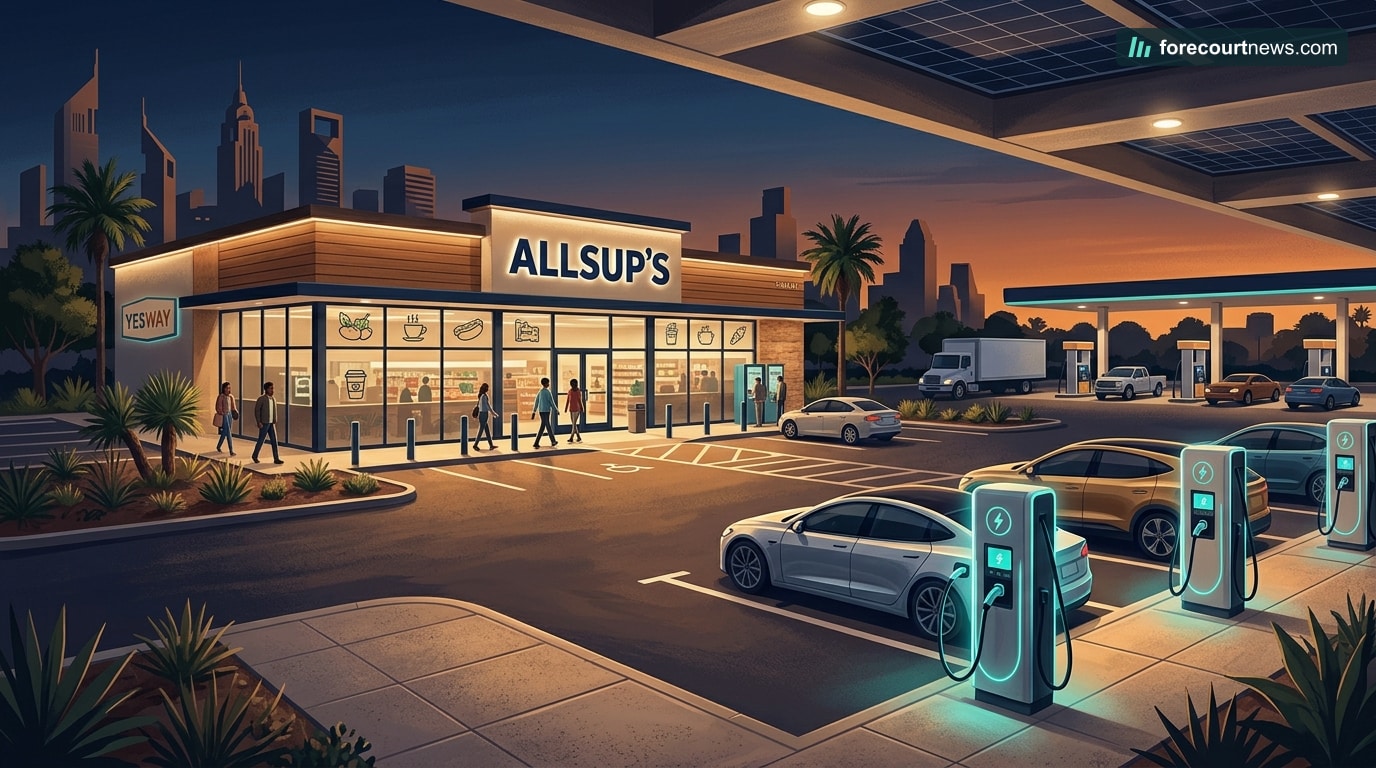
Convenience retail operators managing multiple retail banners face critical decisions regarding when to standardize under a single flag versus maintaining regional sub-brands. NACS reported that Yesway plans to convert 24 existing Yesway convenience stores in Texas into its Allsup’s banner, with execution scheduled for completion by the close of the first quarter of 2027. Yesway's chief real estate officer, Tom Brown, indicated that the conversion leverages the established customer loyalty, brand recognition, and regional legacy that Allsup’s holds throughout Texas.
Rather than executing a total brand erasure, Yesway is maintaining a dual-banner strategy. Following the conversion of the 24 Texas stores, the operator stated it will continue operating 26 Yesway-branded stores across four states alongside its expanding Allsup's network. The Allsup's brand has also served as Yesway's primary vehicle for geographic expansion, exemplified by the opening of its first-ever Allsup’s location in Arizona in October 2026, which marked the company's expansion into its tenth state.
Operational Mechanics of Dual-Banner Portfolios
Operating two retail flags within adjacent territories requires careful operational coordination. While single-brand consistency simplifies marketing procurement and uniform supply contracts, regional brands often command distinct foodservice followings and local loyalty that generic rebrands can disrupt. In Yesway’s deployment, concentrating the Allsup's banner across Texas and new western territories allows the company to align store formats with regional brand equity while keeping a focused 26-store Yesway footprint elsewhere.
For operators evaluating similar portfolio reorganizations, banner conversion involves more than changing exterior fascias and forecourt pylons. Store conversions require evaluating category mix, kitchen infrastructure, and point-of-sale (POS) menu configurations. If a heritage banner is known for proprietary hot foodservice items, introducing that banner into converted stores requires validating that back-of-house layouts, fryer capacities, and ventilation can support the legacy menu without creating kitchen bottlenecks.
Foodservice Loyalty Mechanics: Fatburger Rewards
As convenience operators expand prepared foodservice and quick-service restaurant (QSR) operations, loyalty architecture plays a central role in repeat customer retention. Restaurant Dive reported that burger concept Fatburger introduced its first digital rewards program, Fatburger Rewards, on October 8, 2026. The program's rollout follows major corporate restructuring; its parent entity was renamed OHG Brands after FBG Bid Co. acquired Fat Brands out of bankruptcy for $595 million in four separate transactions, trimming the portfolio from 18 concepts down to 12 following a January bankruptcy filing tied to over $1 billion in debt.
The loyalty program’s financial mechanics illustrate standard QSR value-exchange design. Under Fatburger Rewards, enrolled guests earn points at a rate of 1 point per $1 spent on eligible purchases. Redemptions are structured at a threshold of $5 off for every 75 points accrued. This establishes a baseline nominal rebate rate of approximately 6.67% on eligible spending, excluding promotional multipliers or app-exclusive bonuses. To drive initial member acquisition, the program offers new sign-ups an introductory incentive of $5 off an order of $20 or more, which remains valid for 30 days at participating locations.
Analysis: Balancing Loyalty Liability and Forecourt Margins
Retailers introducing structured point systems to forecourt food counters must account for balance-sheet liabilities and store-level redemption friction. Unredeemed points represent deferred revenue that must be tracked against operating cash flows. Furthermore, a baseline discount rate of nearly 7% demands tight cost-of-goods-sold (COGS) oversight, particularly on high-cost protein categories.
Operators considering point-based loyalty structures can test programmatic thresholds through controlled A/B geographic trials before system-wide launch:
- Redemption Velocity and Margin Impact: Measure whether point redemptions disproportionately cannibalize full-margin staple sales or successfully drive incremental side and beverage attachment.
- Onboarding Conversion Friction: Evaluate whether acquisition incentives—such as welcome discounts restricted to orders above a specific ticket size—increase initial basket values without elevating cashier intervention times during peak drive-thru or counter rushes.
QSR & Foodservice
Hospitality AI Deployment Realities: Balancing Order-Taking Automation and Back-of-House Controls
Front-Facing AI and Operational Pitfalls
Quick-service and forecourt dining operators face growing pressure to automate customer touchpoints. However, public-facing automated ordering continues to reveal major operational friction. According to industry analysis published by Restaurant Dive, customer and employee frustrations with artificial intelligence have emerged across several major hospitality chains. Front-line failures—such as automated drive-thru systems interrupting ordering guests or prematurely advancing cars to the payment window—demonstrate that consumer-facing speech recognition remains vulnerable to conversational nuance.
High-profile trials underscore these technical boundaries. McDonald's ended its automated order-taking partnership with IBM in 2024 following reports that performance fell short of expectations, subsequently moving in June to test Google-powered drive-thru technology across five U.S. sites. The chain has since outlined plans for ArchIQ, an operating system intended to manage voice ordering, computer vision equipment, and automated inventory. Similarly, Starbucks halted an internal AI inventory management platform in May after nine months because the system miscounted and mislabeled stock.
Public skepticism mirrors these operating hurdles. A Pew Research Center poll conducted in June found that 52% of Americans feel more concerned than excited about increasing AI adoption in daily life. When automated ordering fails, consumer perception frequently frames the initiative as an aggressive cost-cutting maneuver rather than an enhanced service standard, eroding loyalty at the physical counter.
Executive Sentiment Versus Back-of-House Execution
Despite high-profile trial adjustments, commercial investment into hospitality AI remains heavy. A Deloitte survey of restaurant leaders conducted in the fourth quarter of 2024 revealed that approximately 80% of executives planned to raise their AI spending during the following fiscal year. The same survey indicated that 63% of executives already use AI daily to support customer service, while 26% report running pilots or limited implementations.
When asked about primary expected benefits, 60% of surveyed executives pointed to enhanced customer experience, 36% cited improved restaurant operations, and 31% sought stronger loyalty mechanics. However, administrative and governance concerns remain widespread: 48% of leaders expressed concern regarding risk management around AI, with 20% citing intellectual property risks and 16% noting concerns over the misuse of customer and client data.
Operational researchers note that AI implementations succeed most consistently when applied to bounded, data-intensive tasks behind the scenes. Labor scheduling represents one such deployment; McDonald’s significantly cut schedule-generation time across several international markets using algorithmic scheduling tools. Similarly, automated demand forecasting can process sales data without exposing guests to algorithmic errors, allowing operators to refine purchasing without generating front-of-house service friction.
Menu Execution and Seasonal Beverage Workflows
While technology leaders address ordering algorithms, food-to-go operators continue relying on seasonal menu rotation to maintain foot traffic and counter check sizes. In the beverage sector, QSR Magazine reported that 85°C Bakery Cafe rolled out a seasonal Apple Series for the colder months. The launch features an Apple Black Tea combining tea, apple flavor, and sliced fruit, alongside a caffeine-free Apple Cider garnished with cinnamon and apple slices, with both offerings available in hot and iced formats.
Introducing multi-temperature beverages with fresh fruit garnishes places distinct physical demands on preparation stations. For forecourt foodservice operators, balancing such seasonal assembly steps against kitchen throughput requires tight ingredient portioning and consistent staging. Introducing experimental automated ordering during high-volume seasonal beverage promotions presents operational hazards if ordering algorithms misinterpret customization requests like ice levels or caffeine preferences.
Operational Analysis: Phasing Automation Pilots
Operators evaluating automated restaurant software should treat technology claims with rigorous skepticism. An operational hypothesis for retail networks is that testing AI in back-of-house inventory and labor optimization yields measurable cost stabilization without putting brand reputation at risk. Conversely, introducing conversational AI at drive-thrus or order kiosks prior to achieving high baseline accuracy risks increasing cashier intervention labor rather than reducing it.
To manage this transition, hospitality operators should establish strict pilot stage gates. Internal metrics must track intervention rates—measuring precisely how often human staff must override automated systems—alongside order completion times and inventory discrepancy rates. Automating back-office forecasting first provides the data foundation necessary to support reliable kitchen production, ensuring customer-facing service remains dependable.
Host
Should a fuel retailer self-fund EV fast chargers when retail dispensing tariffs are capped by regional transport regulators? Welcome to the executive briefing. We address that question by looking at the commercial rollout at the Al Rahmaniya service station in Sharjah. Fuel retailer Emirates National Oil Company, or ENOC, partnered with ION—a joint venture between BEEAH and Crescent Enterprises—to launch EV charging at this site. Equipped with 150-kilowatt direct-current fast chargers, this marks the initial deployment of a planned roll-out across more than 15 ENOC stations in the emirate.
Co-Host
The operating environment at the Al Rahmaniya service station in Sharjah is heavily regulated. The Sharjah Roads and Transport Authority set a standardized dispensing tariff of AED 1.20, about 33 cents, per kilowatt-hour. Customers manage sessions via the ION app. ION is licensed as a Charge Point Operator and is working under authority mandates to install and service over 100 fast chargers across Sharjah. For forecourt operators, this fixed retail price fundamentally alters investment returns.
Host
Analytically, capped tariffs eliminate dynamic pricing flexibility. If wholesale electricity tariffs or demand ratchets rise, the site host cannot raise prices to protect margins. Partnering with a third-party Charge Point Operator shifts hardware depreciation, maintenance, and software costs off the fuel retailer's balance sheet. In exchange, the retailer receives a site-host fee or fractional margin, relying on the hypothesis that charging dwell times lift inside-store retail foot traffic.
Co-Host
Broader vehicle demographics reinforce this caution. Transportation Energy Institute data shows the average new light-duty vehicle transaction price exceeded 52,000 dollars in November 2026. Because roughly half of light-duty vehicles sold today remain on roads for 16 years, passenger fleet turnover is gradual. Ahead of the Future of Mobility Summit in North Carolina, analysts stress that local vehicle registration data—rather than broad national projections—must dictate capex to avoid underutilized chargers.
Host
In fuel retail, upstream European regulatory deadlines are shifting. FuelsEurope reported that European Union co-legislators agreed to a two-year postponement for EU methane import requirements. The delay offers refiners and downstream buyers interim relief while verification frameworks, third-party accreditation, and cross-border guidance are developed. A formal review scheduled for 2028 will assess operational readiness. While FuelsEurope argued the delay should be extended if deficits persist, co-legislators have only authorized the initial two-year delay.
Co-Host
This delay is not a compliance freeze. Downstream contracts renewing between 2026 and 2028 must clarify who bears verification liabilities. Meanwhile, commercial focus is shifting to non-fuel retail. At the 10th Convenience Leaders Convention in Hamburg, the European Female Leaders in Convenience Awards highlighted growth in food-led mobility hubs across networks like Shell, BP/Aral, and EG Group. In parallel, forecourttech announced its regional conference will expand with forecourttech LATAM in Cancún in March 2027.
Host
That focus on non-fuel conversion brings us to convenience banner realignment. NACS reported that Yesway plans to convert 24 Texas convenience stores to its Allsup’s banner by the end of the first quarter of 2027. Yesway's chief real estate officer, Tom Brown, indicated this leverages Allsup’s established brand recognition across Texas. Yesway will maintain a dual-banner strategy, keeping 26 Yesway-branded stores across four states while expanding Allsup’s, which recently opened its first Arizona location.
Co-Host
A dual-banner approach requires careful kitchen coordination. Heritage banners like Allsup’s rely heavily on proprietary hot foods. Converted sites must ensure kitchen footprints, fryers, and ventilation can support the menu without bottlenecks. At the same time, convenience and restaurant operators are refining loyalty mechanics to drive repeat footfall. For instance, Fatburger introduced its first digital rewards program, Fatburger Rewards, on October 8, 2026.
Host
That rollout follows parent entity OHG Brands emerging after FBG Bid Co. acquired Fat Brands out of bankruptcy for 595 million dollars. Fatburger Rewards awards one point per eligible dollar spent, granting five dollars off at 75 points. That establishes a baseline rebate rate of about 6.67 percent, paired with a welcome offer of five dollars off a 20-dollar order. Retailers adopting similar structures must monitor deferred revenue liabilities and manage food costs to avoid margin erosion.
Co-Host
Tight operational margins are also driving interest in artificial intelligence, though front-facing systems show significant friction. Restaurant Dive reported guest and employee frustration with automated drive-thrus interrupting orders or advancing cars prematurely. McDonald's ended its automated ordering partnership with IBM in 2024 after performance fell short, and in June moved to test Google-powered ordering across five U.S. sites while planning ArchIQ. Starbucks also halted an internal AI inventory platform in May after nine months due to miscounted stock.
Host
While a Pew poll showed 52 percent of Americans feel more concerned than excited about AI, a Deloitte survey found roughly 80 percent of restaurant executives plan to increase AI spending. However, 48 percent expressed concern over risk management. Operationally, AI proves most reliable in bounded, back-of-house tasks. McDonald's cut schedule-generation time internationally using algorithmic tools, achieving efficiency without exposing customers to front-line algorithmic errors.
Co-Host
Back-of-house stability is critical during complex seasonal rollouts. QSR Magazine reported 85°C Bakery Cafe launched an Apple Series featuring Apple Black Tea and caffeine-free Apple Cider with fresh fruit slices and cinnamon, served hot or iced. Multi-temperature beverages with fresh garnishes challenge prep assembly. Layering unproven front-of-house automated ordering onto complex seasonal menus risks order errors if systems misinterpret customization requests like ice levels.
Host
To conclude today's briefing, operators should consider these strategic questions: First, when evaluating electric vehicle charging, does your five-kilometer catchment demographic reflect the slow fleet turnover identified by the Transportation Energy Institute, favoring a third-party concession over direct capex? Second, do your fuel purchase contracts clearly assign verification liabilities before the European Union's 2028 methane review?
Co-Host
Third, before converting convenience stores to foodservice-heavy heritage banners like Allsup’s, have you audited kitchen ventilation and counter capacity to prevent throughput bottlenecks? And fourth, are you testing hospitality AI in low-risk back-of-house forecasting and scheduling before exposing front-line order-taking to customer-facing failure? We will continue tracking these operational benchmarks.