Global C-Store Outlook: Expansion Strategies, Operational Simplification, and Infrastructure Partnerships
Recent sector reports highlight a generally optimistic operational outlook among convenience retailers alongside strategies to simplify store operations and expand geographic footprints through organic openings and postal network integrations.
Editorial illustration
Industry Outlook and Store Expansion Strategies
Despite macroeconomic uncertainties and cautious spending behaviors among retail shoppers, overall operator sentiment within the retail sector remains positive. According to industry survey data published by C-Store Dive on September 11, 2026, technology provider Toast surveyed 340 convenience store, grocery, and liquor store operators, finding that 94% rate their current business health as good or excellent.
Physical footprint expansion continues to feature prominently in long-term growth planning. Within the convenience segment, 62% of surveyed operators indicated plans to open a new location within the next 12 months. This represents a 4 percentage point increase compared to the prior year's survey response. However, convenience retailers trailed competing format operators in reported expansion intent, with 69% of grocers and 70% of liquor store operators planning new locations over the same annual period.
Differentiating Brands and Operational Simplification
As retail formats evolve, market differentiation presents an ongoing operational challenge for store operators. Survey results show that 59% of convenience retailers report having trouble standing out from competitors. By comparison, 52% of grocery operators expressed difficulty differentiating, while 69% of liquor store operators reported similar struggles. To stand out, operators are deploying levers such as expanding beverage choices, offering higher-quality food, updating loyalty programs, and boosting social media marketing.
At the same time, operational streamlining has become a central focus. The survey revealed that 31% of convenience, grocery, and liquor store operators plan to "simplify operations in the next 12 months" to stabilize execution before expanding responsibilities. For c-store operators specifically, identifying operational simplification as a top annual goal increased by 11 percentage points year-over-year. Other primary goals reported by Toast include improving profitability, enhancing employee productivity, and implementing new tech tools.
Strategic Partnerships and Network Integration in South Korea
Cross-sector retail partnerships offer alternative growth avenues by leveraging existing commercial real estate. As reported by MobilityPlaza on September 11, 2026, South Korean convenience operator BGF Retail signed a strategic agreement with Korea Post on September 9, effective immediately.
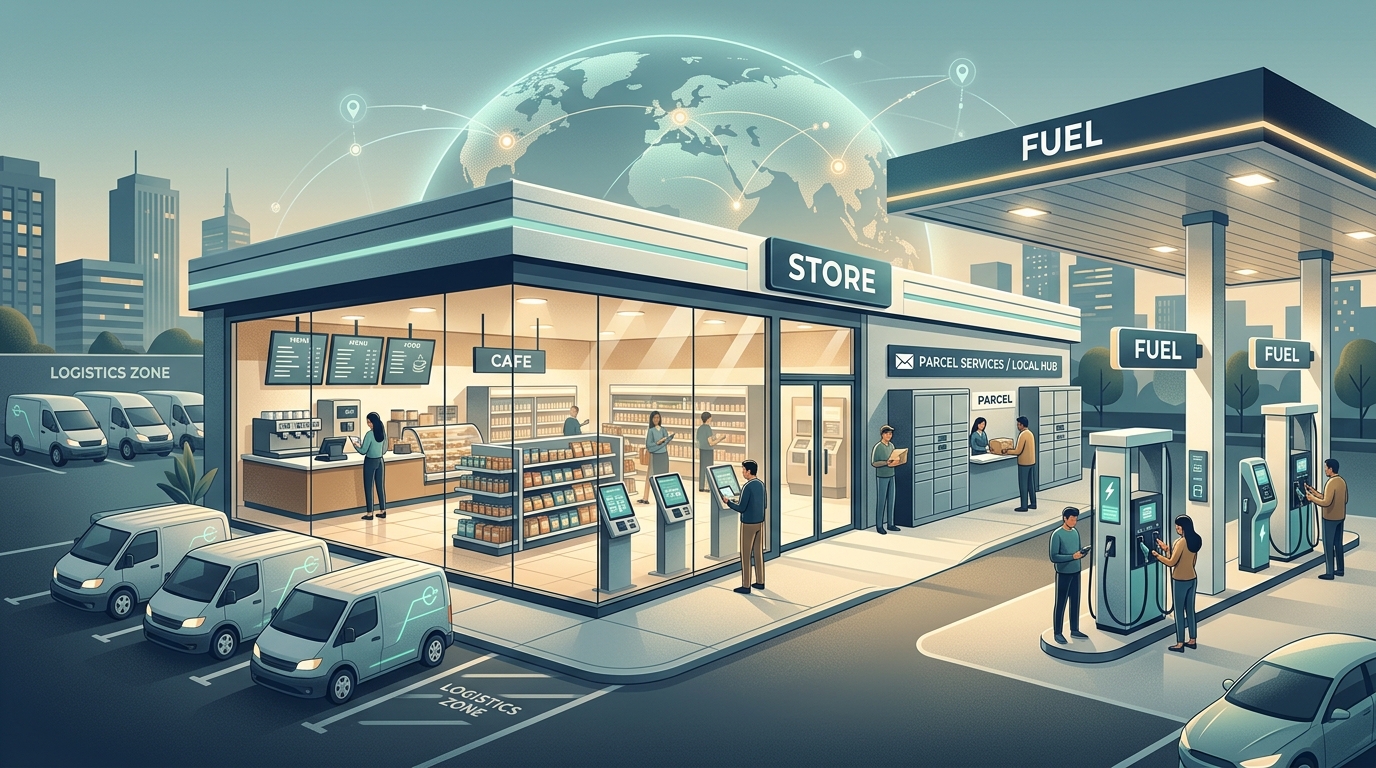
Under the primary terms of the agreement, all 18,900 CU convenience stores across South Korea will act as parcel drop-off locations for the national postal service, expanding upon a pilot home-collection service operating since May. Furthermore, the partnership allows BGF Retail to evaluate using idle space inside Korea Post's 3,300 national branch locations to launch store-within-a-store CU outlets. BGF Retail CEO Min Seung-bae noted that combining the networks will "create powerful synergy" and establish a regional lifestyle platform. Planned future additions to the service scope include international parcel drop-off capabilities through Korea Post.
Analysis and Operational Hypotheses
*Analysis:* When assessing store footprint growth against operational limits, retailers face tradeoffs between expanding physical access points and managing operational complexity. Introducing secondary services—such as parcel handling or enlarged foodservice programs—can increase customer traffic, but without simplified store workflows, extra services risk straining staff productivity.
*Hypothesis 1 (In-Store Logistics and Foot Traffic):* Converting convenience retail locations into national postal drop-off points increases overall foot traffic and raises secondary basket purchase rates. *Proposed Test:* Measure total daily store visits and non-postal point-of-sale transaction volume across a trial group of parcel-enabled sites over 90 days, comparing results against a baseline period and a control group of non-participating stores.
*Hypothesis 2 (Operational Simplification and Labor Efficiency):* Streamlining core store workflows and reducing redundant daily tasks improves store-level labor productivity and operating margins. *Proposed Test:* Introduce a simplified labor workflow protocol in 20 test locations for six months, measuring task completion times, labor hours per unit sold, and store net profit against historical benchmarks.