Forecourt Foodservice Models: Evaluating Automated Kiosks and Regional Customization
Convenience store operators are expanding foodservice contributions through automated robotic kiosks and customized regional menus. This analysis examines Murphy USA's test of automated White Castle burger kiosks and St. Romain Oil Company's growth strategy where foodservice now contributes equally to profitability alongside fuel and merchandise.
Editorial illustration
Forecourt Foodservice Evolution: Automated Kiosks and Regional Customization
The convenience forecourt and quick-service restaurant (QSR) landscape is undergoing structural changes as operators balance physical footprint constraints, labor availability, and shifting consumer demand. Recent developments from national chains and regional independents highlight two distinct strategic paths in foodservice delivery: autonomous automated kiosks and custom localized fresh food programs.
Automated Robotic Kiosks: Automated Retail Technologies & Murphy USA
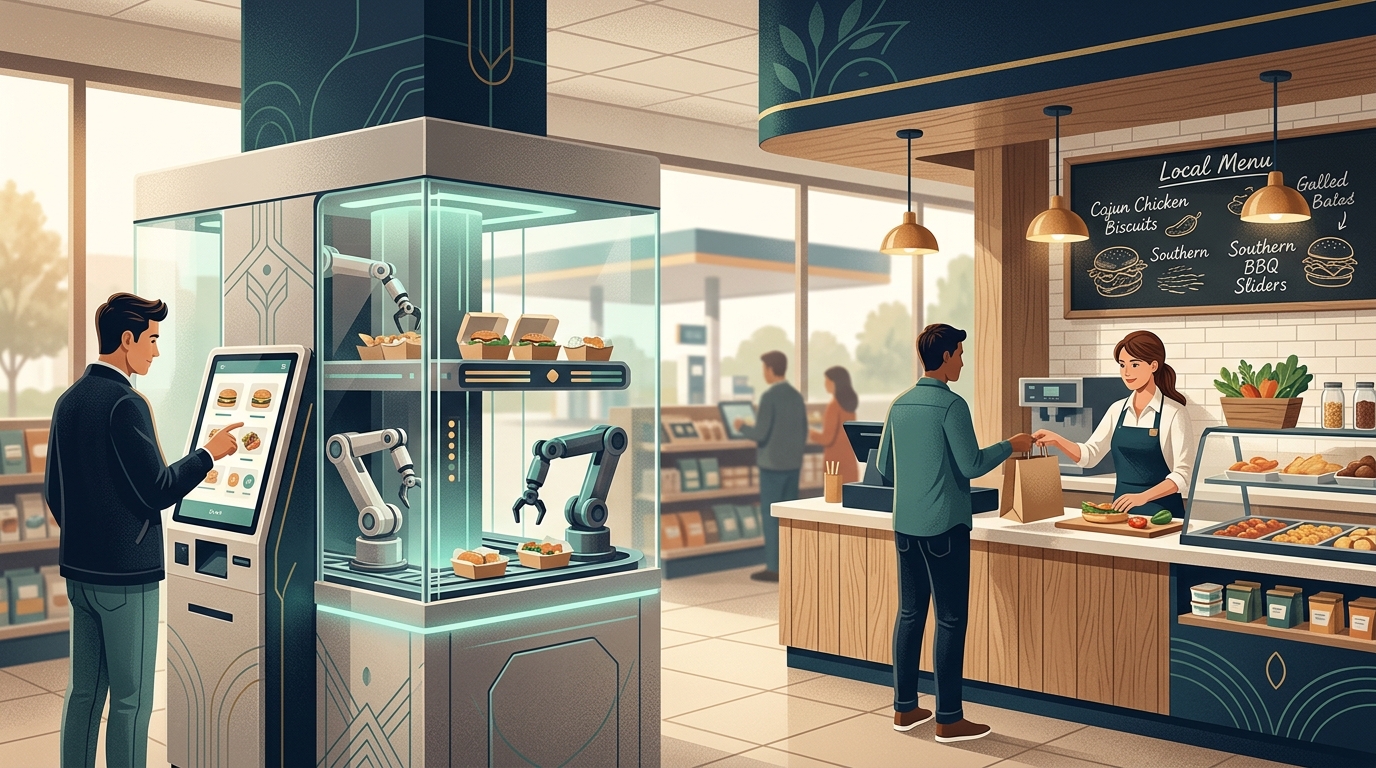
Automated foodservice hardware is entering the convenience retail forecourt through targeted deployments. El Dorado, Arkansas-based Murphy USA announced plans in August to offer White Castle burgers through autonomous kiosks at select larger-format convenience stores. The underlying hardware platform was developed by Automated Retail Technologies, which has also deployed similar robotic units at Boston Logan International Airport (CSP Daily News).
In these installations, food preparation and dispensing occur inside an automated unit rather than being prepared by human kitchen staff. By shifting hot food prep into an automated system, operators aim to maintain branded QSR menu items within forecourt layouts without expanding kitchen space.
Analysis: Hypotheses and Operational Evaluation
*Note: The following section reflects analytical framing and hypothesis development distinct from reported source facts.*
Deploying robotic kiosks for hot QSR offerings presents several operational hypotheses for convenience store operators:
- Hypothesis 1: Labor Reallocation. Automated preparation may reduce dedicated foodservice labor hours during off-peak and overnight shifts.
- *Proposed Test:* Measure labor hours allocated to food assembly over a 90-day baseline before installation against post-installation shift logs across comparable store formats, tracking total labor cost per transaction.
- Hypothesis 2: Footprint Efficiency. Modular robotic units may generate higher gross margin dollars per square foot compared to conventional hot-holding displays.
- *Proposed Test:* Calculate net margin contribution per square foot occupied by the kiosk relative to standard grab-and-go warming cabinets across a 6-month trial period.
- Hypothesis 3: Quality Consistency. Automated temperature controls and cook times may improve product consistency and reduce shrink from expired food.
- *Proposed Test:* Audit food waste logs and conduct standardized temperature and texture scoring daily across automated units versus manual warming wells.
Regional Independent Strategy: St. Romain Oil Company & Y-Not Stop
While national chains test automated kiosks, regional operators demonstrate how tailored foodservice can become a primary revenue driver. Annie Gauthier, CFO and co-CEO of St. Romain Oil Company and current NACS chair (installed in October 2025 at the NACS Show in Chicago), manages the 16-store Y-Not Stop chain based in Mansura, Louisiana (MobilityPlaza).
St. Romain Oil Company, founded in 1970 as a third-generation family business, has seen a fundamental shift in revenue mix. Gauthier noted that 20 years ago foodservice accounted for approximately 10% of total contribution. Today, foodservice generates an equal share of company profitability alongside fuel and convenience merchandise.
Gauthier attributes this growth to understanding specific rural trade areas rather than strictly following national chain templates. For independent operators, regional alignment and focused menu execution offer a viable path to equalizing foodservice profitability with fuel sales.
Key Operational Considerations for Forecourt Operators
Operators evaluating foodservice expansion strategies should consider the following comparative factors:
- Format Eligibility and Location Scale: Murphy USA's deployment targets larger-format stores, indicating that automated kiosks require minimum foot traffic thresholds and adequate power and footprint capacity to justify capital costs.
- Brand Leverage vs. Proprietary Menus: Partnering with established QSR brands like White Castle provides immediate brand recognition, whereas proprietary programs require long-term culinary development and localized marketing.
- Capital Investment vs. Margin Distribution: Autonomous kiosks represent upfront technology investments with low direct labor, while traditional fresh food programs demand ongoing labor management but provide full menu ownership and higher gross margin flexibility.