Fast-Charging Network Expansion: Navigating Port Density Trends and European Permitting Rules
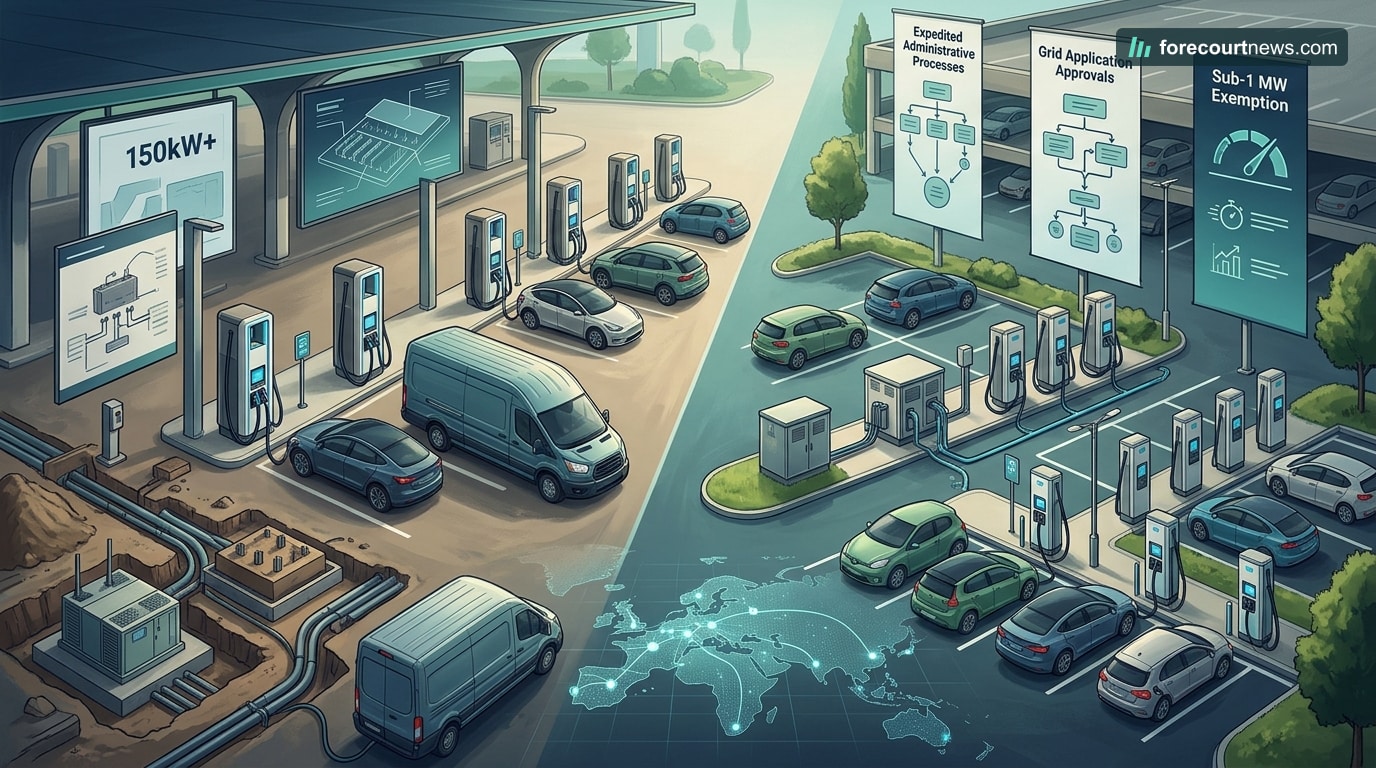
Data from Q3 2026 shows U.S. fast charging expanding toward higher-power dispensers and larger site footprints, while the European Union establishes a provisional framework to expedite grid interconnections and exempt sub-1 MW installations from administrative permits.
Editorial illustration
U.S. Network Metrics: Port Scale and Ultra-High-Power Deployments
Data from the Transportation Energy Institute (TEI) Q3 2026 EV Fast Charging Industry Pulse Check reveals continued growth in public charging activity across the United States. According to the Transportation Energy Institute, total public fast-charging sessions reached 50.3 million during the third quarter, representing a 26% year-over-year increase. Across the country, the fast-charging network expanded to 80,547 ports located at 14,565 stations, reflecting annual growth rates of 25% for ports and 19% for station sites.
Network operators are concentrating capital into larger physical hubs. Newly deployed charging stations averaged 6.2 ports per location, expanding from 5.3 ports per site in the prior year. Power ratings for newly installed hardware also increased: 36% of newly deployed DC fast chargers in Q3 were rated at 400 kW or higher, up from 27.5% in the second quarter.
Operational reliability remained level across the country. TEI reported a national first-attempt charging success rate of 94.4%, slightly shifted from 94.5% recorded in Q2. Pricing dynamics showed modest movement alongside retail electricity trends. The average advertised non-member pricing held steady at $0.545 per kilowatt-hour (kWh), marking a 2.8% increase year-over-year, which TEI noted remained below headline Consumer Price Index (CPI) inflation over that timeframe. Meanwhile, time-of-use pricing adoption continued to broaden: 26% of U.S. charging stations offered variable time-of-use rates, up from 19% in the fourth quarter of 2025. TEI Executive Director John Eichberger observed that the shift toward ultra-high-power installations reflects wider market confidence in public charging infrastructure.
European Regulatory Framework: Expedited Timelines and Permit Exemptions
In Europe, network deployment is intersecting with new statutory deadlines intended to streamline site construction. As reported by MobilityPlaza, the European Parliament and the Council reached a provisional agreement on measures originating from the European Commission’s December 2025 grids package.
Under the provisional agreement, authorities must process and grant permits for stand-alone EV charging stations and battery storage facilities within a strict six-month window. Furthermore, installations with an aggregate capacity of up to 1 MW mounted on artificial structures—such as forecourt parking canopies, commercial rooftops, or existing paved lots—will be completely exempt from administrative permitting requirements. For small-scale solar generation, battery storage, and recharging facilities, the permit-exempt threshold will increase from 100 kW to 200 kW.
Grid interconnection queues are also addressed in the provisional text. Distribution and transmission operators must grant grid connections within three months, extendable to six months only if duly justified. To prevent fragmented local procedures, European Union member states will be required to establish a centralized digital portal covering all permitting stages. The agreement incorporates a legal presumption that renewable energy and grid reinforcement projects serve an overriding public interest, which authorities may only override under specific exceptions such as cultural heritage or defence. Projects exceeding 7 MW will also face mandatory economic benefit sharing with host communities.
Operators should note the procedural status of the European rules: the agreement remains provisional. It requires formal approval from Parliament’s Industry, Research and Energy (ITRE) committee, confirmation votes by the full Parliament and Council, and publication in the Official Journal before entering into legal force.
Analysis: Site Capacity Planning, Tariff Models, and Commercial Trade-Offs
These parallel developments in North America and Europe illustrate how operational constraints are shifting from initial footprint verification to electrical envelope design and tariff optimization.
In Europe, the pending exemption from administrative permits for installations under 1 MW on artificial structures provides a tangible operational incentive. Forecourt operators planning retrofits must determine whether to size their electrical connection strictly beneath the 1 MW ceiling or commit to full utility permitting for larger hub formats. For instance, installing two 400 kW dual-port dispensers creates an 800 kW nameplate load, comfortably fitting inside the permit-exempt envelope without triggering standard municipal construction approvals. However, expanding to three or four 400 kW dispensers pushes total capacity past 1 MW, forfeiting the streamlined track. Operators could test whether deploying dynamic power-sharing hardware allows them to install four physical dispensers while capping total grid import at 990 kW, potentially qualifying for the permitting exemption while preserving multi-vehicle throughput.
In the U.S., the jump to 36% of new chargers operating at 400 kW or higher presents distinct demand-charge considerations. Because average retail pricing rose only 2.8% to $0.545/kWh, margins risk compression if utility demand charges spike during uncoordinated high-draw charging sessions. The expansion of time-of-use tariffs—now present at 26% of stations—suggests operators are attempting to manage these peaks. A forecourt business can test whether offering off-peak retail discounts shifts daytime fleet or consumer dwell times, measuring whether lower per-kWh rates during grid troughs offset peak demand penalties. Additionally, operators should track whether 400 kW charging alters c-store foot traffic: shorter plug-in intervals may reduce dwell time inside the store, requiring retailers to re-evaluate grab-and-go placement and rapid transaction counters.